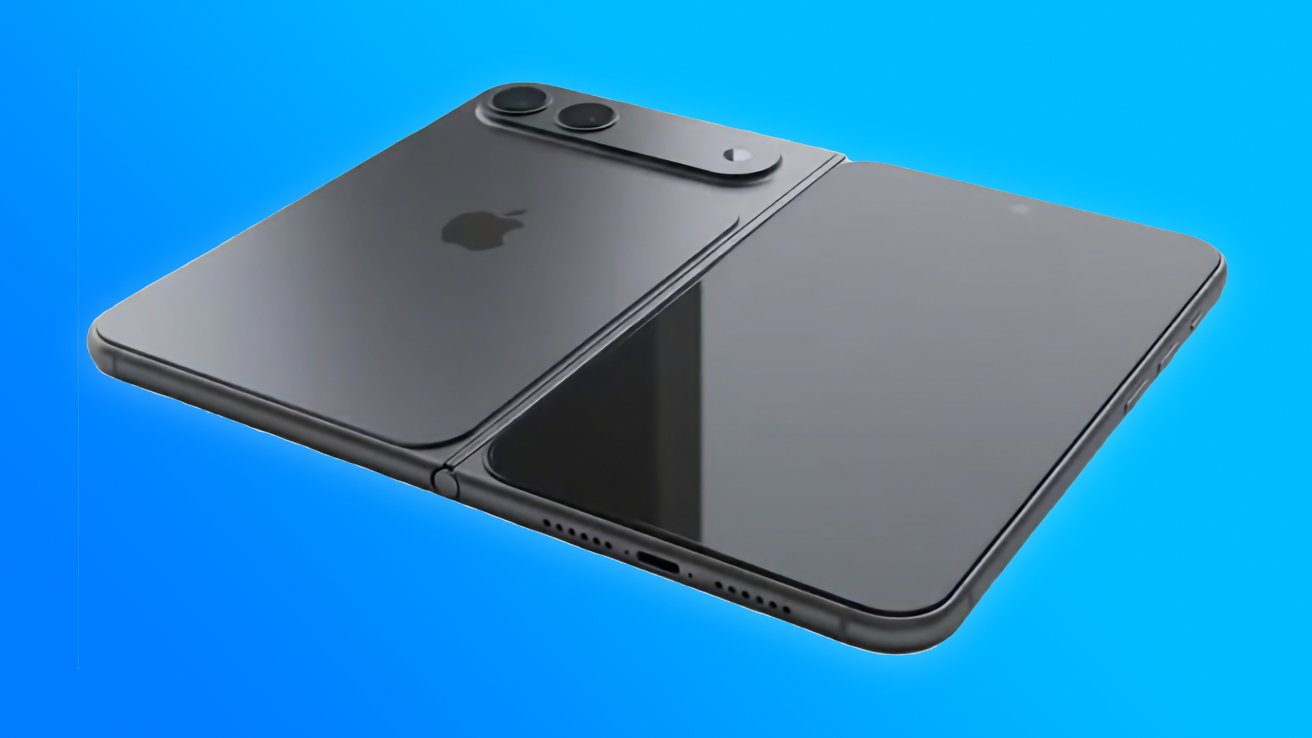
The iPhone Fold could be a lot wider open than expected, with a schematic of unknown provenance depicting the device shaped more like a paperback when folded.
The iPhone Fold is a long-awaited addition to the Apple smartphone roster, and could make its way into consumer hands in late 2026. However, the final product may end up feeling a little wider than usual.
Supposed CAD drawings for the model provided to accessory makers, converted into renders and published by iPhone-Ticker.de, show a version of the iPhone Fold. That version may look a little odd due to the dimensions of the model.
The render is for the fully-opened device, positioned face down so the smaller external display and the rear are shown to the viewer. The CAD file gives the front and rear views of the opened device, along with a side-on view when it is in its folded-up state.
Each half of the iPhone Fold is made up of a unit measuring 83.8mm wide (3.3 inches) and 120.6mm (4.75 inches) tall. There's also a small 1.8mm section of the hinge popping out the side when closed up.
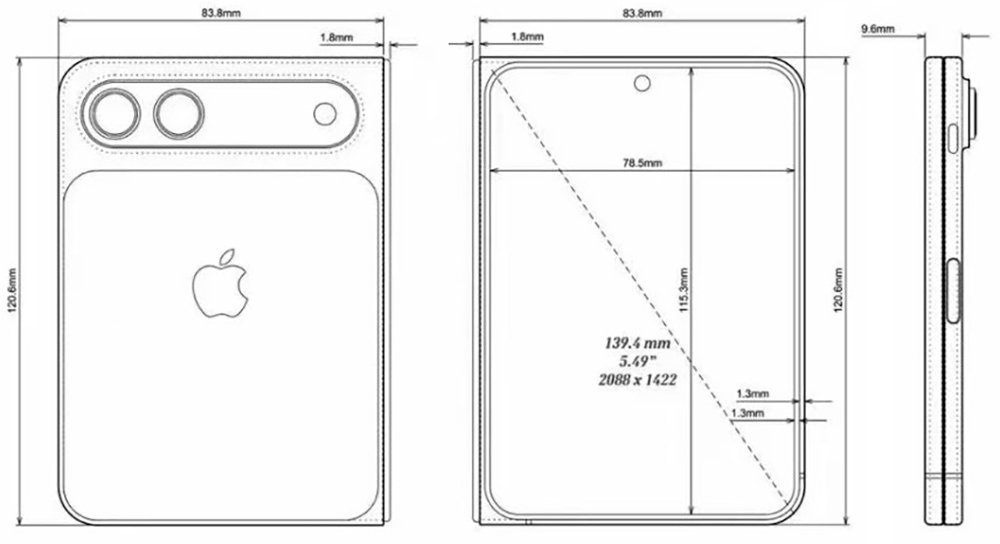
A CAD drawing of what could be the iPhone Fold - Image Credit: iphone-ticker.de
These main dimensions of each half are somewhat shorter and wider than iPhone users may expect. For reference, the iPhone Air is 2.94 inches wide and 6.15 inches tall.
The external display is depicted as 5.49 inches diagonally, which lines up to the rumors of a 5.5-inch version being used. The claimed resolution of 2,088 by 1,422 is also reflective of its differing aspect ratio.
Wider than you'd think
Opened up, the model becomes a lot more like an iPad mini in size, but not quite. At 7.76 inches, it's a little short of the 8.3-inch iPad mini overall, but also meets previous rumors on the size.
The screen is also said to have a resolution of 2,713 by 1,920 pixels, which would be higher than the current iPad mini's 2,266 by 1,488.
It seems that the design of the iPhone Fold, if the CAD is accurate, was made to focus on making the opened-up internal display be reasonably close to the iPad in terms of aspect ratio. This would explain the fairly squat appearance of the device when folded up.
While previous rumors proposed that it could be similar to two iPhones next to each other, that would result in a much squarer internal display than the CAD image proposes.
Thickness and the bump
When it comes to the thickness when folded, the CAD shows the main body as being just 9.6mm thick, ignoring the camera bump. However, when laid flat, it is supposedly 4.8mm thick, which also ties into previous rumors.
For comparison, the iPhone Fold is 5.64mm thick, while the M4 iPad Pro is 5.1mm.
Though the report doesn't say why, the variance in thickness between flat and folded states could be accounted for by the use of the hinge. Apple has an intention to avoid the common folding display issue of a crease developing in the middle, and one way to fix that is to manage how it folds so it doesn't generate stress.
Not folding the display completely on itself and leaving a small curvature at that point puts less stress on the display panel, preserving it for longer.
One other key part of the design is that it continues to use the camera plateau design that the iPhone Air uses. This design trick allowed the iPhone Air to be so thin, by pushing more of the processing hardware into that bump.
In the schematic, the plateau reappears. It instead has a pair of cameras, not just one. This is contrary to most recent rumors that suggest only a single camera will make the first shipping iPhone Fold.
There's also a pair of selfie cameras, one in each display, but with the internal display version offset to one side. It is unclear whether this would be a Dynamic Island design or some other option Apple has yet to implement in its models.
As for the rest of the design, the render depicts speaker holes and USB-C on one half of the unit, but not the other. For a premium iPad-like device, this may not be right, as some form of stereo sound would be arguably expected here.
While the render seems plausible, it is worth remembering that it is an image that probably was not sourced from Apple directly. It's likely that it has been made and leaked by an accessory producer, preparing upcoming products for the model.
Apple does not historically provide information to any case manufacturer that asks, and limits information to a scant few, especially this far ahead of launch.
Nobody outside of Apple will truly know the actual design until it gets formally presented to the world. Leaks closer to the time may become more accurate, but they aren't guaranteed to be correct.