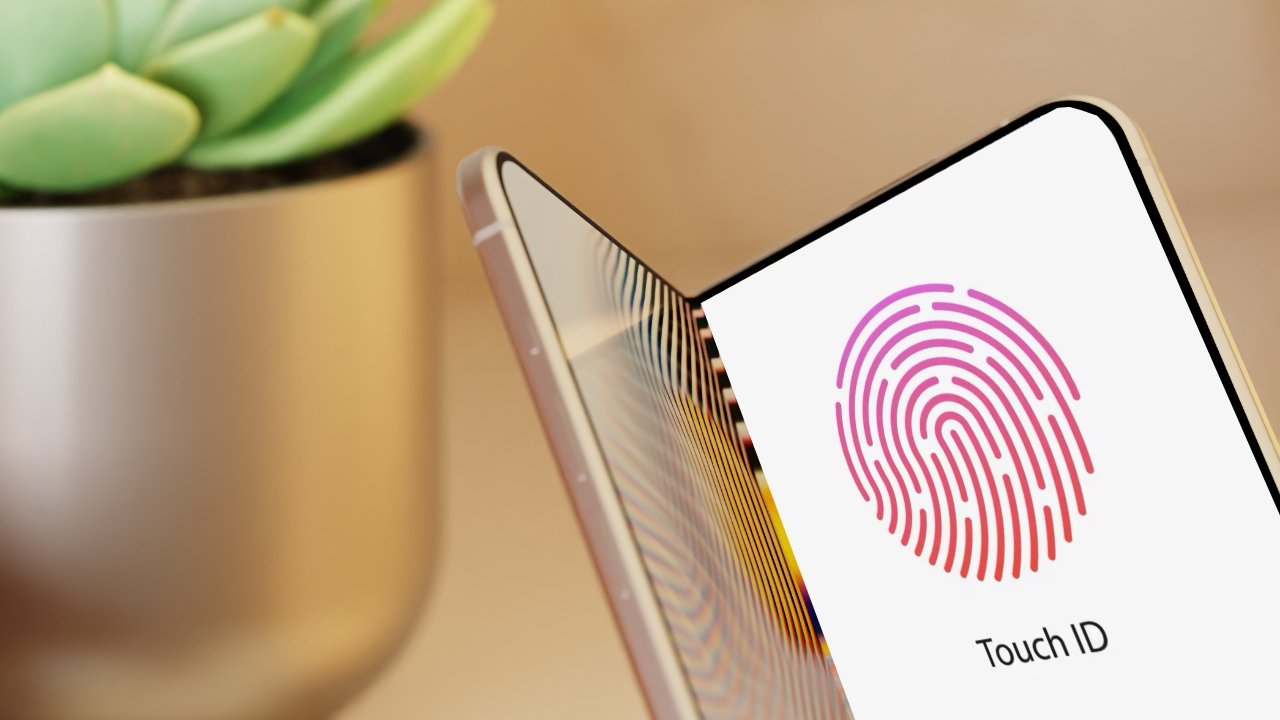
Instead of a Home or a side-button, Apple is researching how best to implement under-screen fingerprint sensors, not just for mobile devices like iPhone Fold and iPad, but potentially also the Mac.
The expected iPhone Fold has been said to be too thin for Face ID, so it must use Touch ID. Despite some claims of it getting Touch ID sensor under the screen, most reports predict it will be part of the side button, as was introduced with the iPad Air 4 back in 2020.
Now a newly-granted patent, however, appears to show that Apple is at least researching under-display Touch ID. The patent hides the fact a little, being called just "Display with localized brightness adjustment capabilities."
But that brightness adjustment is not something like True Tone, or anything altering light levels based on your environment. Instead, it is about being able to have certain pixels generate a camera-like flash specifically for fingerprint detection.
"The device may have an array of components such as an array of light sensors for capturing fingerprints of a user through an array of corresponding transparent windows in the display," says Apple. "[The] control circuitry can direct the display to illuminate a subset of the pixels, thereby illuminating the user's finger and causing reflected light from the finger to illuminate the array of light sensors for a fingerprint capture operation."
This is not the same as the way Photo Booth on the Mac, or the Retina Flash introduced for selfie photos on the iPhone 6s. For those work by turning the whole screen white, if only for an instant, and this new patent explicitly says it's not always for the entire display.
Instead, the intention is for the screen to remain readable and displaying information, even as a portion of it flashes to illuminate a fingerprint being detected. There are mentions of the flash coming from the whole screen, but that's in a segment about where the user's finger can be.
At one point, the patent refers to detecting the user's finger so that the system can direct the screen to illuminate that portion, or all of it. That suggests that the user can place their finger anywhere.
But then alternatively, the patent suggests a configurations in which a light sensor array occupies a portion of a display. Based on the drawings, that refers to an option where there is a specific section of the screen for doing this.
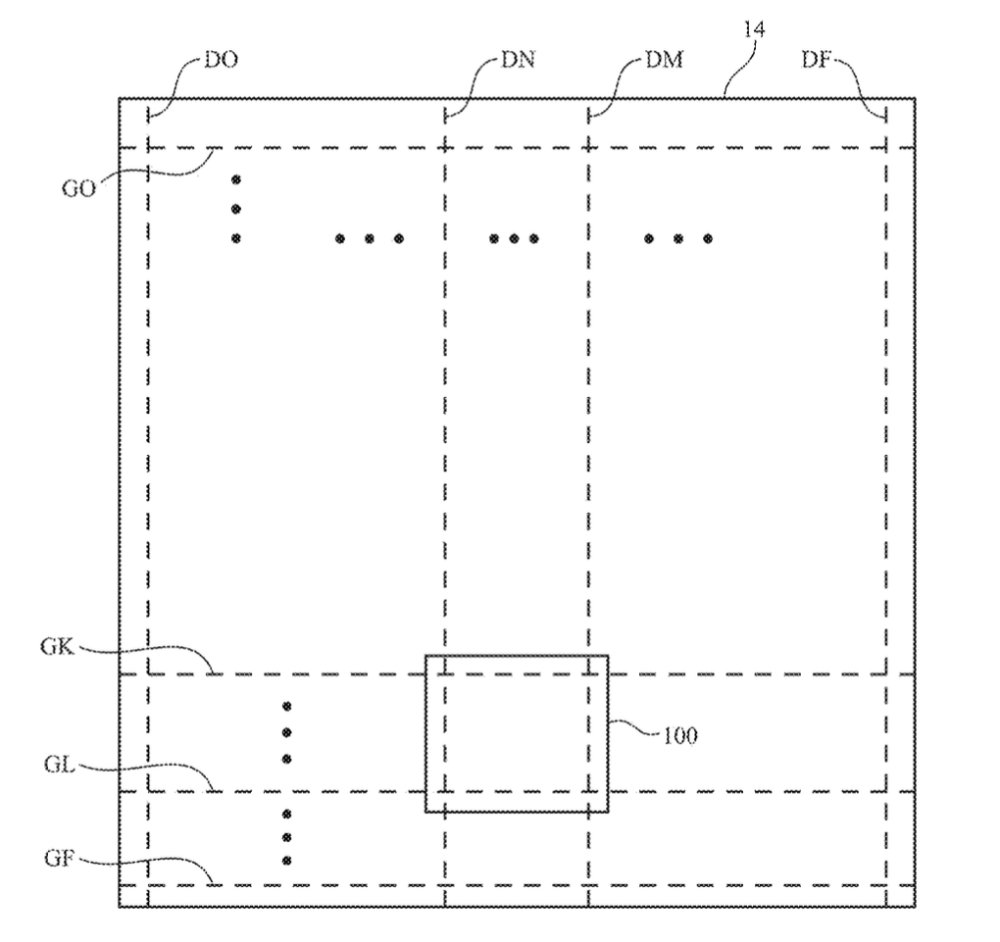
Detail from the patent showing a screen with a specific, marked-off area for fingerprint detection — image credit: Apple
That section would have to be clearly indicated for the user. And Apple also suggests that surrounding pixels that overlap the sensor could illuminate too.
At no point does the patent refer solely to an iPhone or a Mac. Instead, it falls back on the regular patent approach of saying it could be for everything from an iPad to "a desktop computer, a display, a cellular telephone, a media player," and so on.
-The patent's illustrations, too, are chiefly circuitry and timing diagrams that could apply to anything — or every Apple display.
iPhone Fold and Mac
The fact that the iPhone Fold is believed to be reliant on Touch ID rather than Face ID, suggests that this patent's technology is really for the iPhone. The patent filing may even be the reason that leakers have disagreed over whether the iPhone Fold will or won't get under-display Touch ID.
If it is the iPhone Fold, though, there is no way to even guess whether it's for the first generation. It may well even be a direction that Apple subsequently decided not to pursue for some reason.
But then if this really is for a device that does not have the room for a Face ID component, then that equally describes the whole Mac range.
At present, all MacBook Pro and MacBook Air models have a Touch ID sensor on their built-in keyboard. Apple also has keyboards with Touch ID for desktop Macs.
So neither the Mac nor the presumed iPhone Fold are exactly wanting for Touch ID. But the patent was applied for in January 2025, so it's not that this was an early idea that was supplanted by the Mac keyboards or the iPad's side-button biometrics.
Separately, though, in July 2025, Apple applied for a patent that describes a Face ID system for Macs.