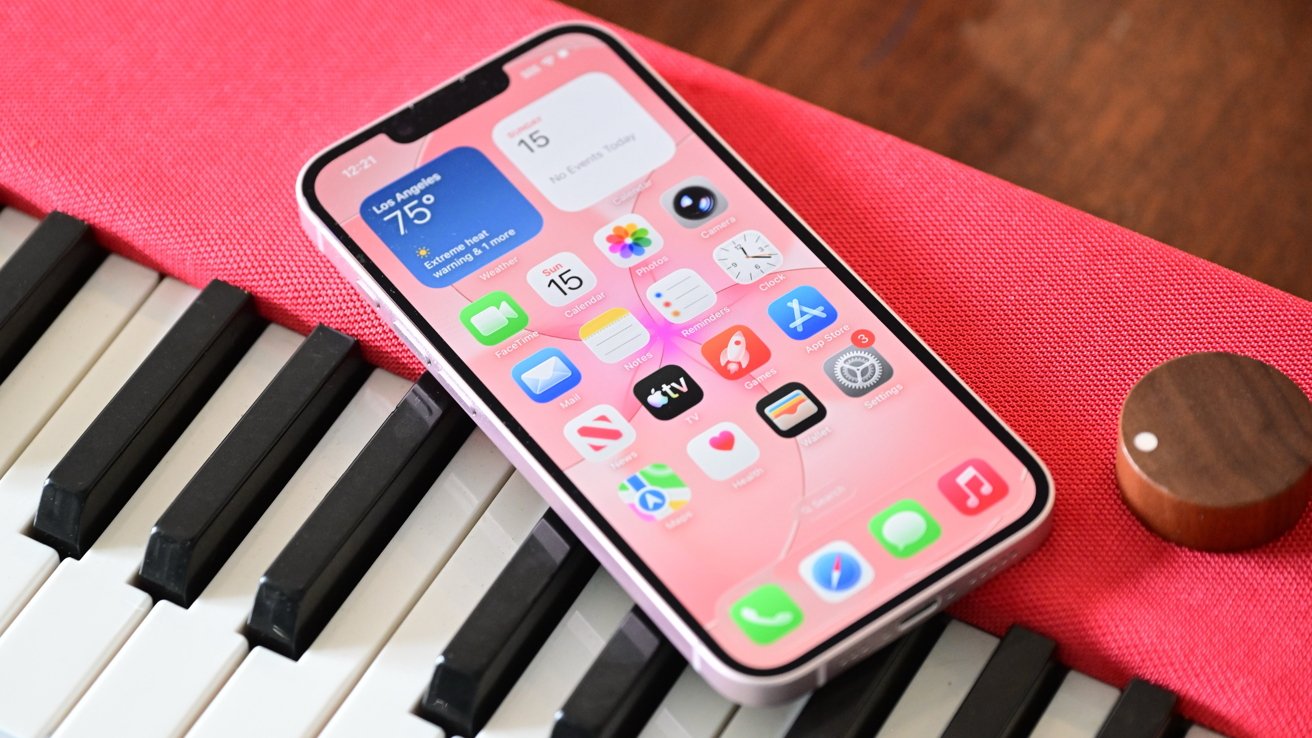
The iPhone 17e kicks out the iPhone 16e and improves Apple's offering for the budget-conscious consumer, but it's still not quite a bargain as the original iPhone SE was.
The 2025 launch of the iPhone 16e was a big change for Apple's iPhone lineup at the value end of the scale. While Apple stayed with the budget concept as a whole, the iPhone 16e wasn't quite the same scale as how the iPhone SE started out, and finished.
For a price difference of $170 between the iPhone SE 3 and the then-new iPhone 16e, Apple had to ensure there was a lot to offer anyone buying it. This was doubly important, since the standard iPhone 16 experience was barely $200 away, and every iPhone 16e downside made the upgrade more attractive.
One year after that transition, and the iPhone 17e replaces the iPhone 16e in the same place in the catalog. While it's not as much of a major jump in specifications as last time versus what it replaced, Apple has still made some changes to justify the new upgrade.
iPhone 17e review: A familiar appearance
The idea of the iPhone SE was to reuse previous design ideas and components, making as inexpensive a model as possible for consumers to buy. The iPhone followed this idea, with many elements pulled from more recent releases.
Under the SE banner, this resulted in relatively few updates with years between releases. By shifting to what now appears to be an annual refresh schedule, Apple cannot make as many major design changes as it wants.
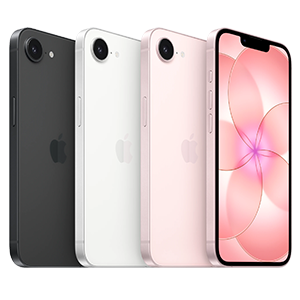
iPhone 17e
This is something that Apple's other products also endure, with periodic big overhauls between multiple years of similar designs. The changes are less visible from the outside, but are more internal in nature.
That is precisely the case here with the iPhone 17e. It's a glass sandwich with an aluminum chassis, with a full-screen display and IP68 dust and water resistance.
At 5.78 inches tall and 2.82 inches wide, it's the same size as the iPhone 16e. Even the depth of 0.31 inches is identical, though it is ever so marginally heavier at 5.96 ounces.
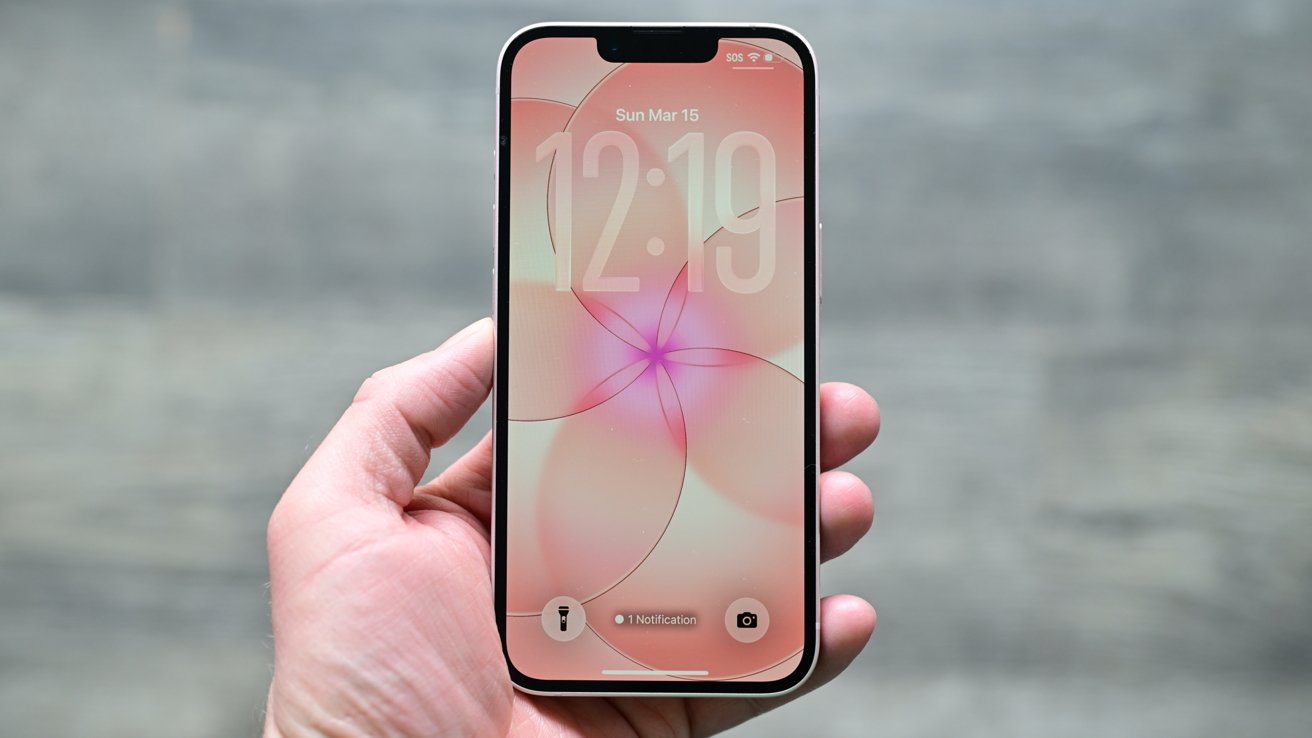
iPhone 17e review: The external dimensions aren't changed from the iPhone 16e.
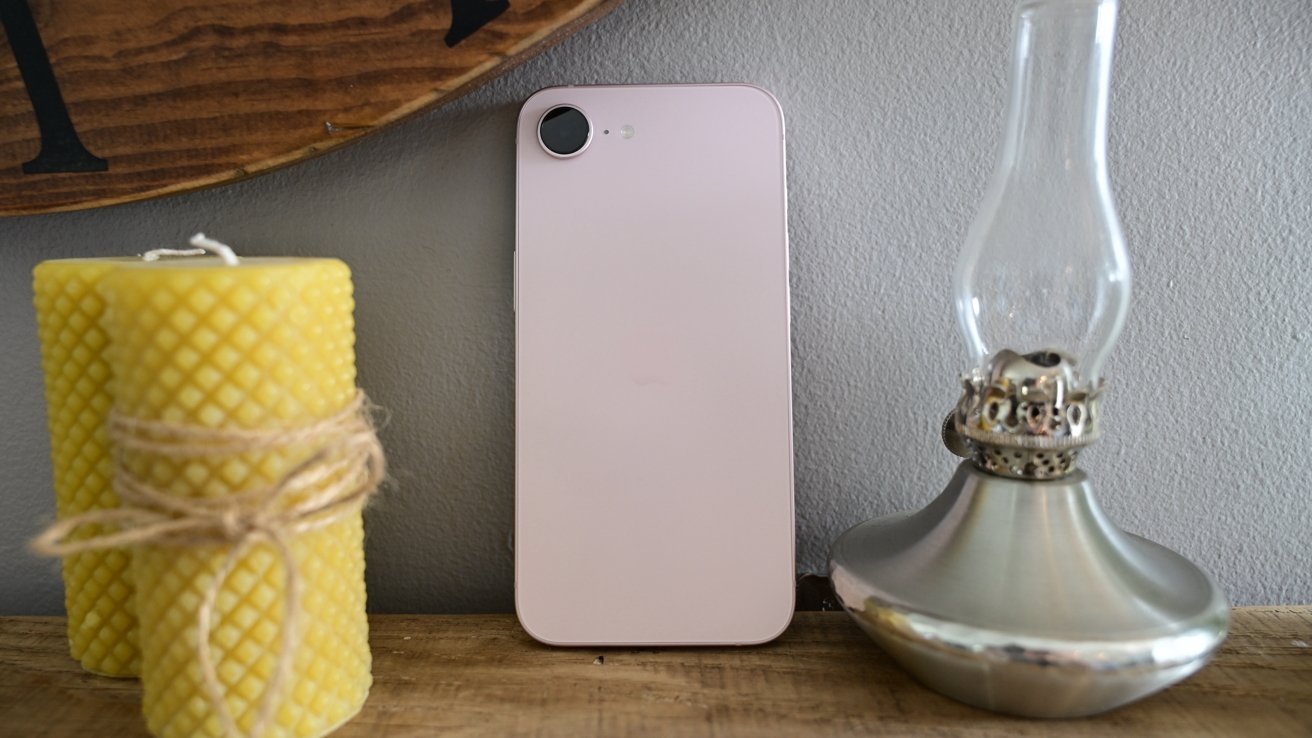
It is a design that certainly screams iPhone, with flat metal edges and the Apple logo around the back. Even the rear is unchanged, with the same round camera in the corner evoking the iPhone XR.
The button selection is also unchanged, with the volume controls joined by the Action Button for one more round. Camera Control hasn't arrived with this update, but we're not expecting that to arrive in the iPhone "e" lineup any time soon.
Even the base has the returning USB-C port. And as before, it's running at USB 2.0 speeds instead of USB 3.
The design itself was solid in 2025, and it still is now. Apple didn't really need to make any design changes for the model, since it was good in the first place.
That said, there's still a bit of a change to the better. That Ceramic Shield-protected front glass has been updated to Ceramic Shield 2, making it three times better at resisting scratches according to the company.
You also have a little bit more personalization than before too, but not by much. Black and White colorways are still here, but so is a new Soft Pink.
iPhone 17e review: Same screen
There are no changes in the screen year-over-year. The iPhone 17e has the same 6.1-inch OLED Super Retina XDR display as the iPhone 16e.
That means it has an identical resolution of 2,532 by 1,170, which gives it a great pixel density of 460 pixels per inch. It's unchanged, but again, it's good in its own right.
Other spec lines are almost stoic in being static. A 2 million to 1 contrast ratio is great, and so is Wide Color (P3) support and True Tone, but we saw all this in 2025 too.
Haptic Touch is back once again if you want a couple of personalized software buttons on the screen.
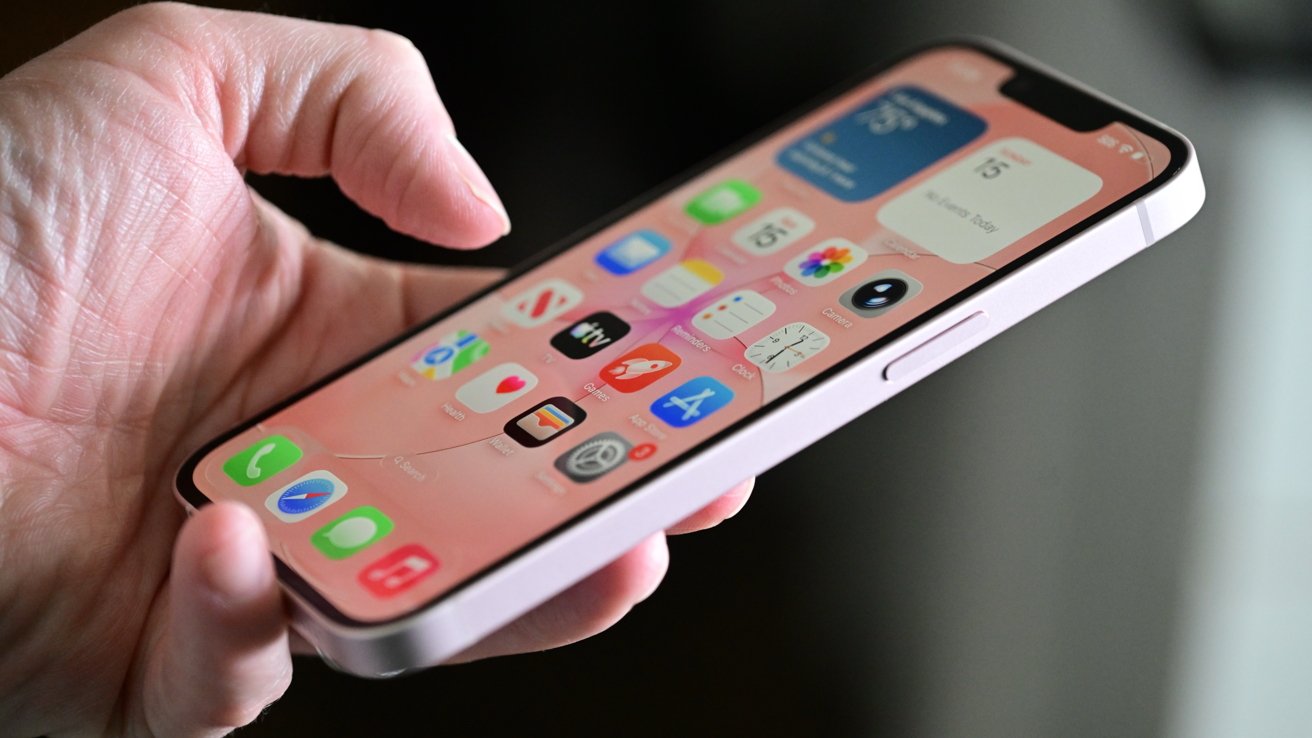
iPhone 17e review: The display is very familiar to us.
The brightness of 800 nits for typical content and 1,200 nits for peak HDR content are copied from last time.
Despite the rumors, Dynamic Island did not come to the iPhone 17e.
With so many similarities, you could be forgiven to think that it's just using the same panel as in the iPhone 16e. It probably is.
But, in a budget device like this, there's little to complain about here. It is suitable for task, which is about the best thing we can say about it.
iPhone 17e review: An AI performance bump
The hallmark of a spec-bump update is that Apple changes the chip running the show, maybe a few other internal components, and that's about it. That's precisely what's been delivered with the iPhone 17e.
The A18 has expectedly been replaced by the A19, bringing it in line with the current iPhone 17 generation. At least, in most respects.
The A19 here is the same CPU as the A19 in the iPhone 17, including two performance cores and four efficiency cores. Performance is comparable across models here.
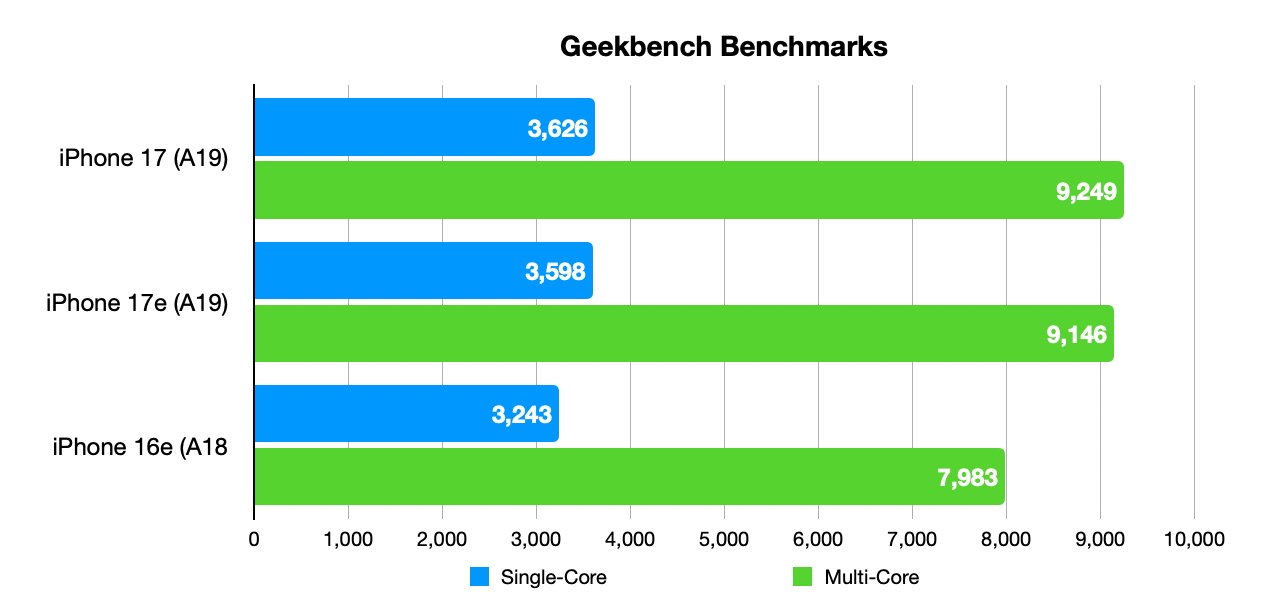
Geekbench single-core and multi-core tests for the iPhone 17, iPhone 17e, and iPhone 16e
At 3,598 for single-core and 9,146 for multi-core tests under Geekbench, there's little material difference in the CPU between the iPhone 17e and the marginally higher-scoring iPhone 17 CPU. There's a considerable generational jump from the iPhone 16e, but that is to be expected.
Artificial YouTube tests bouncing between applications have very little bearing on real-world use. This CPU doesn't matter that much in everyday use of the phone compared to the iPhone 17, or for that matter, even the iPhone 16e.
Just like the iPhone 16e, the iPhone 17e A19 GPU differs, which has a bit more of an impact for gamers, and almost none for the more casual user. There's a four-core GPU, one less than the A19 in the iPhone 17. This does cut a bit into its graphical performance.
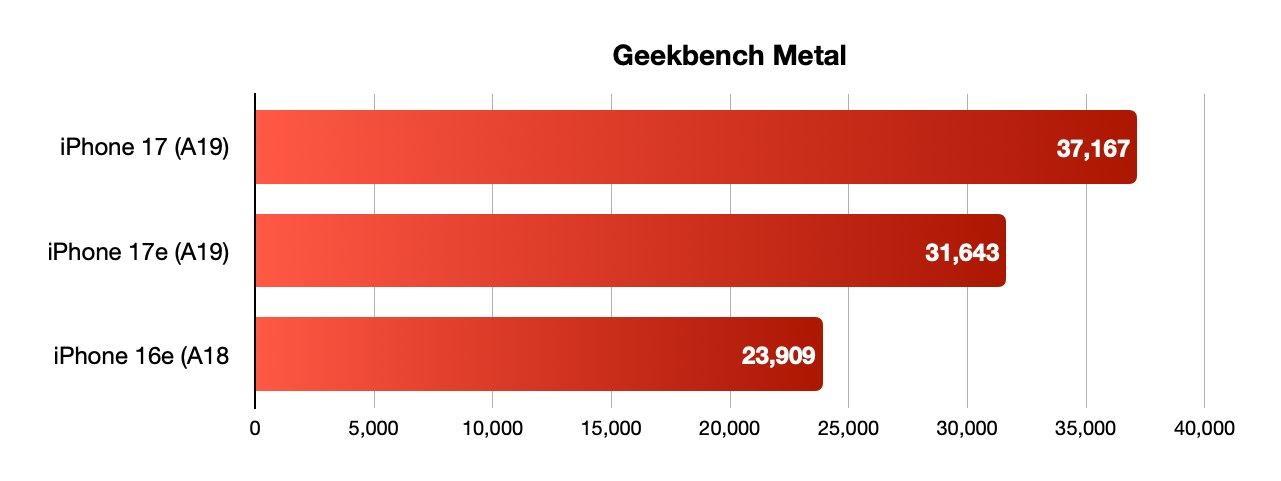
Geekbench Metal tests for the iPhone 17, iPhone 17e, and iPhone 16e
We knew that it wouldn't be as good graphically versus the iPhone 17 because core counts matter. The benchmarks bear this out, with the iPhone 17e's 31,000 being a good chunk below the 37,000 of the iPhone 17, while still being an improvement on the iPhone 16e.
But, against the AI processing capabilities of the iPhone 16e, the Neural Accelerators will be a big factor here.
This GPU does have the same added benefit as others of its generation, in that each GPU core has a Neural Accelerator. This element is designed to help improve the machine learning performance of the iPhone, in addition to the existing 16-core Neural Engine.
This may not seem like much, but it's really a big deal when it comes to processing tasks.
With Apple pushing forward with Apple Intelligence, there's a lot more potential for onboard processing in this generation, and for Apple to maximize its benefits.
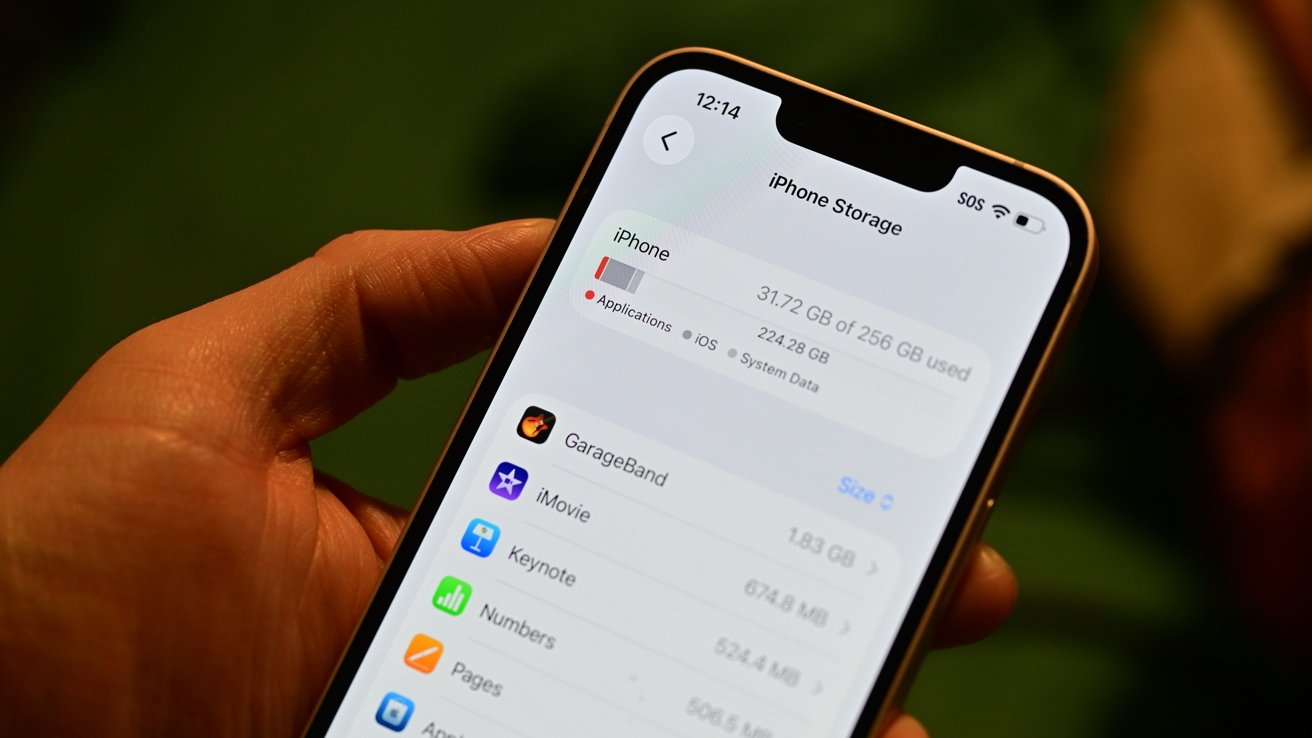
iPhone 17e review: The base configuration now has double the storage capacity.
Storage is also an area that has seen a rare improvement, too. While the previous model started with 128GB of storage, Apple is instead starting at 256GB without raising the price.
This is a massive change, especially for people who have previously tried to get around storage limitations by paying for cloud storage. With more on-device capacity, there's less of a need to have cloud storage in the first place.
iPhone 17e review: Single shooter
Like the display, the camera situation is practically identical to the previous generation. The back has a solitary 48-megapixel camera, which Apple is now marketing as a Fusion camera system.
This is the same "Main" camera as last time, complete with optical image stabilization, True Tone flash, and a 2x "optical zoom options."
For those noticing the weird phrasing Apple is using here when it could've stopped at "optical zoom" and left off "options," it's there for a reason.
Apple doesn't have a normal lens-based zoom or a second rear sensor to handle any optical zoom-in. However, it does have a trick, in that it crops the large 48MP image down to the central area of the shot.
The result is a 12MP image that is of "optical quality," which happens to be a 2x zoom level. It's not your typical 2x digital zoom that conjures up pixels to increase the file resolution, but one that cuts from a bigger overall image to provide a still-adequate crop of a shot.
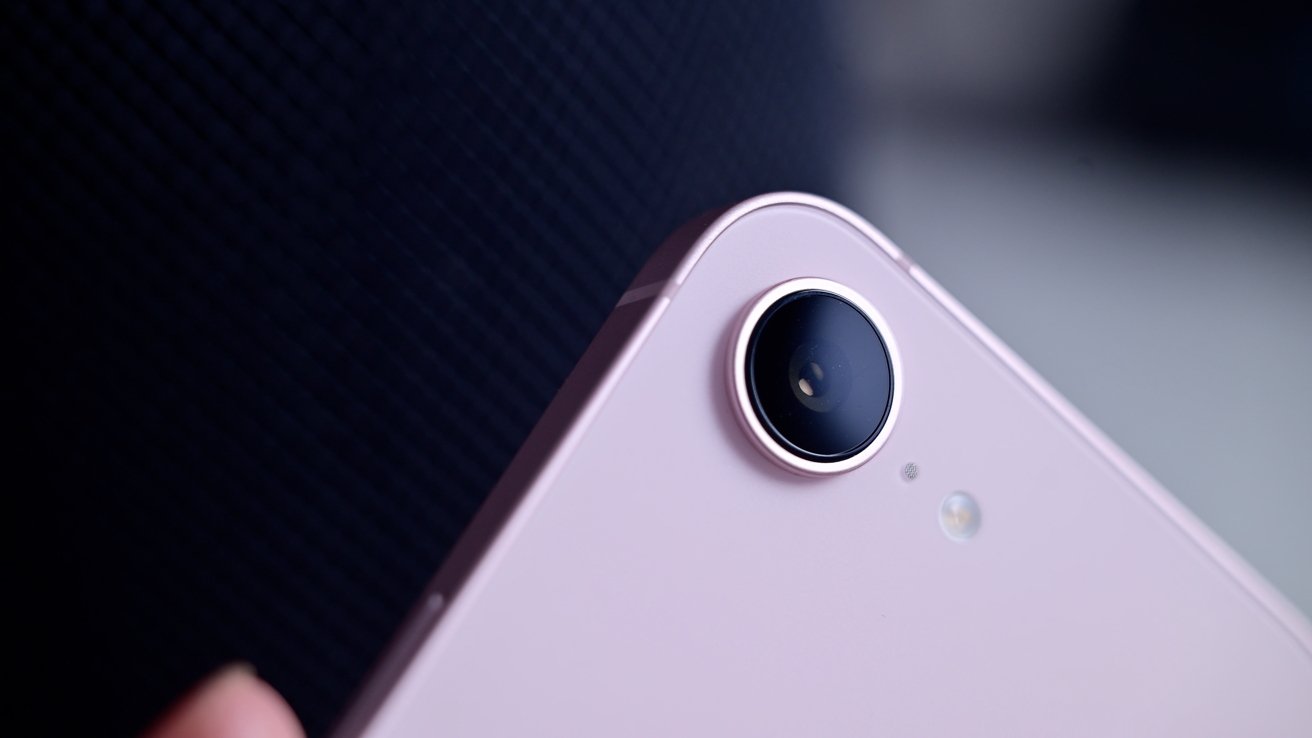
iPhone 17e review: One camera, two "optical" zoom levels.
Apple is still careful enough to bundle in the usual selection of features and functions. Computational photography via Deep Fusion and Photonic Engine are still present, as are things like Smart HDR 5, Night Mode, and Photographic Styles.
Portrait Lighting and Portrait Mode are here too, but this time with "Next generation" portraits with Focus and Depth Control.
The video side of things is unchanged, with it capable of 4K Dolby Vision footage at 60fps and 1080p 240fps Slo-Mo. Spatial Audio with stereo recording and wind noise reduction are also here from last time.
That dreaded notch has the same TrueDepth front camera as last time. That's a 12MP sensor that gets the same computational photography benefits as the rear, Next-gen Portrait mode, Photographic Styles, and Night Mode.
Video at the front also pushes to 4K Dolby Vision at 60fps and 1080p 120fps Slo-Mo shots.
You're not getting any camera updates here, not even the new massive front sensor used in the iPhone 17 that lets you change orientation at will.
Here, you're stuck to the manual method of twisting your wrist between portrait and landscape orientations. It's expected from a budget mobile like this.
iPhone 17e review: Oh joyous MagSafe...
At the face of it, the power situation for the iPhone 17e hasn't changed much from the iPhone 16e. One year later, it's still offering up to 26 hours of local video playback from a single charge, or 21 hours if streamed, by Apple's approximation.
Our testing about bore that out. But, there is no one true workflow, and your mileage may vary. Of course, gaming will hammer the battery life on the phone, and so will keep the brightness up to maximum.
Fast-charging is also here, with a 50% charge possible after just 30 minutes with a 20W adapter.
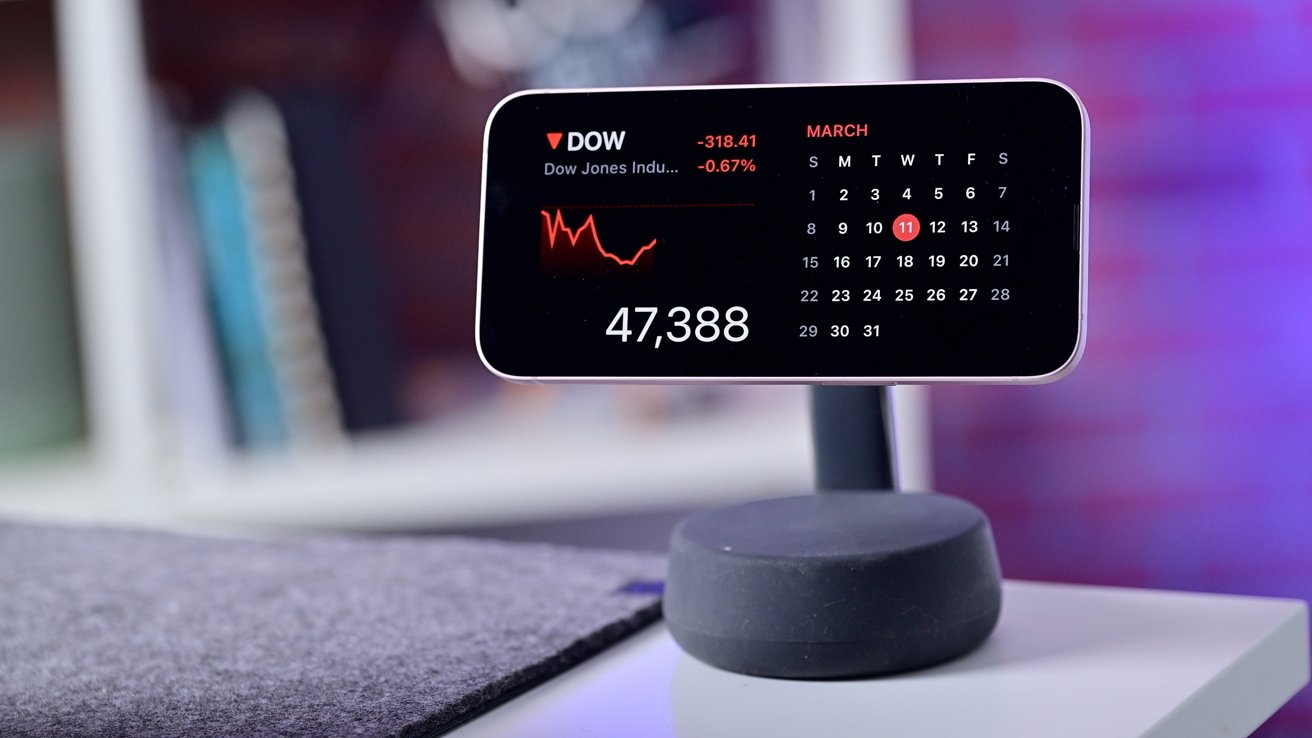
iPhone 17e review: There was wireless charging before, but now there's MagSafe.
However, Apple has taken the time to change one of its biggest shortfalls in the iPhone 16e. It has brought back MagSafe.
The iPhone 16e could do the whole wireless charging thing, but you were limited to Qi at up to 7.5W.
There was no MagSafe built-in. For most, this wasn't a giant deal, as it took about five days for cases that added MagSafe to appear on the market when the iPhone 16e shipped.
That's not necessary anymore.
That upgrade also includes Qi2 charging support. Both Qi2 and MagSafe operate at up to 15W in the iPhone 17e, which isn't as good as the 25W in the iPhone 17, but it's still a win.
Continuing with connectivity, there's still the same Wi-Fi 6 and Bluetooth 5.3 as last time, as well as NFC and a lack of Ultra Wideband support. It's not a massive loss here, as this is still ample enough Wi-Fi and Bluetooth speed for this class of mobile device.
When it comes to cellular, there's still sub-6GHz 5G support, with 4x4 MIMP in effect. So, there's no mmWave in play again, but that is something that is really more appreciated and needed by buyers of the Pro lineup.
And, the US buildout of 5G mmWave is still terrible. It's still a matter of inches if you connect to mmWave networks, and we don't see vast improvement coming soon.
And if you live in remote areas, it will come approximately never.
iPhone 17e review: The modem's faster, but still no mmWave support.
That said, Apple has gone for its own C1X cellular modem design. Apple says it's twice as fast as the C1 in the iPhone 16e, while using 30% less power than the iPhone 16 Pro's modem.
This is a nice claim to make, but it's hard to really boast about cellular speed improvements when it lacks mmWave, buildout area be damned.
For those going off-grid, there's still Apple's full suite of satellite-based features, with Emergency SOS, Roadside Assistance, Messages, and Find My via satellite all present and correct.
Wireless works. It does what it says it will do on the package. That's really all that needs to be said about it.
Your carriers have more to do with your wireless speed when you're out in town than your iPhone does.
iPhone 17e review: A better budget iPhone
There are elements that are annoyingly carrying over from the previous cheapest model. The notch lingers around for a while longer, as does the front camera system and the USB-C connection being glacial as ever.
All of this is packaged in a form that Apple assembled and released a year ago. That said, it's a pretty decent package as far as smartphones go.
However, Apple also managed to fix some of its more egregious design issues here. Adding MagSafe support is a big change, as is adding more storage as consumer appetites increase.
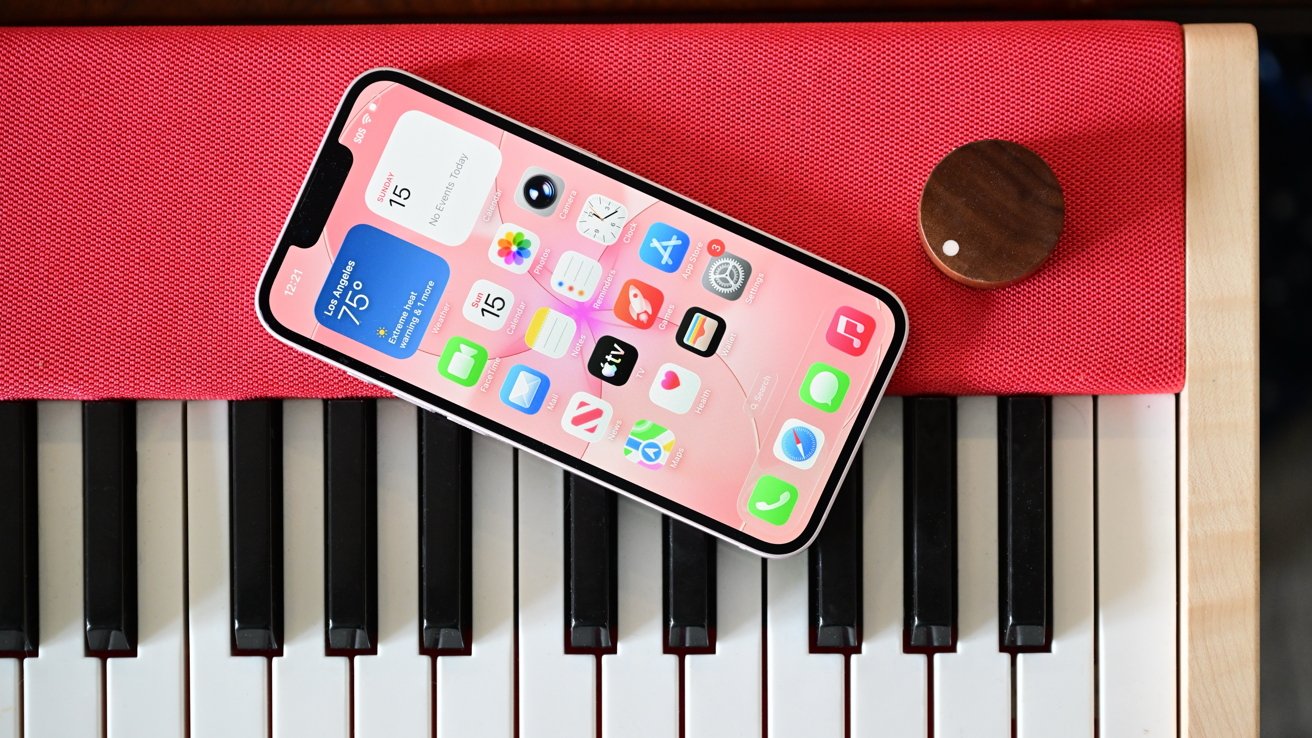
iPhone 17e review: It looks a lot like the iPhone 16e, and that's OK.
Going into the iPhone 17e from the iPhone 16e, you had a general expectation of a bit more performance but few changes. That assumption is right, but Apple's "few changes" were the right ones to make.
Apple delivered a solid foundation in the iPhone 16e. Apple has course-corrected with the iPhone 17e to make it a more useful device.
This is, of course, by design. Apple's annual upgrade cycle and pricing ladder begins anew.
The iPhone 17e's main competition is still the iPhone 17, which people who want more photography options will flock to in droves. For others in the market for Apple's cheapest smartphone, the minimized gap in specifications will mean fewer people will be tempted to go for the next tier up.
If you need or want a Pro iPhone, you're done, and you didn't need to read this far. But, for those in the market for the lower end of the market, it's closer than ever between the e and the non-pro models.
iPhone 17e Pros
- Good cost to performance ratio
- MagSafe and storage bumps versus iPhone 16e
- AI performance jump
iPhone 17e Cons
- Spec-bump update doesn't change the appearance
- iPhone 17 is just $200 away
- No mmWave
Rating: 4 out of 5
For now, the iPhone 17e is an excellent balance of price and performance, inexpensively. That is, assuming you can wait six months after initial release of the family to buy the e model, instead of the non-pro.
In 2027, the iPhone 18 is expected to ship at about the same time the iPhone 17e did. Things may be different, sooner than we think.
But for now, the iPhone 17e remains a solid offering, if not as enticing as an iPhone SE was at the time of every refresh.
Where to buy the iPhone 17e
Incentives on Apple's iPhone 17e are available at popular wireless carriers, bringing the cost down to as low as $0 per month via bill credits. Jump straight to the promotions below or check out our iPhone deals page for a roundup of offers across Apple's smartphone line:
- T-Mobile: Get the iPhone 17e for as low as $0/mo*
- Verizon: Grab the iPhone 17e for as low as $0/mo*
- AT&T: Grab the iPhone 17e from $5.99/mo* *Terms and conditions apply. Please see carrier's site for details.