Following a total ban on non-US made routers, the Federal Communications Commission is allowing Netgear to sell wireless routers in the United States, practically giving it a monopoly. However, it's unclear exactly why that approval was granted.
In March, the U.S. Federal Communications Commission made the decision to ban imports of all foreign-made routers, due to national security concerns. At the time, no exemptions were made, so the ban affected practically every router being sold in the United States.
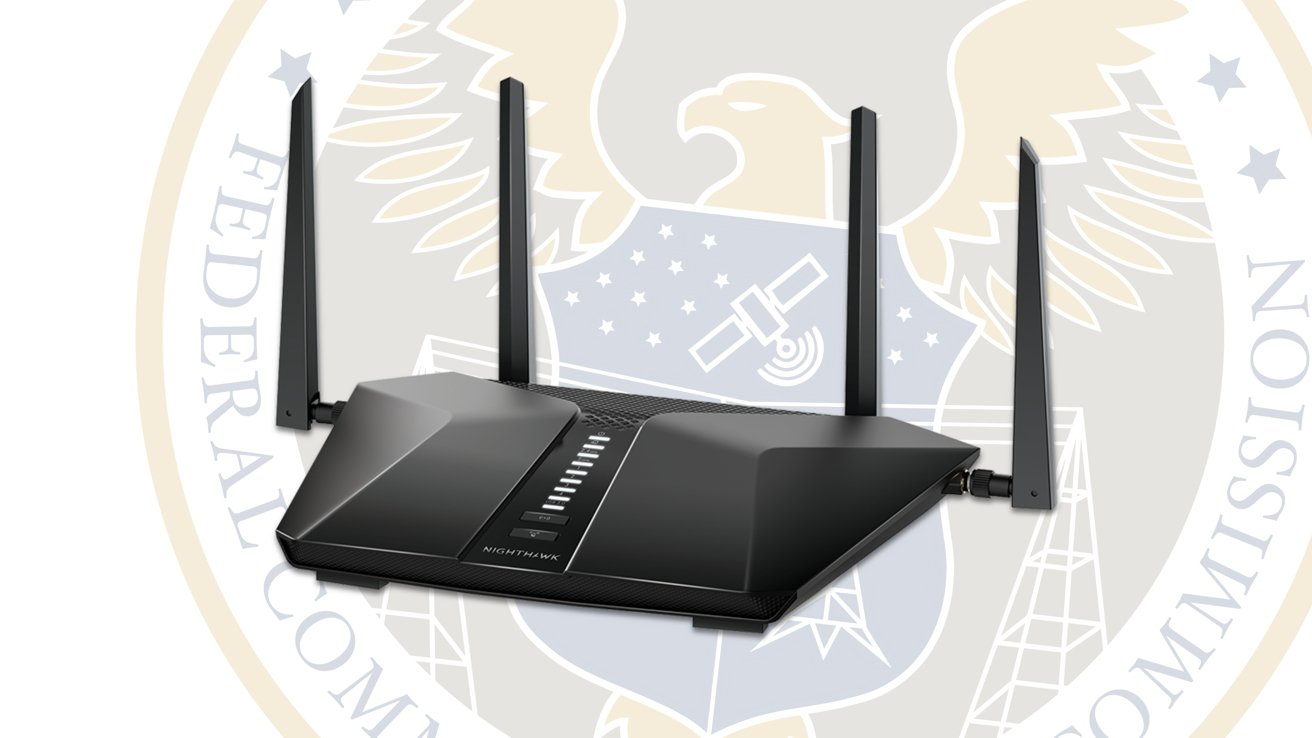
However, on April 14, Netgear got a rare reprieve. In an update to the list of equipment and services covered by Section 2 of the Secure Networks Act, the FCC lists Netgear under a very short list of conditional approvals for routers.
The Netgear listing includes its Nighthawk and Orbi product lines, as well as cable gateways and cable modems. The other occupant on the list is Adtran, for its Service Delivery Gateway class routers, aimed at corporate use.
Netgear's conditional approval runs until October 1, 2027.
Approved, but questionably
FCC issued a public notice for the conditional approvals list changes the same day. At the same time, Netgear CEO CJ Prober posted about the change, emphasizing that it is a "U.S. founded and headquartered company."
However, neither notice explains why Netgear received the approval in the first place.
A Netgear spokesperson speaking to AppleInsider explained that the company reviewed the FCC's public guidelines for conditional approval, applied, and then got the approval.
The main thrust of the FCC's ban on imports is an emphasis on where routers are manufactured. This is a continuation of the overarching attempt by the Trump Administration to bring manufacturing back to the United States.
However, Netgear doesn't manufacture its hardware in the United States at all.
Its FAQ on the topic explains that it manufactures consumer router products in Indonesia, Vietnam, and Thailand. Netgear tries to soften this fact by claiming the countries are "considered allies by the U.S. government."
It also doesn't source components from manufacturers in China, nor from companies controlled by China or any country "deemed to be a foreign adversary."
Netgear could've gone down the route of Apple and made massive overtures to bring bits of the supply chain to the United States. However, it doesn't appear to have made any public notice of that.
That said, the public guidance for the approvals process does indicate that U.S. manufacturing is a major element. Applicants have to detail where router components are acquired, and where assembly takes place.
There's also a hefty "U.S. Manufacturing and Onshoring Plan" section that demands details of existing U.S.-based manufacturing and a "detailed, time-bound plan" for establishing or expanding manufacturing in the United States.
An effective monopoly
As well as drawing manufacturers to make their routers on U.S. soil, the ban is also claimed to be an attempt to block attempts to spy from overseas. As the FCC deemed all foreign-made routers as a national security risk, it prevents anyone from importing the routers, except those that the FCC permits.
It's a more hard-line approach by the FCC. The agency is accusing everyone of being guilty until it deems a lucky few innocent, instead of blocking companies after assessing specific evidence.
Doing it this way has a few side-effects. First, the FCC looks less like the bad guy since it's not banning specific companies for arbitrary political reasons.
Then there's the kingmaker aspect. Since the FCC can grant exemptions, those chosen few will immediately become dominant in the market because the rest of the market has been excluded.
In effect, the FCC has handed Netgear a regulator-permitted monopoly while hammering down on its main rival TP-Link.
We could speculate that, if Apple was still making routers, it would be on that exemption list too, alongside Netgear. To date, Apple has pointed at a very few new programs and almost exclusively already-announced ones for its own US-manufacturing pledge as well.
As it stands, companies are allowed to sell-through existing inventory. When happens when that inventory runs out is another question that so far is mostly unanswered.
As it stands, some transparency from the FCC on why Netgear got its approval would be nice. Announcing and being consistent about what others have to do to secure it for themselves would be good too. We're not expecting either.
Updated April 15, 2026 at 12:24 PM Eastern: Added statement from Netgear spokesperson and details of application guidelines.