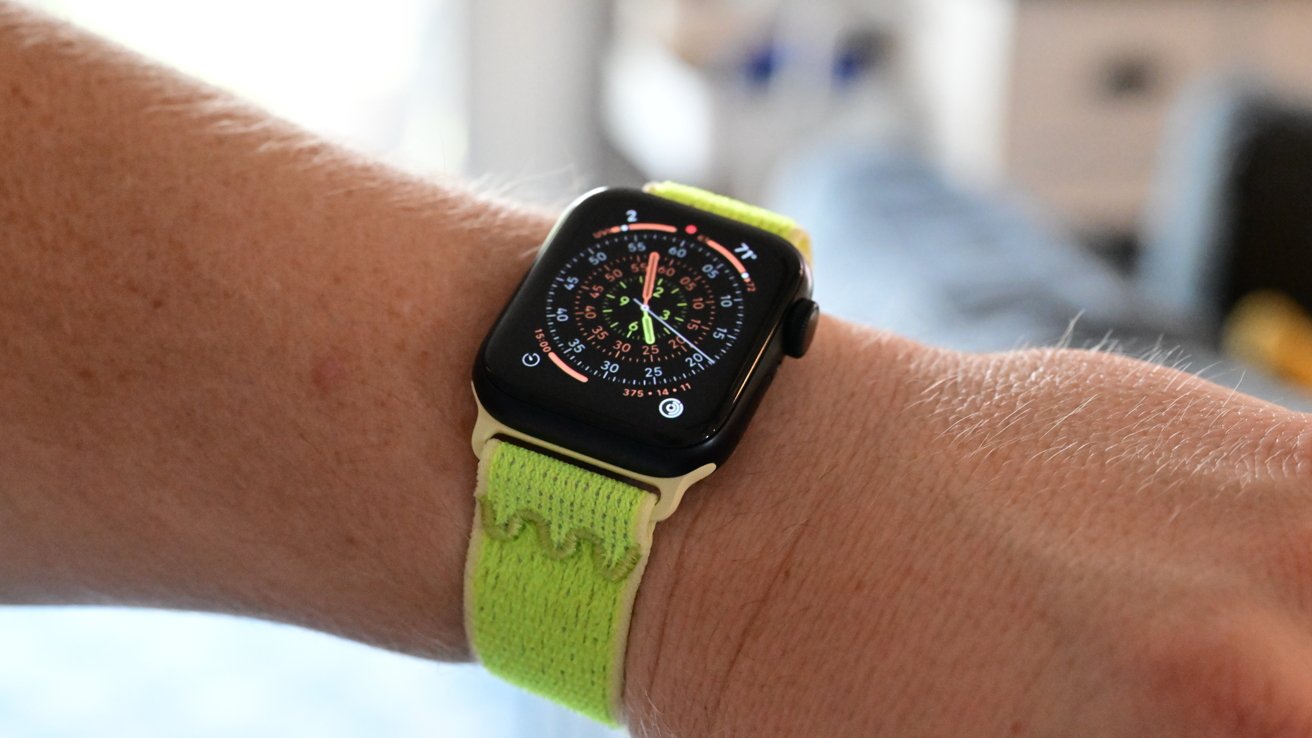
The Apple Watch won't be getting any extra biometric security measures anytime soon, because it's an engineering nightmare.
Like other Apple products, there are security measures in place on the Apple Watch to make sure only the owner can use it. However, while it is one of the few Apple products to not include biometric security, it's going to be that way for a long time.
In a Monday post to Weibo, serial leaker Instant Digital denounces apparent rumors of Apple bringing some form of biometric security to the Apple Watch as pure speculation.
To the leaker, Apple's current strategy is still focused on allowing users to unlock devices using a link to their iPhone. It has no intention for the moment of adding such a thing to the Apple Watch.
Currently, the Apple Watch relies on users entering a PIN to unlock the device while on their wrist, or by using Touch ID on a linked iPhone. The Apple Watch remains unlocked while it detects it is still on the wearer's wrist, and automatically locks when it is removed.
Instant Digital doesn't specify the leaks they're talking about, but there was an apparent code leak in August 2025 hinting at Touch ID being tested on the Apple Watch. At the time, it was thought to be an internal-only software build, pointing to it being a prototyping and experimental phase.
Obvious, but there are options
The leaker justifies the view by insisting Apple prefers to maximize the battery and include more advanced health sensors instead. Adding other sensors for fingerprint readers would only increase the construction cost and reduce the battery space.
This is a pretty obvious conclusion to make, if you consider how tightly packed the Apple Watch, or quite frankly any modern mobile device, truly is.
Any teardown of the Apple Watch will show how densely packed each wearable is, with minimal room for extra items. Adding a sizable component like a fingerprint reader would mean less space for the battery cell to consume, short of further miniaturizing everything else inside the casing.
Apple executives have previously discussed the small size putting constraints on what can be included in the design, and for what information can be shown to the user on the display. Increasing the size of the display, and the Apple Watch as a whole, is also not a real possibility due to it needing to be wearable all day long.
That said, Apple has considered the possibility of adding some other form of biometrics to the Apple Watch, at least in patents. In 2020, this took the form of vein mapping, so that the Apple Watch could tell how the hand is moving for gesture recognition purposes.
While more for no-touch gesture purposes, Apple has also thought about using veins for biometric purposes, specifically for Face ID. It wouldn't be a massive stretch of the imagination for this to use veins in a wrist instead.
For the moment, Apple Watch users will still have to tap in their PIN or have their unlocked iPhone nearby.