Apple has slashed emissions by more than 60% since 2015, but its Apple Intelligence ambitions may complicate its path to 2030 carbon neutrality.
Apple is striving to balance its climate commitments with its technological advancements. The company aims to achieve carbon neutrality in all aspects of its operations by 2030.
Achieving carbon neutrality includes everything from manufacturing facilities to the energy used to charge iPhones. Yet the rise of artificial intelligence inside Apple products brings with it an energy bill that could test that plan.
Apple, however, views these challenges as undermining broader climate goals by dismissing the role of carbon removal alongside emission cuts. Furthermore, the climate cost of Apple Intelligence remains unmeasured.
Apple's 2030 climate goals
Apple's target is sweeping. By 2030 it wants to cut total greenhouse gas emissions by 75% compared to 2015, with the last 25% offset through verified carbon removal projects.
The scope covers not just offices and retail stores but also manufacturing, device use, transportation, and end-of-life recycling.
To get there, Apple relies on three pillars — powering its entire supply chain with renewables, replacing mined materials with recycled ones, and transforming logistics to cut transport pollution.
The company already declared its offices and data centers carbon neutral back in 2020, but as it admits, that was the easy part. Making millions of iPhones and shipping them worldwide is another matter.
Suppliers are under strict orders. Any manufacturer that touches Apple hardware must commit to 100% renewable electricity for Apple-related work by 2030.
Apple audits progress and publishes updates. It uses its leverage as one of the world's largest buyers of semiconductors and consumer electronics parts.
To fill the gaps, Apple invests in carbon removal projects through its Restore Fund. The company claims its strategy emphasizes actual emissions cuts over the accounting trick of cheap offsets.
Progress and achievements as of 2024-2025
The 2025 report puts Apple ahead of schedule. As of April 2025 the company had cut overall emissions more than 60% from its 2015 baseline, and that figure excludes offsets.
Crucially, Apple's reductions are direct, not the result of credits. The company maintains that offsets are reserved only for the small share of emissions that cannot be eliminated.
Most progress is tied to clean energy, material recycling, and logistics changes. In other words, three-quarters of the way to its 75% reduction target with five years left on the clock. The Supplier Clean Energy Program is central to this progress.
In 2024, Apple suppliers delivered over 31 million megawatt-hours of renewable electricity. The effort helped avoid 21.8 million metric tons of CO emissions that year.
Additionally, in 2023, Apple encouraged more than 100 supplier facilities to upgrade their equipment for better efficiency. These upgrades saved two billion kilowatt-hours and reduced emissions by another 1.7 million tons.
Materials have also shifted. In 2024, 24% of the total material Apple shipped came from recycled or renewable sources, up from 22% a year earlier. Rare earth elements in magnets and cobalt in Apple-designed batteries reached 99% recycled content.
Aluminum enclosures for products like the MacBook Air and Mac mini now use 100% recycled material. Because aluminum can be endlessly recycled without quality loss, Apple treats it as a cornerstone of its design strategy.
Behind the scenes, Apple's disassembly robots Daisy, Dave, and Taz have scaled up. In 2024 those systems helped Apple refurbish or recycle nearly 16 million devices and accessories.
Each robot employs computer vision and automation to recover high-value components. The process reintroduces rare earths and cobalt into the supply chain rather than discarding them.
Packaging and logistics redesign
Apple's environmental work extends beyond factories. Packaging is now more than 98% fiber by weight, with the company declaring an endgame of eliminating all plastic.
The company's material recovery efforts have also scaled up
Apple's latest Watch packaging is entirely made of fiber, a claim they're making as an industry first. The product redesign also contributes to this innovation.
New iPhones are about 6% smaller by volume than their predecessors and use 54% less energy during customer use. Smaller products mean lighter shipments and less power per device.
Apple's efficient logistics network is shifting from carbon-intensive air freight to eco-friendly ocean and rail transportation.
Between 2022 and 2024, Apple cut transportation emissions by 20%. For its carbon-neutral products, such as the Apple Watch Series 10 and Mac mini, more than half of all units now travel by ocean freight instead of air.
It's a reminder that even mundane details like how a product gets from China to Chicago matter in Apple's climate math.
Carbon-neutral products as test cases
Starting in 2023 Apple began stamping certain devices with a carbon-neutral badge. The Apple Watch Series 9, Apple Watch Series 10, and a redesigned Mac mini all qualify.
These products are constructed with a significant amount of recycled content. They are manufactured using 100% renewable electricity.
Shipping is conducted with low-carbon logistics, with about half of the Apple Watch Series 10 units transported by sea. Apple also invests in clean energy to match the electricity used for charging.
The Mac mini is designed with over 50% recycled content. It operates entirely on renewable electricity during production.
Shipping is primarily done by sea, and remaining emissions are offset through nature-based projects in the Restore Fund. Lisa Jackson, Apple's vice president of Environment, Policy, and Social Initiatives, admitted in 2025 that the hardest part still lies ahead.
Cutting the last 15-20% of emissions will demand deeper changes, from decarbonizing stubborn suppliers to transforming materials. And now there's AI, the wildcard that could tilt the curve back upward.
How Apple's strategy differs from peers
Apple likes to present itself as the tech company that doesn't just follow industry trends but rewrites the rules. Its climate playbook is no exception.
Competitors such as Microsoft and Google have seen emissions spike as AI workloads balloon in their cloud data centers. Apple, by contrast, has leaned on on-device AI, embedding Neural Engines into A-series and M-series processors.
This approach means most tasks — dictation, transcription, predictive text, even image generation — run locally at a few watts instead of requiring thousands of watts in a server farm. Where Apple does need cloud infrastructure, it insists it's powered by renewable electricity.
On paper, that allows Apple to expand AI without the same carbon hit that haunts rivals. Yet the story isn't that simple.
On-device AI leads to more frequent charging, which contributes to Apple's Scope 3 emissions from customer product use. Apple says it will match that electricity with clean power investments, but hasn't yet published clear data on AI's contribution.
Skeptical analysts note that without transparent numbers, it's hard to know if Apple is truly bending the curve or just hoping nobody notices.
Apple Intelligence and the energy question
The Apple Intelligence platform is Apple's answer to the generative AI boom. Unlike ChatGPT-style services that live in the cloud, Apple Intelligence leans on on-device processing with specialized hardware.
Apple argues this keeps energy consumption low, avoids reliance on massive data centers, and preserves user privacy. The A-series and M-series Neural Engines are engineered to run inference at very low power, usually just a handful of watts.
In comparison, cloud-based AI models draw thousands of watts per task. Apple frames that efficiency as both a privacy advantage and a climate benefit.
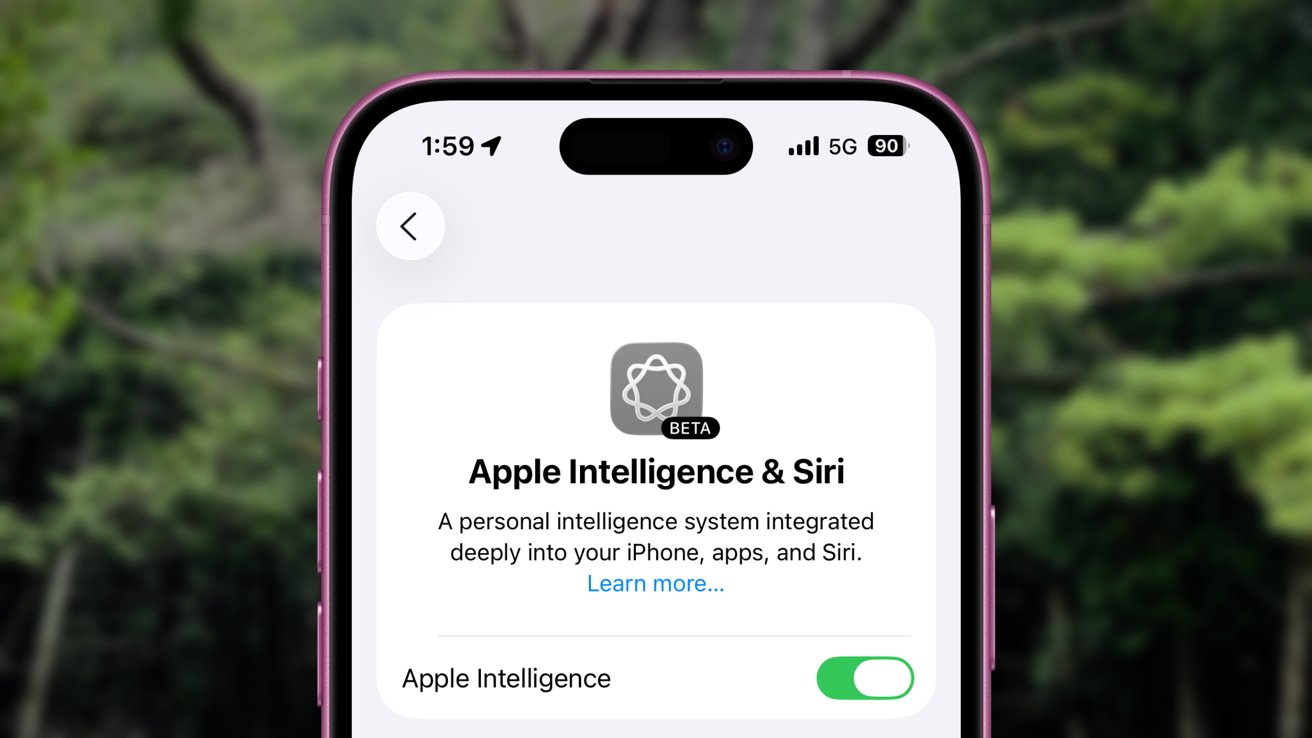
The strategy emphasizes processing AI tasks directly on devices
But the company is also experimenting with larger models behind the scenes. A project known as Ajax GPT is reportedly in testing, with the potential to upgrade Siri or enable cloud-assisted features.
Training and running models at scale would necessitate new data center capacity, even if powered by renewables. Apple commits to maintaining its 100% clean energy rule for any expansion.
However, critics argue that each new data hall increases the use of steel, concrete, and water, beyond just wind turbines.
AI in recycling and infrastructure
AI isn't just a climate risk. Apple also deploys it to make sustainability programs more effective. Daisy, its disassembly robot, uses machine vision to recognize components and recover materials with higher purity than traditional recycling.
One Daisy unit can dismantle more than a million iPhones each year, salvaging cobalt, gold, and rare earths for reuse. Apple runs Material Recovery Labs in Texas and California and partners with researchers at Carnegie Mellon University to push the frontier of robotic recycling.
The more efficient these systems become, the less Apple depends on mining, which remains one of the dirtiest parts of the electronics supply chain. Inside Apple's data centers, AI-driven cooling has already cut fan energy use by 35%.
Reusable air filters and optimized airflow, guided by machine learning, reduce waste and extend the life of infrastructure. Apple rarely labels these changes as AI, but they are proof that data-driven automation can chip away at the emissions total.
Mitigation strategies and supplier enforcement
To square innovation with sustainability, Apple leans on a blend of renewable energy expansion, efficiency upgrades, and hardware-level design. All Apple facilities have run on 100% renewable electricity since 2018.
Now the company is pressuring suppliers to match , claiming over 300 partners — covering more than 90% of production spend — are on board. The Supplier Clean Energy Program provides resources, training, and help negotiating power deals.
By 2024, supplier-led renewable projects were active in 28 countries, delivering 17.8 gigawatts of clean electricity and avoiding 21 million metric tons of emissions. Those are real numbers, but the question is enforcement.
Pegatron, one of Apple's major assembly partners, still hasn't fully committed, drawing criticism from groups like Greenpeace. Apple insists it will keep suppliers in line, though history shows it's easier said than done.
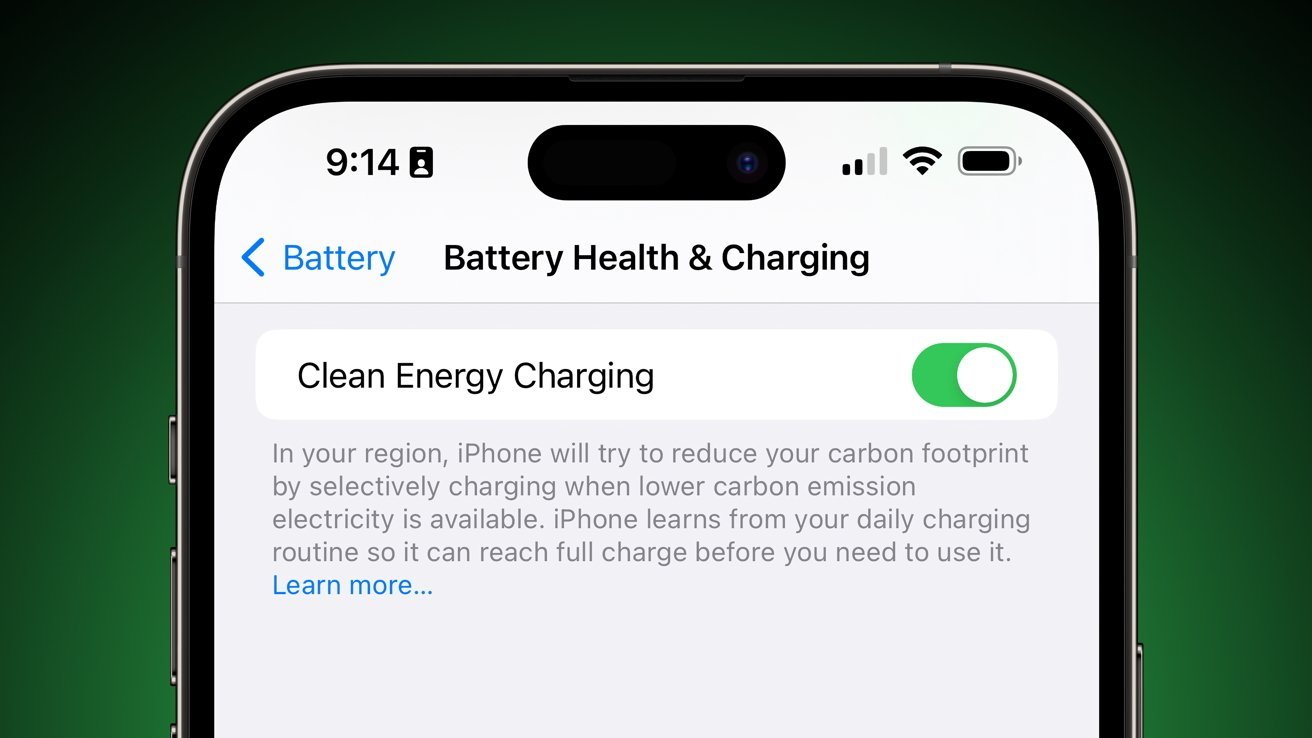
Apple has also introduced software-based tools like Clean Energy Charging
Energy efficiency remains a key theme. At the data-center level, Apple has redesigned airflow and cut fan energy use by a third. At retail and offices, more than 100 Apple buildings now hold LEED or BREEAM certifications for top environmental standards.
On the product side, Apple Silicon continues to improve performance per watt, limiting emissions from everyday AI tasks. Apple also leans on software.
Clean Energy Charging, introduced on iPhone, shifts charging to times when the grid is cleaner. It's a small nudge, but multiplied by hundreds of millions of devices, it adds up.
Offsets and the Restore Fund
Offsets remain controversial, but Apple insists it uses them as a last resort. The Restore Fund supports reforestation, mangrove preservation, and indigenous-led land stewardship projects around the world.
In 2023, Apple expanded the fund and brought suppliers such as TSMC and Murata on as co-investors. Projects include forest restoration in Kenya and land management in Australia.
Apple says its approach requires credits to be retired annually and verified by third parties. Some projects are paired with buffer pools that cover carbon losses by canceling equivalent credits.
The company's line is that offsets cover only what can't be eliminated directly. Long-term, Apple says it wants to move past offsets entirely.
That would set it apart from peers that often lean heavily on buying credits instead of cutting real emissions. Still, lawsuits filed in 2025 over Apple Watch "carbon neutral" claims argue that some Restore Fund projects lack additionality.
That's the key test for whether an offset is truly removing carbon. The legal fight highlights a core problem — consumers are now savvy enough to challenge green marketing in court.
Is Apple on track for 2030?
Apple is making significant progress in reducing emissions. The company has achieved substantial cuts without relying on offsets.
Additionally, Apple has transitioned most of its supply chain to clean energy and redesigned products and logistics to lower carbon intensity. Its AI strategy, built around efficient chips and on-device inference, has prevented the emissions spikes that plague other tech giants.
But the hardest work is still ahead. The last 15-20% of emissions reductions will require breakthroughs in materials, complete supplier compliance, and new carbon removal at scale. AI remains a wildcard, especially if Apple pushes deeper into cloud-based services.
On top of that, new EU regulations will soon bar companies from labeling products "carbon neutral" if that claim relies on compensation. By 2026 Apple will have to retire the label, even if its underlying practices remain unchanged.
The move highlights the contentious nature of climate action language. Despite this, companies persist in their efforts.
Apple hasn't disclosed AI-specific energy use, leaving investors and watchdogs guessing. If it wants to keep the lead in climate credibility, the company will need to publish that data and prove its clean-energy claims hold water when workloads expand.
Apple's climate progress is genuine, not just a marketing ploy. Since 2015, the company has already reduced its carbon footprint by over 60%.
It has also established a framework that incorporates renewable energy, recycled materials, and supplier mandates that most competitors cannot replicate. However, the next five years present challenges such as lawsuits, slow-moving suppliers, regulatory changes, and the uncertain energy demand for artificial intelligence.
Apple likes to say it can reconcile innovation with climate responsibility. If the numbers keep moving in the right direction, it might just prove that a trillion-dollar tech company can clean up its act while still shipping millions of gadgets every quarter.