Very few developers have released Liquid Glass updates to their apps, and Apple isn't fully compliant either with its own applications. Based on past experience, it's going to take years before the redesign is the norm.
So many headlines from Apple and others this week have announced that Liquid Glass is here — and it isn't entirely true. The base of the new redesign has launched, and there are apps that have adopted it already, but the majority have not.
That shouldn't be a surprise, even though developers have had months since the WWDC 2025 announcement of Liquid Glass. Some developers have chosen to wait since the redesign changed throughout the beta process, and others are not about to let Apple dictate their development schedules.
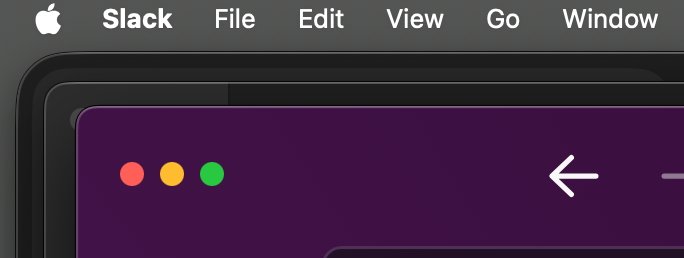
Rounded corners are the first clue an app has or hasn't been updated: here Slack (front) has not, and the Finder (rear) has
Over the decades, it's really the largest developers who decide to update to Apple's design ethos only when it suits them. It's the big players who've decided that if — not when — they adopt Liquid Glass, they will do it on their own time, and not necessarily the next time they release an update.
So for instance, there was never going to be an update to Microsoft Office apps on the week of Liquid Glass's official launch. There might actually never be such an update at all.
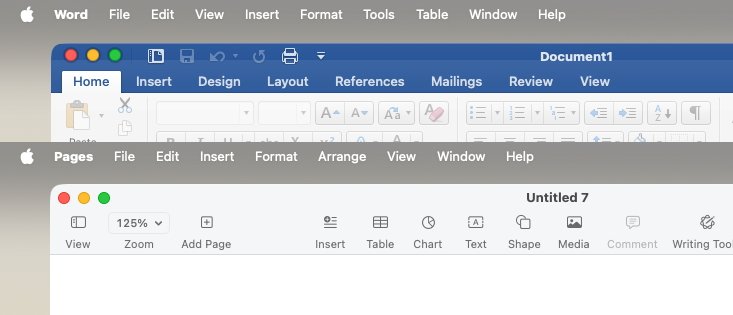
Neither Word nor Pages have been updated, but it's like Word hasn't ever quite tried.
Even now, while Microsoft Word for the Mac has adopted Apple's old three traffic light-style icons in the top left corner of windows, it hasn't really. There are three such icons but compare them to Pages and you can see that not a lot of effort has gone into making them match Apple's sizing and positioning, despite there being clear guidelines.
Microsoft also took three years to adopt to Aqua. And even then, it was half-assed, like how they effectively ignore Apple's design guidelines on the traffic lights.
Then famously, Adobe still hasn't quite updated all of its apps to run natively on Apple Silicon — five years after Apple launched it. And before that, Adobe was slow to adopt 64-bit code in Photoshop back around 2006, and it didn't exactly rush to move that or Illustrator from PowerPC to Intel-based.
They also took many years to move to Aqua when it was new. They too only adopted it half-heartedly.
It's understandable why a large corporation would take some time to update everything. There is just the sheer complexity of scheduling massive updates alongside every other development plan they have.
So it shouldn't be a surprise that the first developers to adopt Liquid Glass are the smaller ones. The Omni Group, for instance, had a Liquid Glass — and Apple Intelligence — version of its OmniFocus To Do app ready on day one.
Text app Drafts 5 is the same, but very few other apps are.
Compare that to Apple itself. On the Mac, Apple Mail, Maps, Messages, Music, Notes, Safari, Podcasts and the App Store have been updated to Liquid Glass, right alongside the Finder.
But Pages, Numbers, Keynote, Final Cut Pro, iMovie, QuickTime Player, Pixelmator Pro, and Chess, have not.
What developers have to do
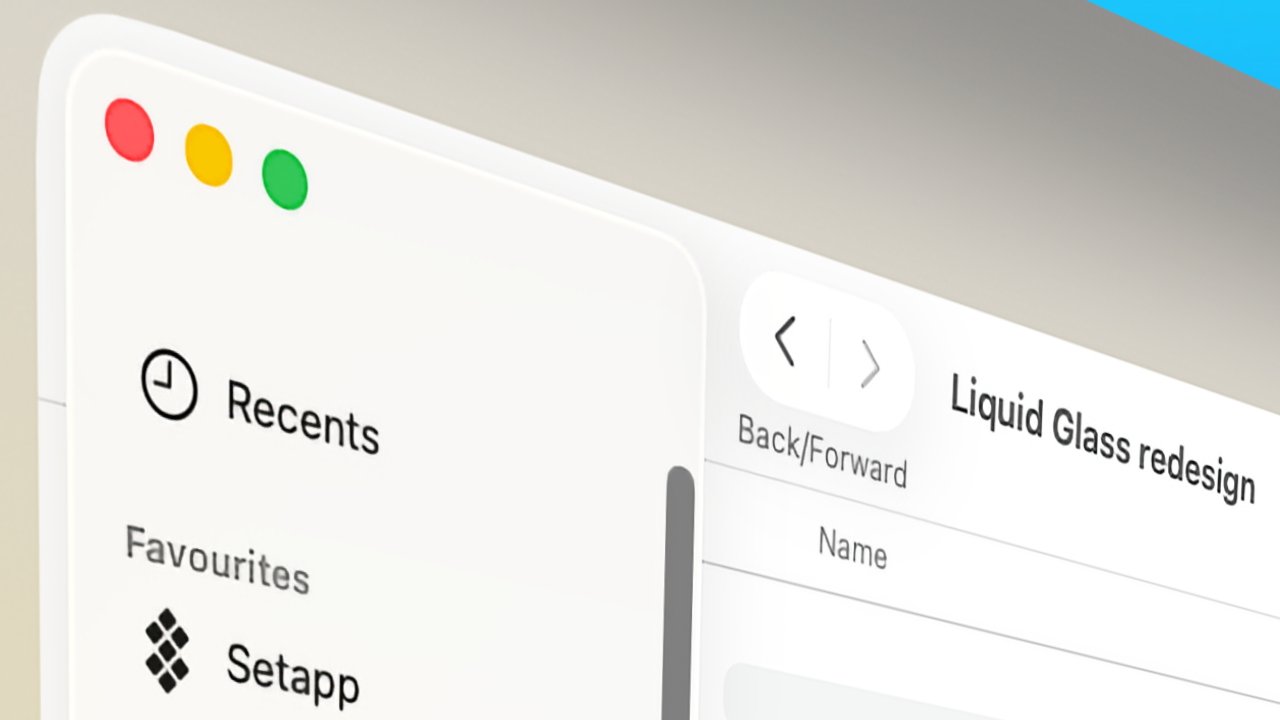
The quick way to see what has or hasn't been updated is to check the corners of an app's windows. Under Liquid Glass, corners are much more rounded.
Elements such as window shapes are a standard that each app calls. It isn't that they each design their own, they request a window and they get what Apple provides.
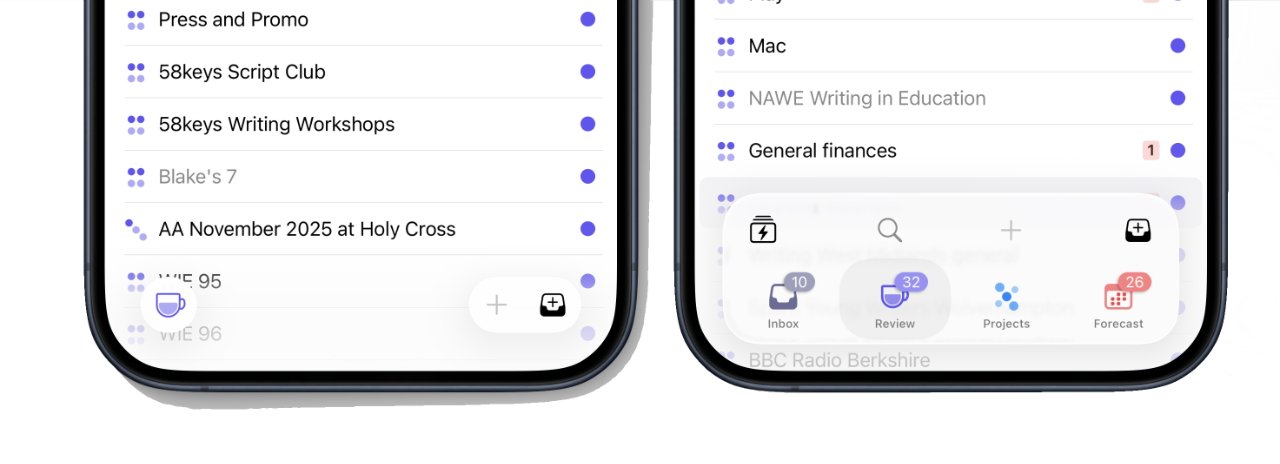
It's not just nice refracting glass — OmniFocus smoothly moves controls out of the way as you scroll
So in theory, a developer just has to recompile their app to get these standard elements.
In practice, there are apps like 1Password that use an abstraction layer. They aren't written for the Mac at all, they use Electron as a way to get their apps running on macOS.
So they have to wait for the Electron app to be updated.
Then there's the issue that Liquid Glass is about more than corners and simple design elements.
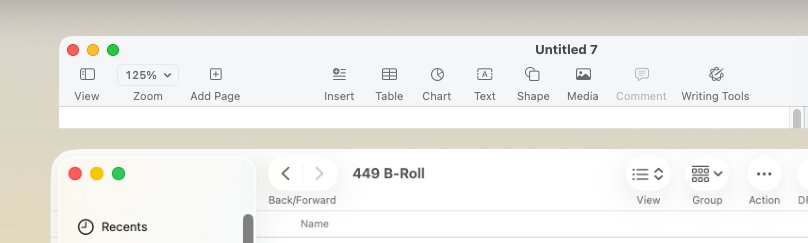
It's not just that Liquid Glass has more rounded corners. Notice the flat tools in Pages (top) and the more prominent ones in the Finder (botton)
It changes buttons, for instance, so that they can refract what's underneath as they are dragged. But depending on what the app is displaying, that refraction can be a distortion that gets in the way, instead of a magnification that helps.
Graphics-intensive apps will probably look better under Liquid Glass than ones which are predominantly text-based.
So ultimately, the issue that it's going to be down to each developer to decide how to implement Liquid Glass so that users get the benefits rather than the potential legibility problems.
Liquid Glass will take years
Liquid Glass is as big a change to the Mac, iPhone, and iPad, as the move away from skeuomorphism to a flat design that was introduced in iOS 7 that replaced skeumorphism. It took years for developers to move to that new flat design.
And it really took more years for that flat design to settle down into what we eventually became used to. Apple continued to refine it, just as it will now continue to refine its Liquid Glass redesign.
Apple needs to lead the way, at least in terms of making it as much a job of just recompiling apps. But it also needs to lead the way in revamping its own apps to show the benefits of it to developers.
We do already know that there are significant updates coming for Apple's Final Cut Pro and Logic Pro apps, even if we don't quite know when.
But if you're expecting all of Apple's apps to fully embrace Liquid Glass right away, remember the Apple Vision Pro. Some 19 months after it was launched, there is still no native Apple Vision Pro version of Apple's own Pages app.