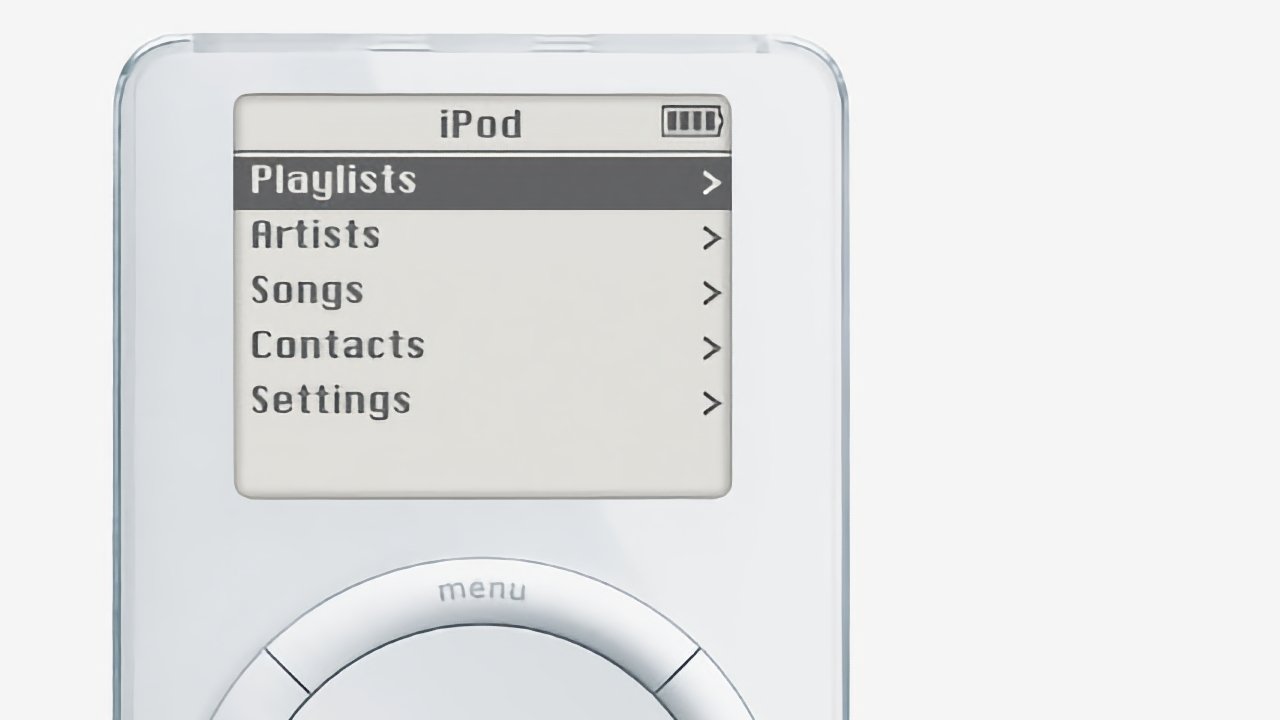
If the iMac saved Apple, the iPod that shipped on November 10, 2001 launched it into the stratosphere, changing this recovering computer firm into a giant one that revolutionized the music business.
We still have podcasts because of it, but otherwise if you see the word "iPod" now, you think it's a typo and was supposed to be "iPad." yet back on November 10, 2001, the first iPod went on sale, with its then extraordinary ability to store up to 1,000 songs, and changed the world.
That isn't the hyperbole it sounds, since the iPod went on to be everywhere, owned by everyone, and those white earbuds became a fashion statement across the world. Plus at the same time, the iPod led to the iTunes Store, and it led to the total revamp of how music was sold.
You just couldn't see any of that change right away.
Steve Jobs had launched it by saying "with iPod, listening to music will never be the same again." Apple's Phil Schiller said "with its breakthrough design and ease of use, iPod may be one of the hottest gifts for every Mac user this holiday season."
The key word there was Mac. To use an iPod, you had to have a Mac using either the new Mac OS X version 10.1, or the latest classic Mac software, Mac OS 9.2.

But if you had that, then for $399 you could have a 5GB iPod. It had a 160x128 pixel display Apple called high resolution, and a FireWire 400 port for connecting it to a Mac.
Today 160x128 is laughably crude compared to the high resolution display of an iPhone — the iPhone 17 Pro Max has a screen of 2,868x1,320 pixels. And FireWire is long gone, too.
That original 5GB storage was also a spinning 1.8-inch hard drive, and Apple doesn't sell anything with those any more.
Even in 2001, though, the specifications weren't electrifying, although FireWire was dramatically faster than previous systems.
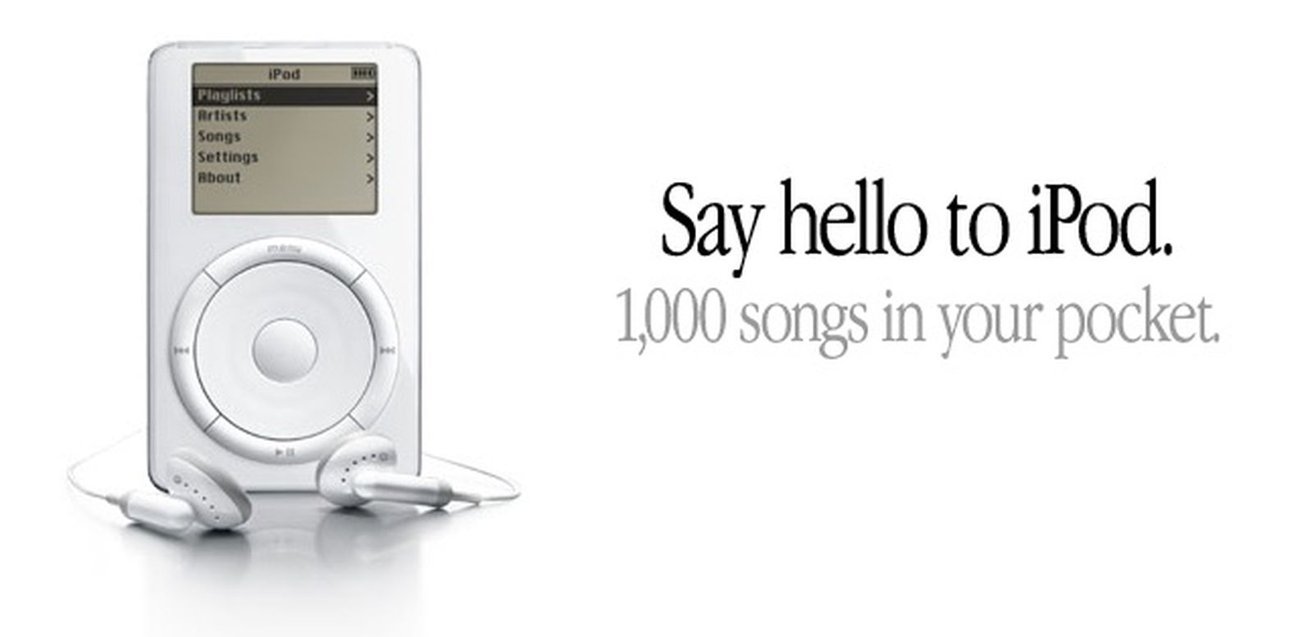
Back in the day, a thousand songs seemed like so much — image credit: Apple
At the time, keeping it to the Mac was a huge limitation. Plus the iPod was far from the first portable MP3 music player.
What made the iPod special
The iPod was genuinely revolutionary, and in part because of that hard drive. The whole device was a marvel of engineering, but the key was the drive.
Apple's Jon Rubinstein — effectively the COO at the time, although Apple didn't use that title — saw the drive on a visit to Toshiba. The story is that this tiny hard drive had been invented and was working, but no one knew what they could use it for.
Rubinstein knew instantly. And he bought up Toshiba's entire inventory of the drive — before there was an iPod to put it in.
Apple then developed the iPod from idea to shipping in record time. Much later in an exchange on Twitter, key iPod creator Tony Fadell gave a summary of his work on the project.
I asked Tony Fadell about the iPod timeline for my fast project page. Summary: . pic.twitter.com/mf0CfbAEtB
— Patrick Collison (@patrickc) January 12, 2020
The short version is that development of the iPod took a mere ten months.
Success took time
In its first complete year on sale, Apple sold fewer than 400,000 iPods. By 2006, that was up to almost 40 million a year.
Key to that was making it compatible with Windows. But ultimately what that massive success did was also teach Apple about making devices at scale.
Nothing the company had made before had sold so much. So here was this computer firm, having to scale up its purchasing of RAM, storage, and components.
It's no exaggeration to say that this is where Apple learned its lessons about global supply chains. Or of the economies of scale.
None of this was limited to the iPod either, as when you're ordering 40 million of a component for one device, you've got buying power. The sheer scale of component orders for the iPad helped Apple negotiate better deals for the Mac.
Changing the music business
But Apple wasn't having things all its own way. Microsoft is now best known in this field for the Zune — and for how that was a brown failure — but it was also trying to lock down the rights to music.
The iPod led to the iTunes Music Store, and for once a limitation was a benefit. Record labels were far from convinced that online sales were a good idea, but they also didn't see Apple as a big player.
So they licensed Apple to sell music and doubtlessly figured it was just an experiment. Before streaming had its way with the industry, online sales became the way that nearly all music was sold.
It was Napster that showed how much appeal there was for buying music online. Yet Apple created a way to buy music that was as simple as it was legal — and made it straightforward to load up your iPod with it.
Simplicity in buying music was matched by simplicity in using the iPod. And initially, simplicity meant that the iPod kept on selling despite the launch of rivals like the Zune.
Ultimately, there was a pressure from fashion and from users' peers, in that everyone had an iPod so you should too. But it got to that stage by being the best MP3 player to use, and by avoiding Microsoft's over-complicated store.
It got there by your being able to buy music and listen to it. Contrast that with Microsoft's marketing label, "Plays for Sure," on music that didn't, in fact, play on Microsoft devices.
And, iPod begat the podcast. More on that another day.
Suddenly gone
Everyone had an iPod — many people had several. Those white earbuds were everywhere — until they weren't.
The iPod was killed off shockingly fast by a rival. It wasn't Microsoft, which limped on with the Zune until late 2011.
Instead, it was Apple and it was Steve Jobs who eradicated the iPod. In 2007, at the height of the iPod's success, Apple launched the iPhone.
At the time, everyone concentrated on Jobs's claim that this new device was a phone. They didn't pay much attention to his saying that it was also a "widescreen iPod with touch control."
And nobody in the audience that day really got Jobs's line about the iPhone also being a "breakthrough internet communications device."
It was, though. It changed how we use the internet.
And along the way, it also changed how we listen to music. Again.
"The start of the iPhone project happened from the iPod project," said Tony Fadell. "We started seeing these feature phones with cameras starting to add digital music features, tools in your phone."
For a time, the iPhone featured an app called "iPod." But it would soon be renamed "Music."
Apple itself was gradually erasing all mention of the iPod. The final iPod was the iPod touch, which Apple hadn't updated since 2019.
And then in 2022, it finally ended all production of it.
The company did make a rare statement about ceasing production.
"[The iPod] impacted more than just the music industry," Greg Joswiak, Apple's senior vice president of Worldwide Marketing, said at the time, "it also redefined how music is discovered, listened to, and shared. Today, the spirit of iPod lives on."
But the actual iPod does not.
It was a sad end to a stunning success. But the iPod was also the stunning success that gave us the Apple of today.