
As Apple starts to close the door on Intel code support on the Mac, the Epic Games Launcher for macOS has added native support for Apple Silicon. Finally.
It's been five years since Apple Silicon Macs shipped, five and a half years since the migration was announced at WWDC, and about 10 years since the first rumors of ARM Macs. Epic finally got the memo.
The Epic Games Store is arguably more well known for being on iOS in Europe as an alternative to the App Store than being a gaming storefront for macOS. In November, the Launcher app received a much-needed update, enabling Apple Silicon support.
You can access the Epic Game Store from a browser on macOS as well as the Epic Games Launcher. However, to install said games on macOS, as well as to access the Unreal Engine for game development, you do so just through the launcher.
Previously, the macOS version of the Epic Game Launcher ran with Rosetta 2 on Apple Silicon Mac models. It was an app that was made to run on Intel-based Macs, and didn't have an alternative for Apple Silicon.
The app was updated to version 19 in early November, to practically no fanfare. Users installing the Epic Game Launcher on a Mac and inspecting it will find it listed as a "Universal" app.
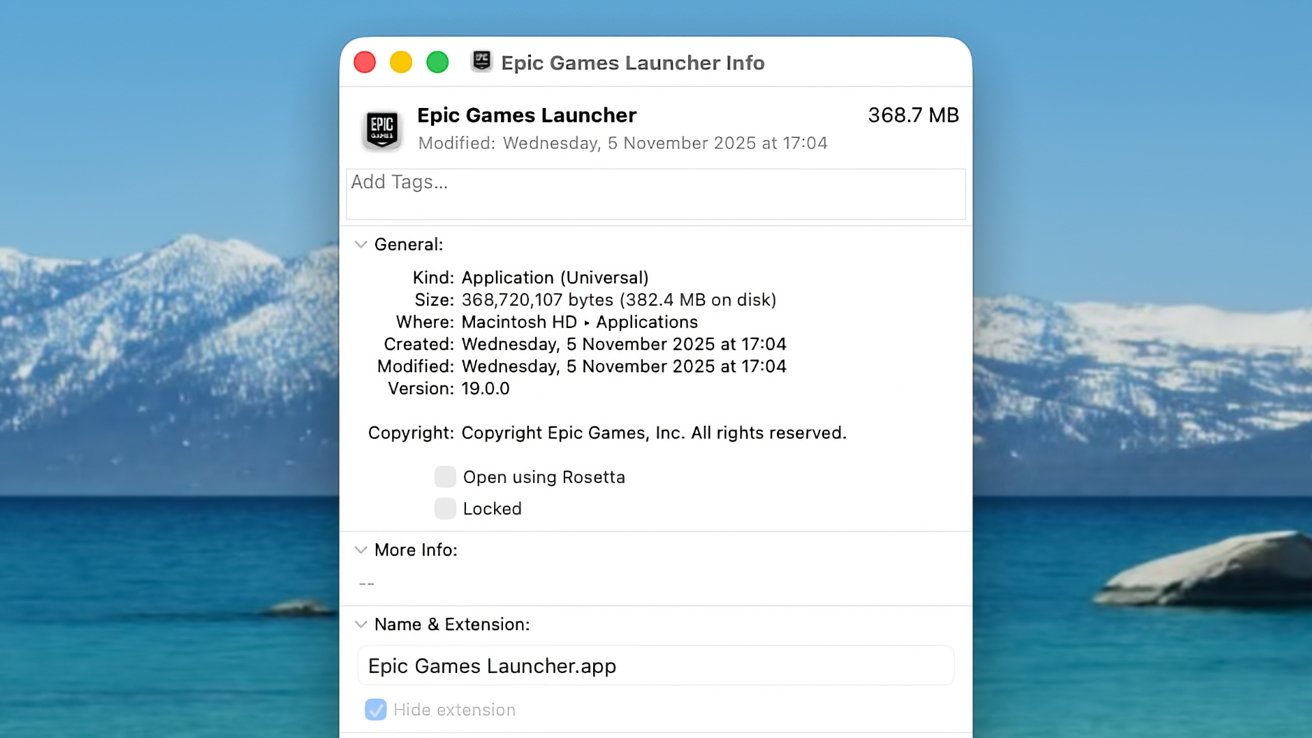
Epic Games Launcher in macOS is now a Universal app.
Apple's present Universal label is used to designate an app that will run on both an Intel-based Mac and a newer model using Apple Silicon. Since Universal apps can run directly on Apple Silicon, it eliminates the use of Rosetta, an ARM translation layer that can consume about 10% more resources than the ARM-specific version alone.
Pushed into slow movement
Epic's extremely quiet rollout of a Universal version of the Epic Games Launcher brings it in line with its main rival, Steam, though after a considerable delay.
An Apple Silicon-native version of the Steam client was issued in beta in June, with Epic's launcher arriving about five months later.
It is unclear exactly why both storefronts have resisted adding Apple Silicon support to their clients for so long. It has been five years since the first Apple Silicon release in November 2020.
However, it is probable that both companies were nudged into transitioning their apps due to Apple's own announcements. During WWDC 2025, Apple confirmed that macOS Tahoe will be the last version to fully support Intel Macs, aside from security updates.
Support for Rosetta 2 was also earmarked for removal during the same event. While Rosetta 2 will not be fully supported in whatever Apple calls macOS that releases in the fall of 2027, there will also be scaled-back and as yet undetailed Rosetta support for unmigrated games.
While neither storefront is dropping Intel support just yet, they both have at least made it so that they can sell and handle the download of games to modern Macs running future macOS updates.
The change is accompanied by the constant background noise of Epic's frequent complaints about Apple, its App Store, and fees.
Recent updates in its long-time war against Apple include continued legal action and an objection to how long apps take to install.