
New research data shows the iPhone 17 family leading North America in real-world Wi-Fi performance despite lacking some radio spectrum space.
Apple's first custom Wi-Fi chip, the N1, is now in every iPhone 17 model. The launch comes as wireless performance becomes crucial for daily tasks.
Meanwhile, Android competitors are boasting about their Wi-Fi 7 features. It's important to compare how these devices perform on real networks.
Ookla examined data collected between September 19 and October 29, 2025, across a wide range of markets. The results include major flagships such as the Google Pixel 10 Pro, Samsung Galaxy S25 series, Xiaomi 15T Pro, and Huawei Pura 80 family, along with the previous iPhone 16 line for reference.
Crowdsourced Speedtest samples offer a clearer sense of how each device performs in homes, offices, and on public networks.
iPhone 17 delivers the fastest real-world Wi-Fi in North America
The iPhone 17 family recorded the highest median download speed in North America at 416.14 Mbps. The next closest result came from the Google Pixel 10 Pro family at lower levels, followed by the Samsung Galaxy S25 series and the earlier iPhone 16 family.
Higher 6 GHz usage in the United States and Canada shapes these results. That regional boost also appears again at the low end.
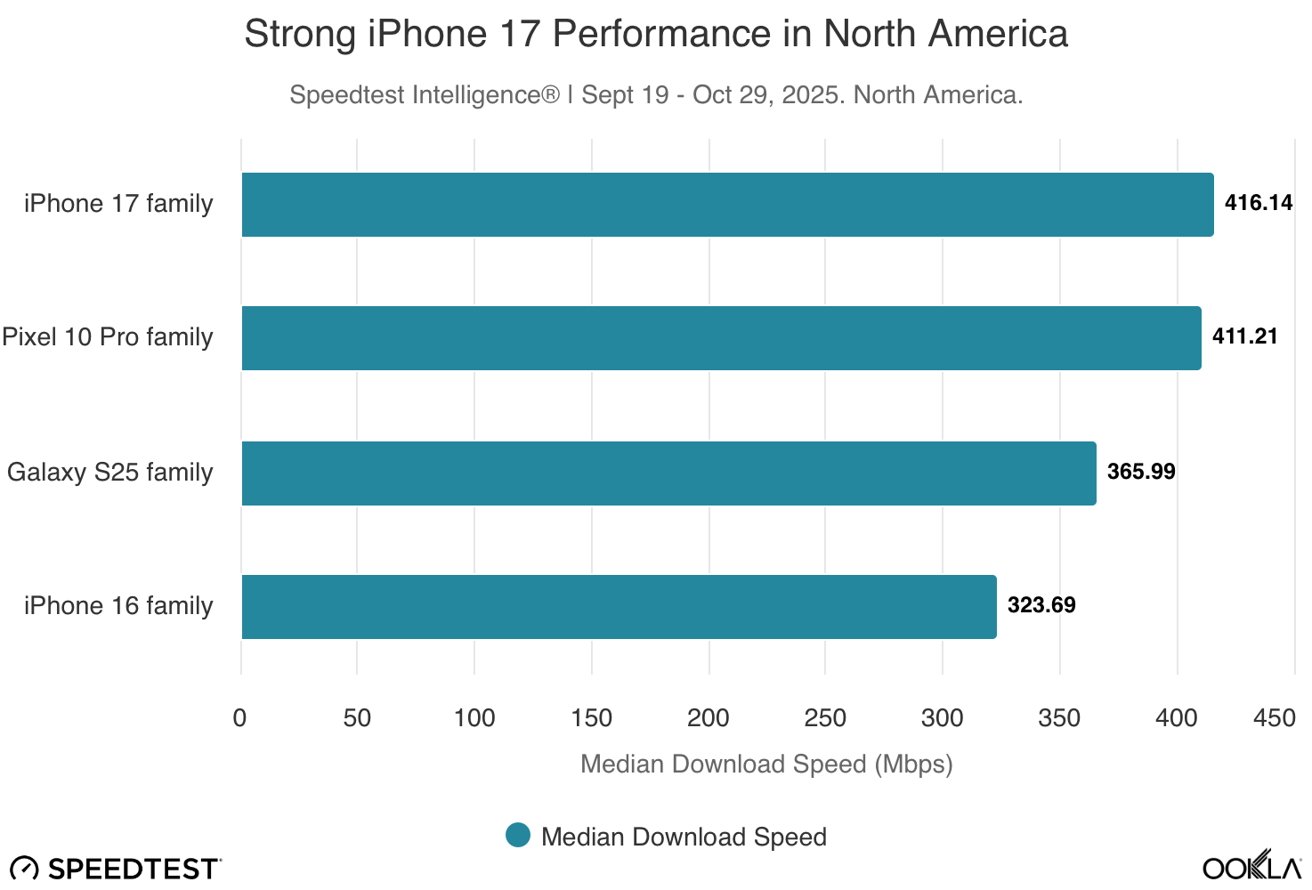
iPhone 17 tops the charts for North America. Image credit: Ookla
The iPhone 17 models achieved a global 10th percentile download speed of 56.08 Mbps, which was the strongest floor performance among all devices in the study. Samples included both strong and weak networks, which adds weight to the consistency gains.
North America stands out for another reason. More than 20% of all Speedtest samples from the Samsung Galaxy S25 series in this region took place on the 6 GHz band.
In Europe and Northeast Asia, 6 GHz usage was only about 5%. In the Gulf region, it was even lower at 1.7%.
Why Apple pulls ahead in a region built for Wi-Fi 7
The United States and Canada offer more 6 GHz access for consumer routers compared with many other major markets. Router adoption also moves faster in North America because high-performance mesh systems have gained ground in suburban homes.
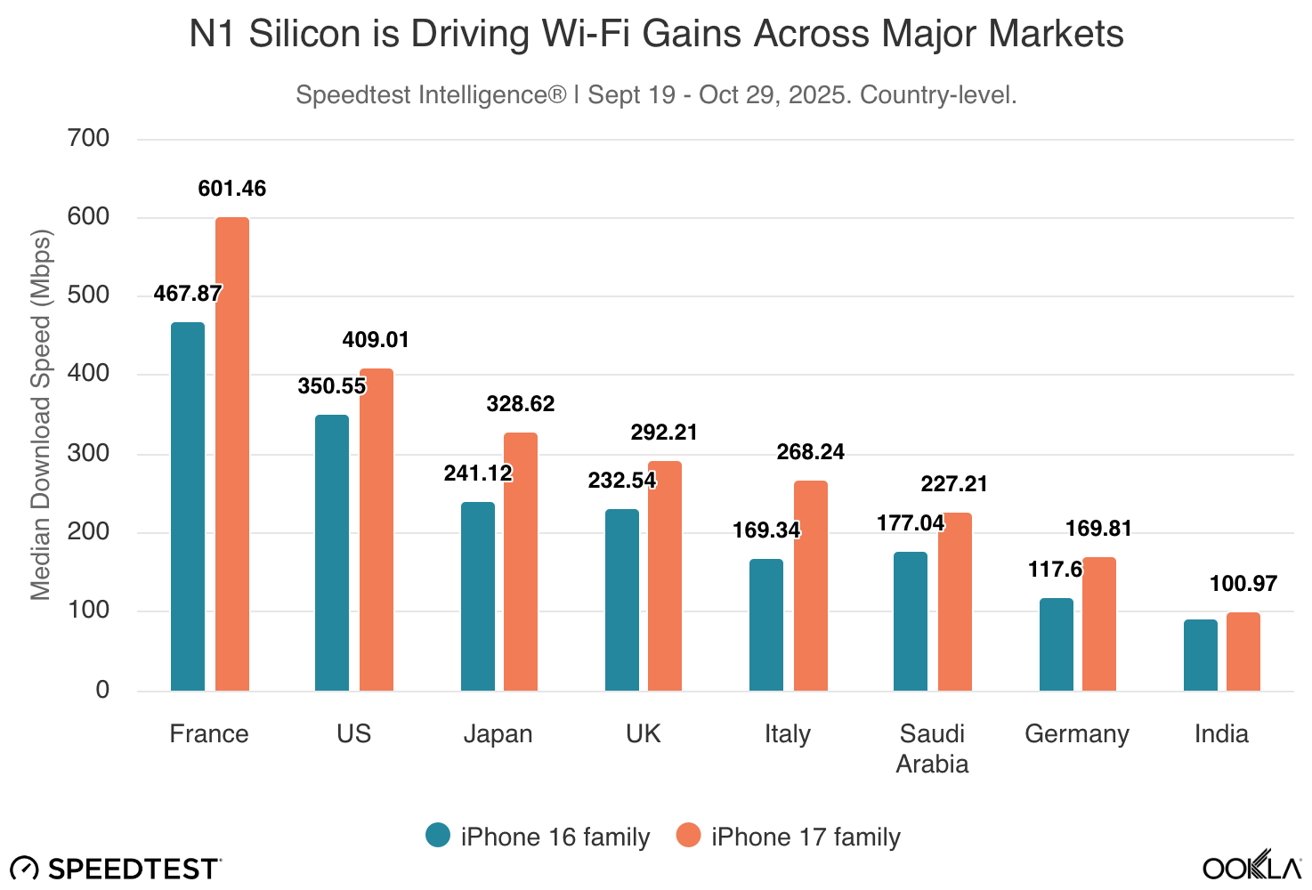
The N1 chip delivers top Wi-Fi results. Image credit: Ookla
These conditions allow the iPhone 17 family to express more of the N1 chip's capabilities.
Lack of 320 MHz channel support on the N1 looks like a disadvantage when viewed in isolation. That feature sits at the center of many Android marketing claims because it unlocks high peak link speeds on Wi-Fi 7 routers.
Impact remains limited today because the installed base of 320 MHz routers is still small. Ookla notes that any disadvantage is rarely visible outside controlled environments.
Apple iPhone 17 models posted the highest median and 90th percentile download speeds of any device in North America. That result suggests Apple's wireless architecture aims to raise performance in typical environments.
Interference from nearby networks, variable access point placement, and inconsistent spectrum conditions all play into that advantage.
Understanding the performance gap
The N1 brings a shift in how Apple approaches wireless design, but the company's explanations remain limited. Apple describes the improvements as gains from tighter hardware and software integration.
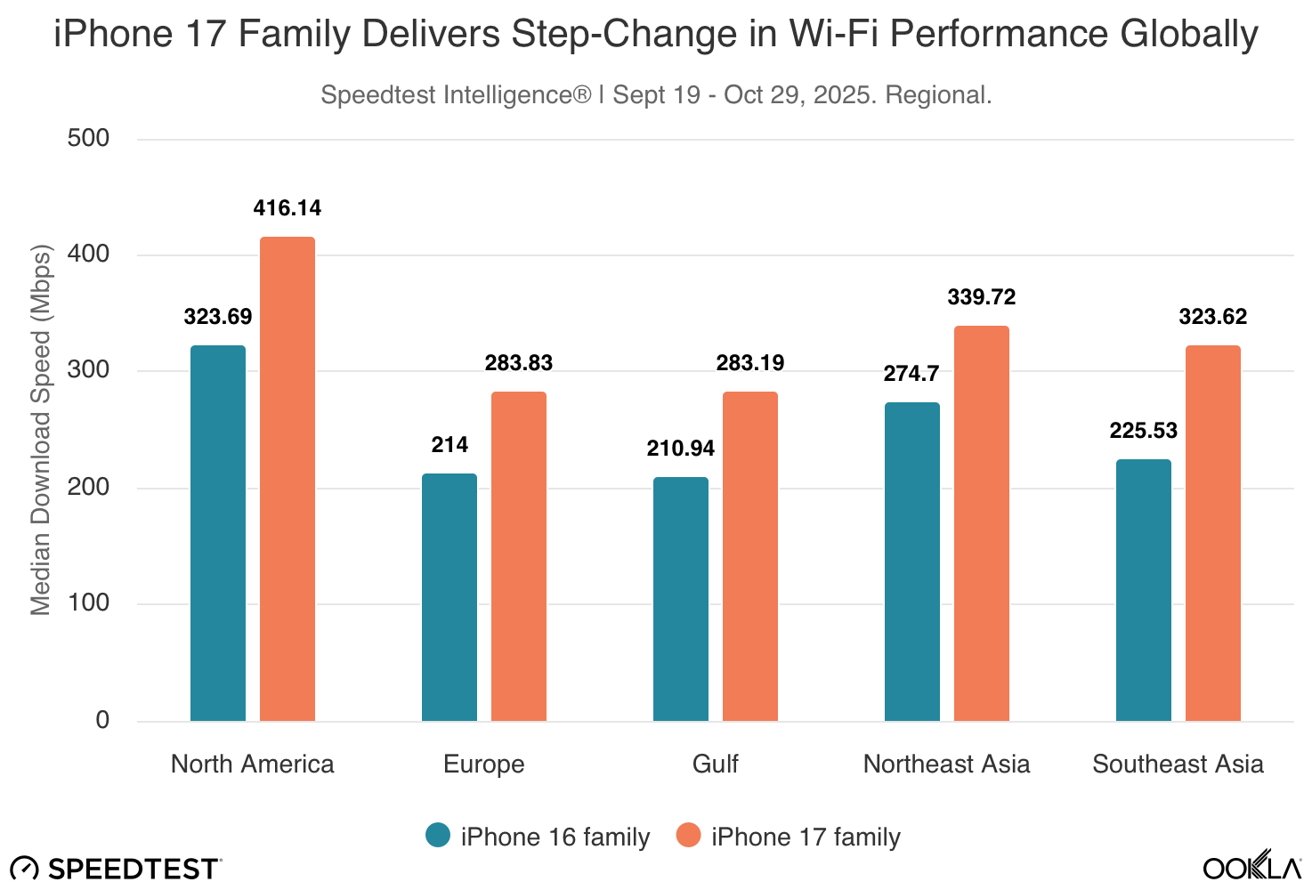
Wi-Fi results around the world. Image credit: Ookla
Exact details of that integration remain undefined. Factors such as antenna tuning, coexistence handling, radio front-end design, and iOS scheduling likely play a role in the consistency gains.
Lack of detailed disclosure makes direct comparisons with Qualcomm and MediaTek more difficult.
Absence of 320 MHz support will matter more as the ecosystem matures. Once 320 MHz routers become common, devices with Qualcomm's high-end silicon will gain higher peak throughput.
Apple's advantage today comes from the small footprint of 320 MHz networks and the stronger influence of mid-percentile performance in most home environments.
The report also suggests that Apple is expanding its long-term silicon strategy. The N-series radio platform is designed to scale across product categories such as Mac, iPad, Apple Vision Pro, and HomePod hardware.
Apple appears to be moving toward full ownership of the wireless stack in the same way the company pursued custom CPU and GPU designs. Regional fragmentation adds another layer to the performance gap.
Europe and Northeast Asia lag behind North America because of slower regulatory approval for 6 GHz channels and longer certification cycles for Wi-Fi 7 routers. The Gulf region sees even lower 6 GHz adoption.
These gaps influence the competitive balance and explain why some Android advantages appear more clearly in global comparisons than in the North American data.
Consumers should view these results as an indicator of stability rather than a race for peak numbers. Real-world performance depends heavily on the quality of the local router and the surrounding network environment.
Upgrading to a modern Wi-Fi 6E or Wi-Fi 7 router will offer the most noticeable improvements for iPhone and Android users.