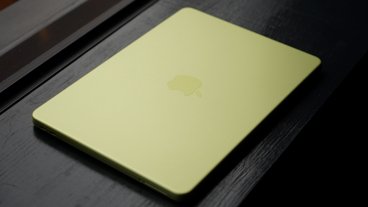
Apple's expected less-expensive MacBook is one of the company's worst-kept secrets, but if it's priced right, it could become a huge hit — just as certain previous MacBooks did.
This anticipated new MacBook is expected to be significant because it will use an iPhone processor instead of the Mac's now usual M-series ones. It is that lower-cost processor that means Apple may be able to compete with Chromebooks.
That's key now, and it was important when Apple would release a MacBook range in 2015. But back in 2006 with the follow up to the iBook, the MacBook, the budget-priced and low specification Chromebook was five years away.
Apple was still doing well in education, too, and with the consumer market. But Apple was also transitioning to a new processor family with the Intel Core Duo.
So for a brief time in 2006, the iBook G4 was still being sold while its successor, the MacBook, had been launched. Also at that point, Apple was around three months into selling the MacBook Pro, which had replaced the last PowerBook.
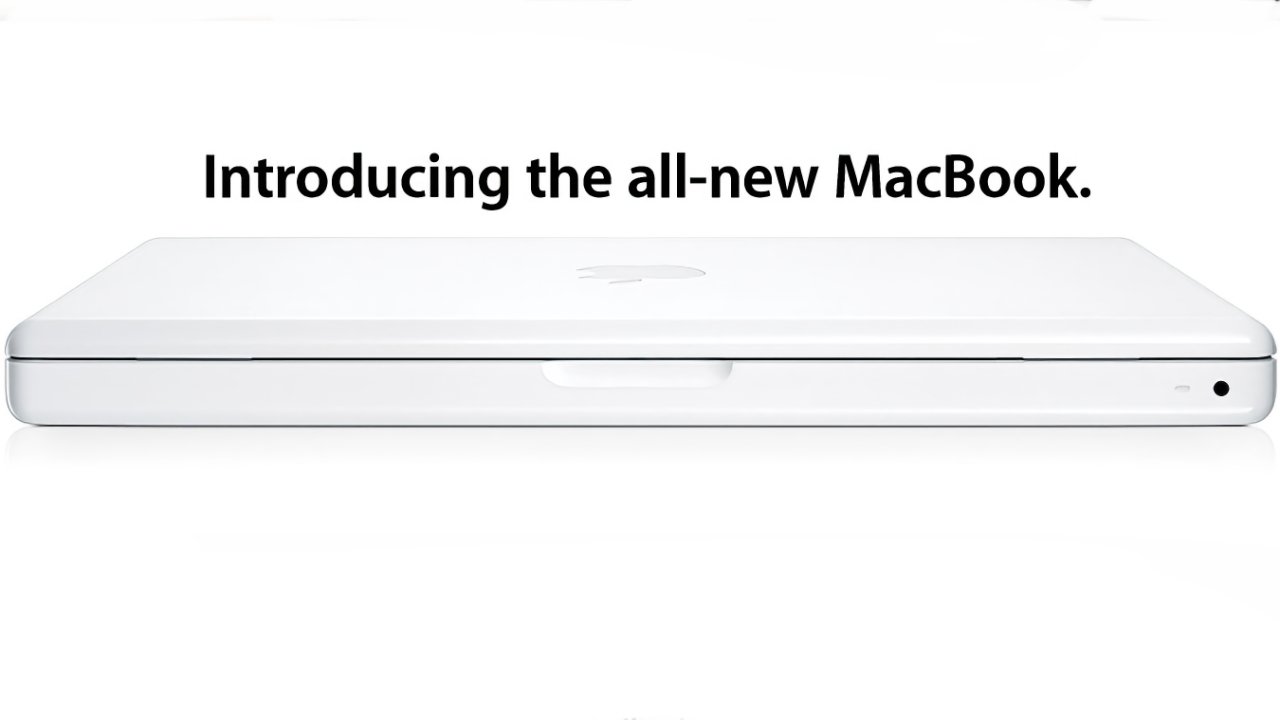
"Apple began the transition to Intel Core Duo-based notebooks in February with the 15-inch MacBook Pro, and now just 90 days later we have completed the transition with the release of the all new MacBook," Phil Schiller, Apple's senior vice president of Worldwide Product Marketing, said at the time. "The complete MacBook lineup leads the industry with Apple's trademark innovative design and advanced mobile features — from top to bottom it is the best notebook line that we have ever offered."
In retrospect, it seems that the more powerful MacBook Pro line was Apple's real focus that year. For its launch in January 2006, Steve Jobs talked about how the previous PowerPC processor family was not able to give the performance Apple wanted to provide its pro customers — and could get with Intel.
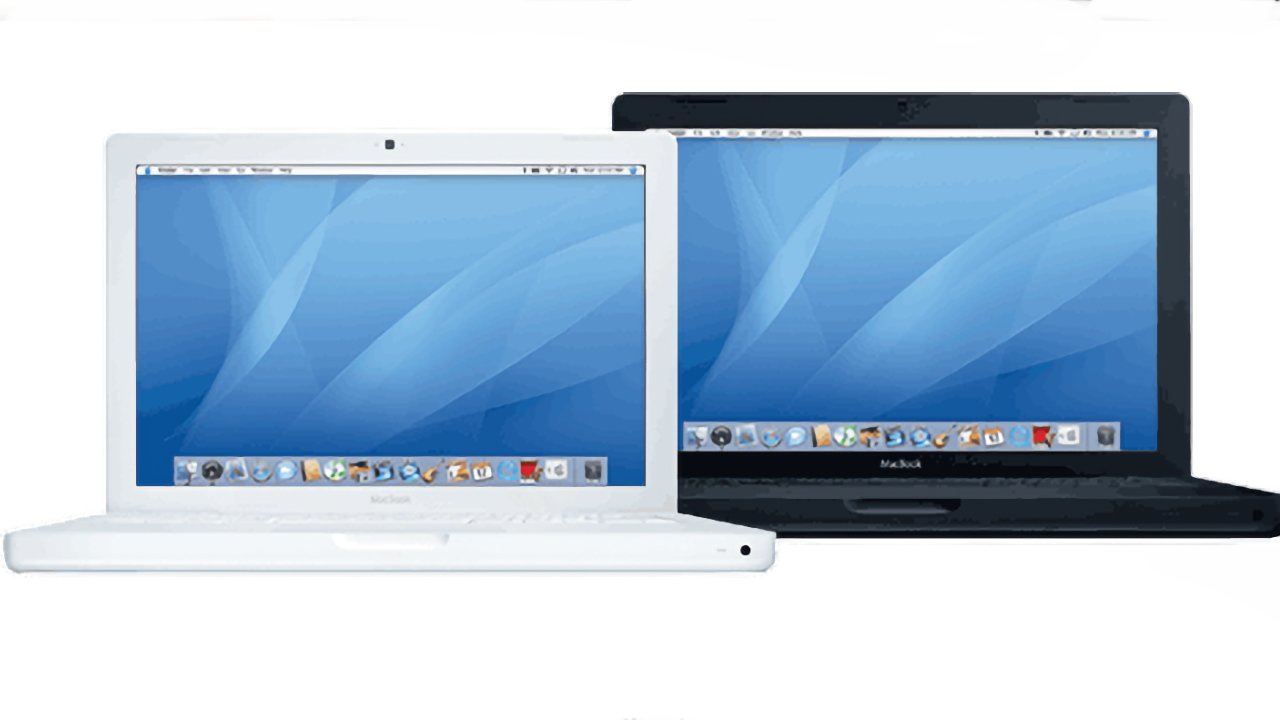
The original two models of the MacBook — image credit: Apple
But Apple was moving everything over to Intel at that time, and it was also shedding the old names of both PowerBook and iBook. Steve Jobs expressly said that "We're kinda done with 'Power'."
He also said that "we want 'Mac' in the name of our products." While he didn't mention the iBook, and the launch of the MacBook was done by press release, the new machine was going to have to be called a Mac.
What was gained and lost
Apple's press release naturally concentrated on the benefits of the MacBook over the iBook, and there were many. The company claimed that the new MacBook was "up to five times faster than the iBook and up to four times faster than the 12-inch PowerBook."
The new model also:
- was 20% thinner than the iBook
- had a 79% brighter display
- had a 13-inch 1280x800 glossy display
- started with a 60GB hard drive
- Included Mini-DVI output
Those last points compared to the iBook's mini-VGA port, and 40GB hard drive for the entry-level $1,099 model ($1,774 in 2026 money). The last iBook started at $999 ($1,612).
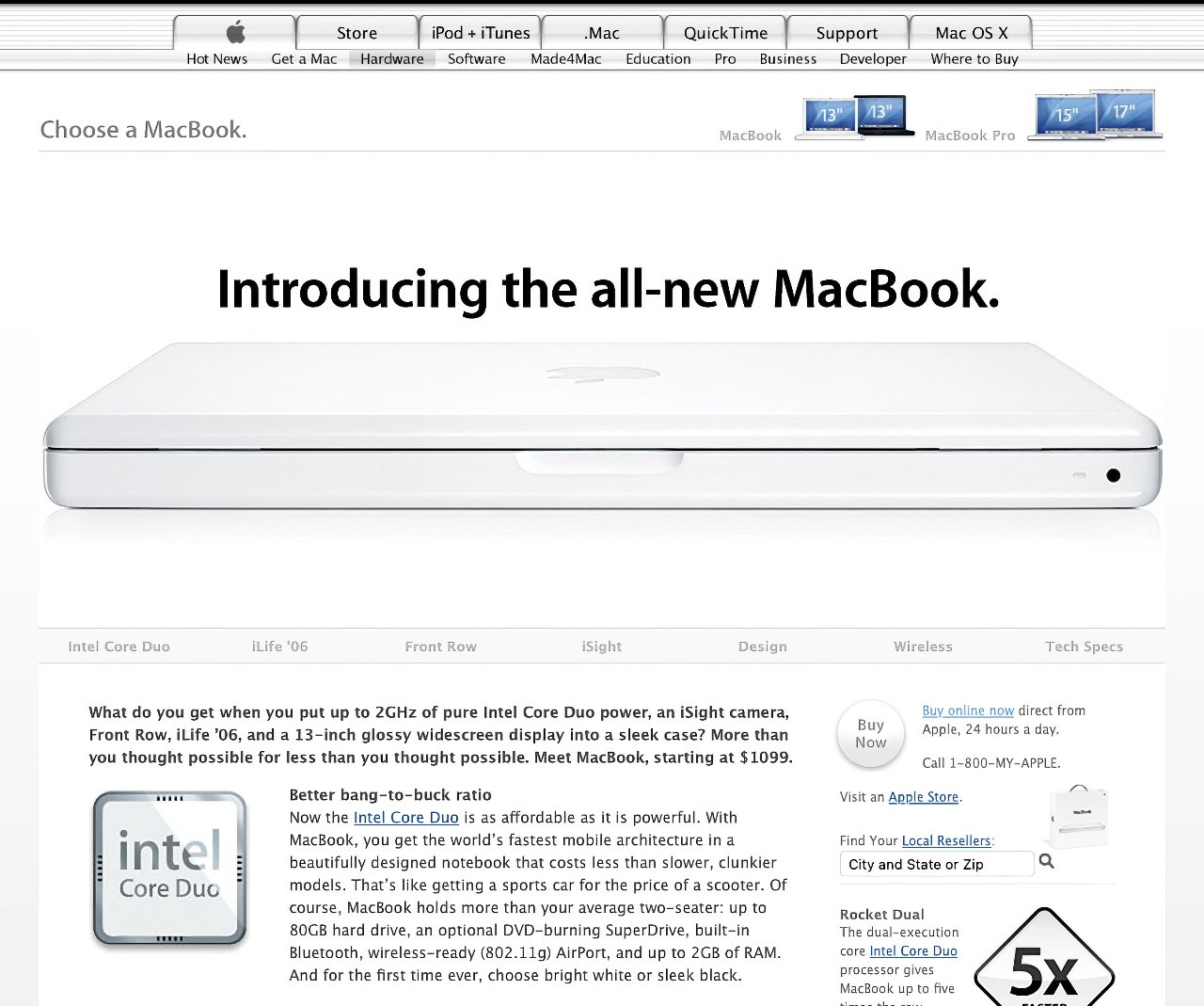
How Apple presented the original MacBook on its site in 2006 — image credit: Apple
But then that starting level iBook had a 12.1-inch screen, and a higher cost $1,299 ($2095 in 2026 money) model had a 14.1-inch one, so the new MacBook's display came in the middle. You gained if you used to use the lower-cost iBook, but you lost out moving from the higher-price one.
At the time, users were in a similar situation to when Apple Silicon was introduced. Apple could talk up how much faster everything was, but until you used an M1 Mac or later, you couldn't appreciate the difference.
It's not as if Apple lies about specifications, when it even mentions them, but it does cherry-pick its results like every other manufacturer. In this case, Apple used SPECint and SPECfp rate tests when buyers wanted to know more real-world results.
They got them, too. Ars Technica ran through a slew of tests comparing the new MacBook to the old iBook.
Some of those tests, such as the Cinebench benchmark, were actually in Apple's favor — and dramatically so.
"The slightly faster processor on the MacBook results in the software lighting numbers to win here, but the MacBook Pro's graphics hardware is clearly superior, and the hardware rendering numbers bear that out," wrote the publication. "A comparison with the iBook's ATI Mobility Radeon 9200 is embarrassing, to say the least."
But then other improvements that users were likely to see were less marked. In ripping a CD, "the iBook was only slower by four seconds."
So in 2006, users were having to weigh up whether spending more was actually worth it for what they would be doing.
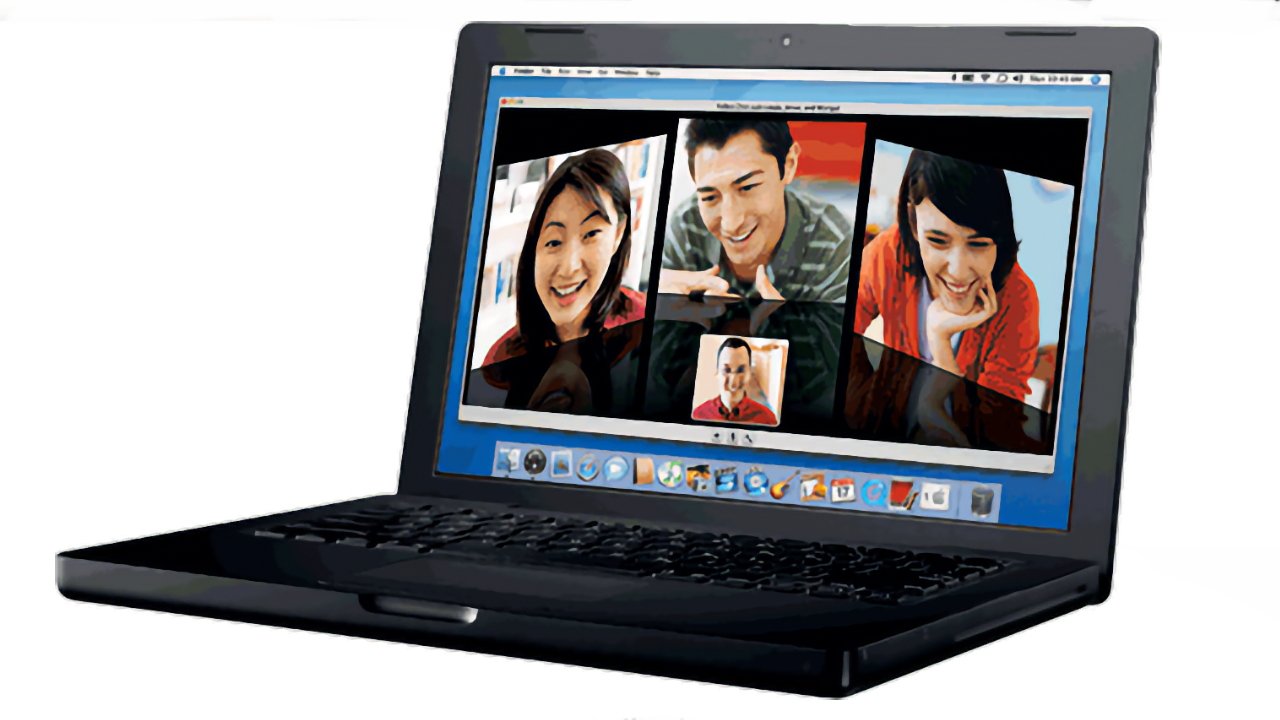
Today it looks a little chunky, but the black MacBook is still gorgeous — image credit: Apple
And as it happens, they also had to work out whether spending a lot more money was worth it for what the MacBook looked like. Two base models were all-white, but there was also an extremely attractive all-black model — that started at $1,499 ($2,418 in 2026 money).
AppleInsider listed the full specifications of all of these the models, but you needed a magnifying glass to spot what the black model offers that was different. Apart from the color, the sole specification difference was that it came with an 80GB hard drive instead of a 60GB one.
You wanted a black one. You still wish today's MacBook Pro models could come in such a rich, dark black. But back then, you had to decide whether that color and that slightly larger drive was worth an extra $400 (now $645) to you.
Consumer and pro choices
Users then were also having to ponder whether their existing apps would run under the new Intel processor.
That concern affected all users during this transition, both from iBook to MacBook, and PowerBook to MacBook Pro. But without a MacBook Air to bridge the gap, users were more clearly delineated between consumer and professionals.
It's not just price/performance that separates casual or consumer users from heavy-duty work. That original MacBook Pro started at $1,999 (now $3,225), but it was also a much more professional-looking device.
Up to then, the iBook had been nothing short of cute. It had long lost its bright colors, bulbous shape, and carrying handle, but it was still rather more friendly than the solid white or striking black of the MacBook.
Apple would later come to differentiate consumer and professional devices by the use of color, or the lack of it. But for these original MacBooks, it eschewed any color but white or black.
That remained the case (pun intended) from 2006 to 2008. After that, despite its arguably better look but certainly higher price, there was no more black MacBook.
But then in 2011, even the white MacBook was discontinued. Its demise had been widely predicted, because of one thing.
The MacBook Air.
Today the MacBook Air is clearly going to sit between the existing MacBook Pro at the high end, and the expected new lower-cost MacBook.
But in 2008, Steve Jobs wowed people with his stunt of pulling the MacBook Air out of an inter-office envelope. And Apple even advertised it as "the next generation of MacBooks."
It was slim, it was sleek, it appeared to be amazing — although initial reviews would dampen that perception. But if nothing else, the MacBook Air destroyed the MacBook because of its price.
In 2011, the MacBook started at $999. But so did the new MacBook Air. Consequently, it was all over for the MacBook — for the moment.
Rebirth of the MacBook
So the MacBook had come out in 2006 as Apple's way of attracting consumers. In 2026, it's believed that a MacBook will do the same.
But in 2015, exactly the same thing happened with another new MacBook. It was low-cost compared to the rest of the range, it was comparatively low-powered too, but it was a MacBook.
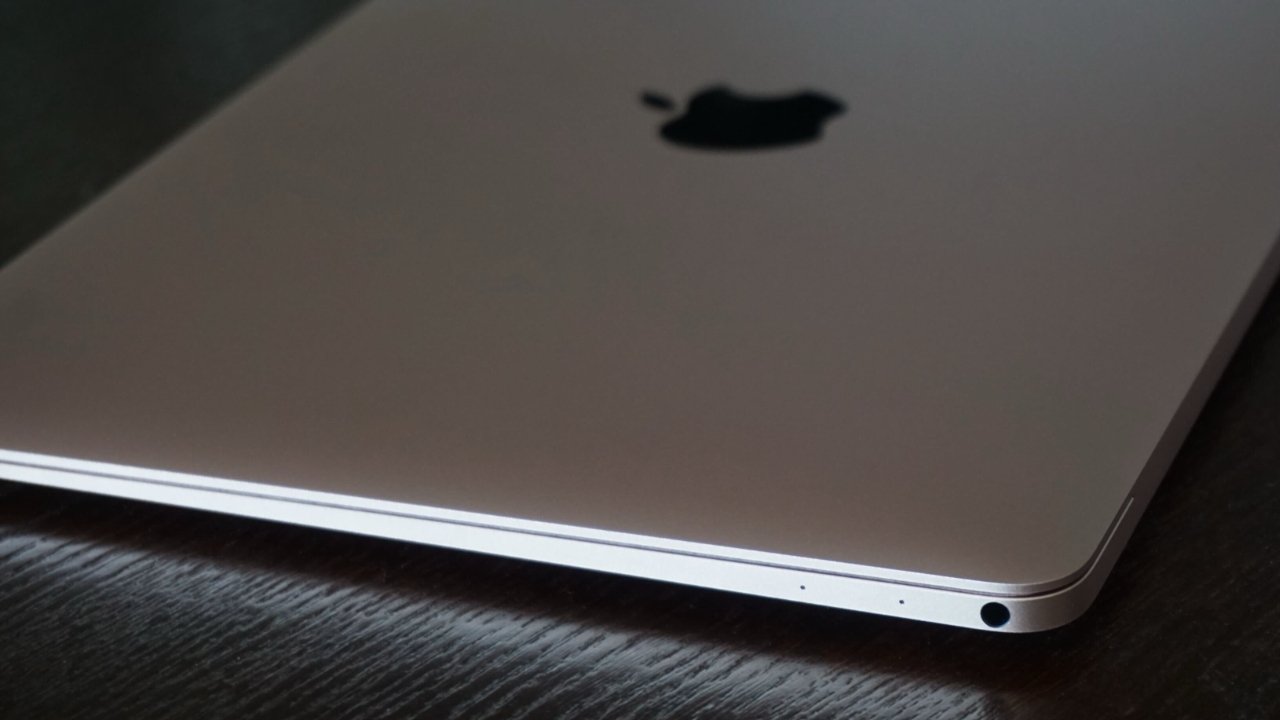
The 2015 MacBook
Then in a parallel that presumably Apple hopes will not be repeated, this 2015 range would be discontinued even faster than the 2006 one had been.
But between its revival in 2015 and its demise in 2019, the new MacBook was gorgeous — if flawed. By the time it was dropped, it had even got a nickname to distinguish it from all the other MacBooks: it was sometimes known as the MacBook Adorable.
It was a 12-inch MacBook, it came with a Retina display, and it came with a USB-C port. It was also wedge-shaped, which both made it look even slimmer than the 13.1mm it was, and it also made for a good typing angle.
At launch, this MacBook started at $1,299 (now $1,783). It also came with a butterfly keyboard, which may have hastened its departure from the range.
For while AppleInsider research showed that there weren't significantly more repairs needed for that keyboard, there were enough to be noticed. There were enough that the butterfly keyboard became something you'd avoid if you could.
Not that you could avoid it as Apple put it on every notebook, but then it did also slowly take it off every model too.
But back in 2015, with the new MacBook starting at $1,299, there was an 11-inch MacBook Air from $899 ($1,234), and a 13-inch model from $999 ($1,370).
So at this point, the MacBook actually sat between the MacBook Air and the MacBook Pro. Where it sat in terms of performance or value for money, though, is harder to establish.
For the MacBook was thinner than the MacBook Air. Then not only did it therefore look sleeker and just better than the MacBook Air, it also had a better display.
The 2015 MacBook had a 12-inch Retina display. Surprisingly, the then-current MacBook Air did not. But then the cheaper MacBook Air had a better webcam — 720p instead of the MacBook's 480p.
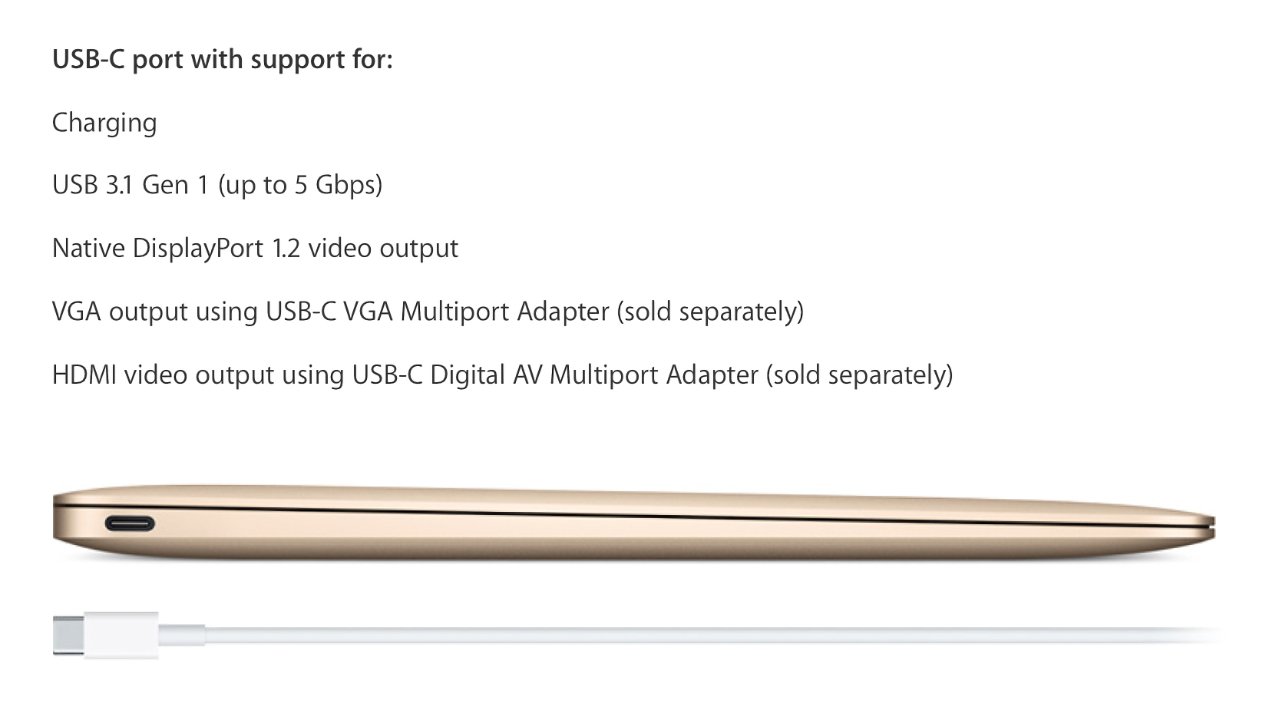
In 2015, Apple tried to make the one port on the MacBook look impressive — image credit: Apple
Plus both sizes of the cheaper MacBook Air had two USB 3 ports, a Thunderbolt 2 port, and a MagSafe 2 power port. The 13-inch MacBook Air also had an SDXCC card slot.
In comparison, the solitary 12-inch size of MacBook came with a USB-C slot. That was it, nothing else, but it was also a huge deal because this was the first Mac with USB-C.
Ports and screen quality can be things you only realise you need or want after you've been without them. So long-term Mac users may have known to avoid the new MacBook.
It's not clear why new Mac users wouldn't see the price difference and be swayed toward the MacBook Air because of it. But then, perhaps they were because whether it was low sales or that butterfly keyboard, Apple discontinued the MacBook in 2019.
By then, Apple had updated the MacBook Air and that 2018 model had a Retina display. This surely killed off the MacBook's place in the range.
Plus that MacBook Air came in gold as well as the more normal silver or space gray. So the MacBook Air had even taken on the mantle of being the only Apple laptop to come in less austere colors.
Color coded
Even now, whether it's an iPad or an iPhone, colors used to mean a device was for consumers.
That has changed, with the iPhone 17 Pro Max's garish orange reportedly contributing to making it a hit.
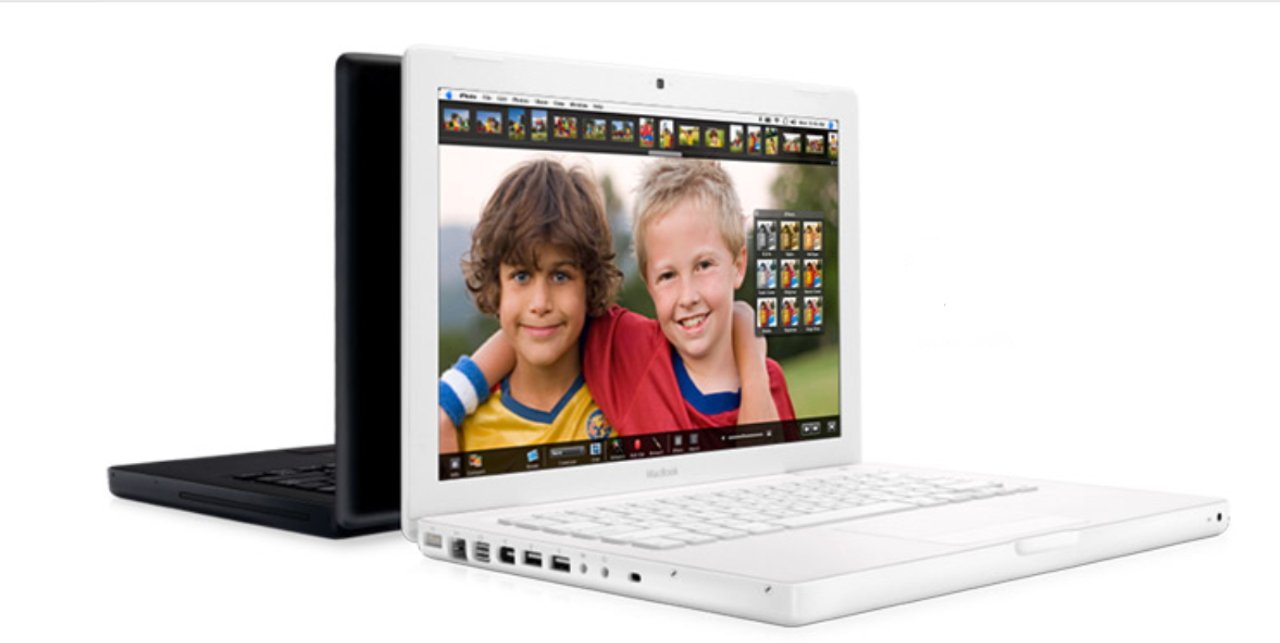
Apple upped the speed for the MacBook in 2007 — image credit: Apple
Now as the long-rumored lower-cost MacBook is said to be drawing near, we're back to similar issues. A selling point should be its colors, for instance.
There could also be a question over its processor. Buyers drawn to it by price are unlikely to be concerned that it has an iPhone processor instead of a Mac one, but long-standing users will wonder.
Then, too, even people entirely new to the Mac may well remember Windows RT. That was Microsoft's ARM-specific version of Windows, which run on the original Surface — but didn't run all Windows apps.
That was back in 2012, but it was a big deal.
Doubtlessly, Apple learned from that and surely the new MacBook running on an iPhone processor will be every bit a Mac.
Though that then just adds fuel to the argument that Apple must be able to put macOS on the iPad too.