Maybe Grammarly's CEO should have stolen other styles to defend the rip-off of big-name writers' voices, because his own explanations didn't make any sense, and completely failed to defend the indefensible.
Recently, I wrote about how Superhuman, the company that owns Grammarly, killed off an unethical feature in its popular grammar checking tool. The feature, known as "expert review," not only taught people how to rip off well-known writers, both alive and dead, but also made it seem like the writers were involved in the process.
The saga is far from over, now, because Grammarly is facing a class action lawsuit, spearheaded by investigative journalist Julia Angwin. Angwin notes that even though the company disabled the feature, it doesn't make up for the eight months it was in operation.
Or the fact that the Grammarly CEO is going to try it again, maybe with the serial numbers filed off.
Suffice it to say, Superhuman and Grammarly have been at the top of human-led journalism's shit list for the past couple of weeks.
And hey, as a human journalist, I concur. But you already knew that.
So, in what must have been a moment of temporary insanity, Shishir Mehrotra, the CEO of Superhuman, decided to go on The Verge's Decoder podcast. I'm not entirely sure what possessed him to do this, but he did, and if nothing else, it allowed us another grim peek behind the mask.

I don't know about you, dear reader, but I'm getting a little tired of all this mask-peeking. That being said, I highly suggest you either watch the interview or read the transcript.
The Grammarly show: All Grammarly, all the time
The interview is led by Nilay Patel, Verge's Editor-in-Chief of twelve years, who has also been ripped off by Grammarly. Patel starts the interview by expressing surprise that Mehrotra agreed to take part in the interview, but then eases into asking what Grammarly's overall goal is.
Mehrotra says that the goal is to make Grammarly work in pretty much any situation.
"The way to think about Grammarly is it's your assistant that lives everywhere," he says. It's a keyboard on your phone, it's an app on your computer, it's an extension for Safari, it's a website you can visit whenever you need to.
Need to write something in the work Slack? Grammarly can help. If you're struggling with drafting an email, Grammarly can help you figure it out.
Effectively, Superhuman wants you to have the option to use Grammarly in any situation where you need to type more than six words in a row. Don't ever worry about coming up with a sentence that isn't completely polished, Grammarly will take the wheel.
Don't worry, writers, you can just look out the window. We'll be at the farm soon enough.
I've never been called an "idea generator" before
Patel lets Mehrotra explain his grand vision before he finally delves into the entire reason for the interview. I applaud Patel for his ability not to go completely berzerk right out of the gate.
In fact, I applaud his ability to conduct himself with any sort of decorum — I would have resorted to yelling within sixty seconds. If you wonder why I don't make appearances on the AppleInsider podcast, I hope you'll realize this is why.
Patel starts by pointing out that, at no point in the development or the eight months while expert review was active, did Grammarly approach any of the writers it synthesized, even after getting busted by the same.
"Tell me about the decision to launch this feature with names you didn't have permission for and the decision to unlaunch the feature," he says.
And, as expected, Mehrotra leads with a non-answer that is extremely patronizing.
"I'd say I understand and respect how challenging a world it is for experts and idea generators these days," he responds. "I've made a long career out of being a partner to folks like you, to folks like the ones you've mentioned."
It was at this point that I paused the video and began rubbing my face in frustration. I took two ibuprofen, poured my third cup of coffee for the day, and dove back in.
"My view of it is that the feature was not a good feature. It wasn't good for experts, it wasn't good for users," he admits. "It was a fairly buried feature. It had very little usage. You mentioned it last week and talked about it. It took months for anybody to even sort of find it."
Well, at least we sort of agree on part of it. It wasn't a good feature, and it wasn't good for users or the people it ripped off.
He goes on to say that the intention was never to harm the experts, that the company fell short, and that he personally feels bad for what happened. Don't worry, everyone, Grammarly hears you, and they'll do better.
And then, in less than two minutes, turns around and says that they want to replace every person with a chatbot that they could sell back to companies on a subscription basis.
Specifically, he notes that people think of Grammarly like their "grammar teacher." And then he goes on to say, and this is a direct quote, dear reader:
"What would it feel like if instead of your grammar teacher, it was all the rest of the people in my life [that] could be with me as well? I want my head of sales to sit next to me and tell me I'm about to recommend the wrong product."
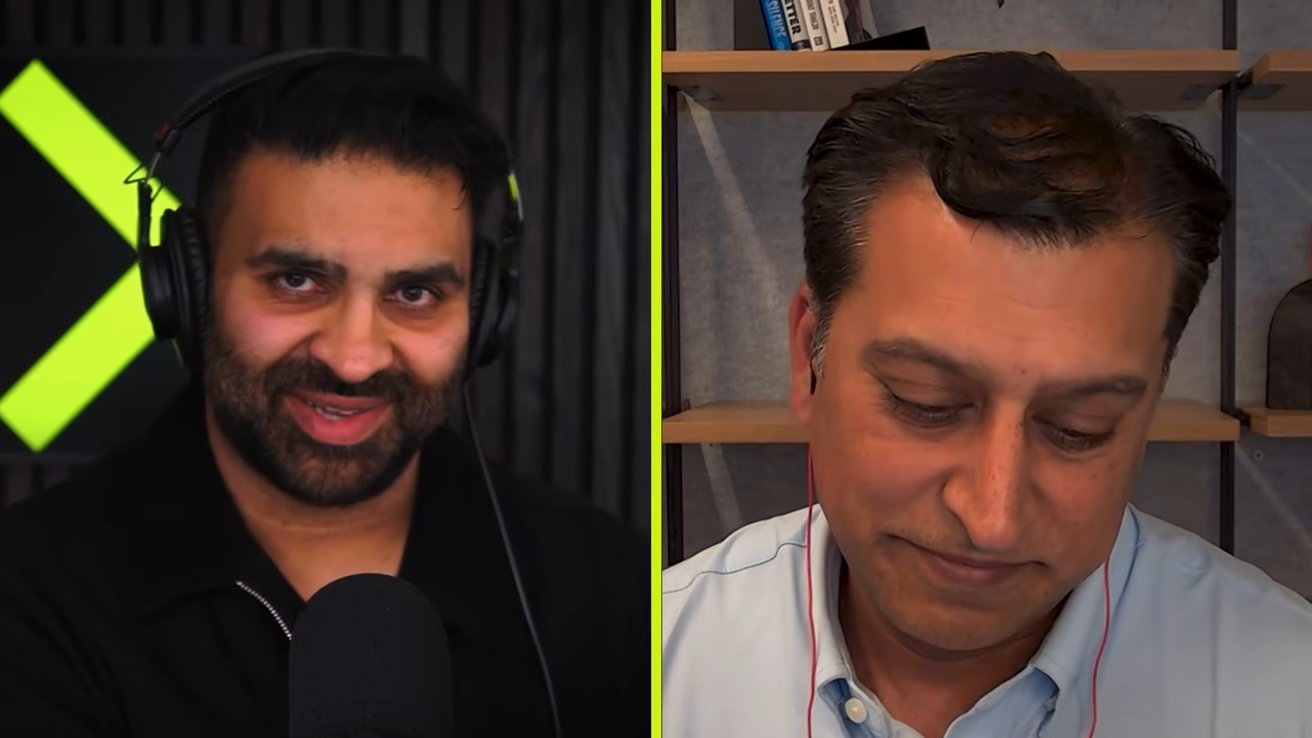
The face of a man who just got told he'd be worth more as "an agent" | Image credit: The Verge
"I want my support person to sit next to me and say I'm about to email this person and you should know they had a big support issue last week and you should acknowledge that before you talk to them."
Oh, is that all? You just want to eliminate the human entirely?
Well, I'm glad it's nothing serious.
I'm not going to transcribe the entire interview, The Verge has already done that, and as I said before, I really hope you go watch or read it. I will, however, show how this is indicative of a much larger problem.
The fact that he basically looks Patel in the face and tells him he'd be worth more as a chatbot is insane.
Zero respect for the human
Superhuman is a great example of the stark turn capitalism has made in the last several years. I remember watching a video by Sky Fisher in 2025 where she mentioned hearing a woman say that corporations act like they're mad that they have to go through you to get your money.
It stuck with me.
But it actually goes much further than that. They're not just mad that they have to go through you to get your money.
Those same corporations are mad that they need to give up any of that money to workers in the first place. Mehrotra's vision of the future isn't about helping the average person who might want to compose an email to their boss asking for a raise.
He doesn't have any grand plans on helping ninth graders turn in a four-page paper on Wuthering Heights.
He doesn't even want to help the writer, whom he allegedly claims he wants to help. This surely existent person who told him that they just wanted a way to connect with readers after they put down the book.
Superhuman's ultimate goal isn't to help the average person. Its ultimate goal is to sell subscriptions to other businesses under the guise that those businesses will be able to cut jobs and reliance on those pesky humans.
Humans get sick, make mistakes, and require time off. They'll always need money because they have rent, mortgages, or children.

Every dollar an employer doesn't have to give you, it can give to another, bigger tech company | Image credit: Chronomarchie on Pixabay
So not only do you have to balance their need for accommodations, be it eight hours of sleep and roughly 2,000 calories a day, you need to provide them with the means to acquire the bed and the bread.
Wouldn't it be so much more convenient if you could design a system that doesn't rely on something so unreliable? And do it by harvesting their previous work to make a digital clone of them to do that work.
When Patel repeatedly asks Mehrotra how much money he should be compensated for using his name and likeness, Mehrotra dodges the question again and again. And he reasserts that the company never meant to hurt anyone, its intentions were good, and actually it attributed everything properly, even if the product was bad and useless.
And then immediately goes on to say that the company was, in fact, trying to create a product where the end user would feel as though they were getting feedback from "[their] idol."
I need you to understand that this is not unique to Superhuman. This is the goal of AI at large.
Business-to-business software-as-a-service, known as B2B SaaS, is the new economy. And artificial intelligence tools are the product.
It's nascent, yes. But that isn't stopping every major tech company from shoveling buckets of capital into the AI furnace, growing pains be damned.
And, unfortunately for most of us, the human doesn't really fit into the equation. Yes, there are, ostensibly, humans involved in the process.
I mean, at least until Claude proves that it can be trusted with a credit card, I suppose.
But ultimately, you aren't the customer they want, nor the tool that they require. You are, effectively, an obstacle.

If we just quit paying people and only take their money, profit is infinite | Image Credit: Special Meme Fresh on Facebook
I'm not really sure what the goal is. As far as I can tell, it's to create five-person mega companies that all sell each other B2B SaaS products and pass around the same several trillion dollars to each other, while siphoning money from the people that they stole from to make the products in the first place.
But where do we go after that?
All watched over by machines, loving grace need not apply
In 2017, I took a digital humanities course with a professor who was, to put it kindly, a huge dork of the cyberpunk variety. In that class, I read Neuromancer and Do Androids Dream of Electric Sheep?, watched "The Matrix" and "Akira," and read a surprising amount of poetry, which fortunately I was into.
One poem we read was "All Watched Over by Machines of Loving Grace" by Richard Brautigan. It's an interesting poem that asserts life will be much better once technology steps in and frees humans from their labors.
While many of my classmates thought it was utopian in nature, I maintained that it felt ironic. Something about it felt a little too tongue-in-cheek.
As it turns out, no one is entirely sure whether or not the poem was supposed to be utopian or a critique of where the author thought the world was headed. Either way, in 2026, I suspect we're not barreling towards the described utopian technofuture.
Brautigan's been dead since 1984, which is a shame because I'd love to get his take on the machines we wound up with. I suspect that he wouldn't be too surprised.
Watching Superhuman and Grammarly get raked over the coals for truly abhorrent practices should be satisfying on some level. But it isn't, it's just a grim reminder that the emerging market sees me — and every other person — as an annoyance at best, and a liability at worst.