With the advent new forms of digital media and the various media devices that have cropped up alongside, Apple several years ago began to explore a concept it calls a "multi-media center" that would effectively combine and control many of those emerging media components from a central interface.
The "multi-media center" itself could be designed in the form of a complex computer program, such as Apple's Front Row software, that would reside on one or more personal computers. The central-user-interface would then be capable of graphically representing each media-component as a selectable item in a main menu, with user input coming by way of a keyboard, mouse, wireless remote, or similarly capable device like the iPhone.
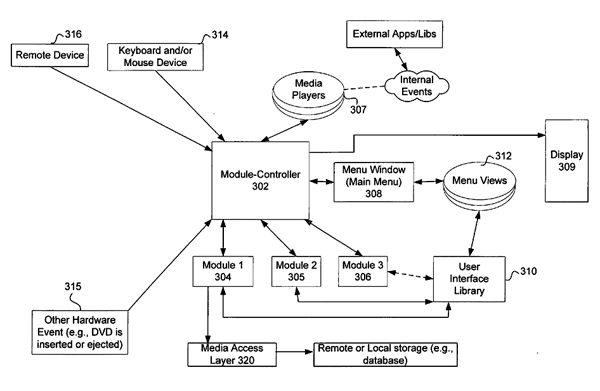
The simplistic plug-and-play aspect of the media center would hinge heavily on a modular architecture that includes at least one software-based media-module for each of the media-components configured for the system. "A media-module can include or obtain data pertaining to a particular media-component (e.g., user interface menus, lists of digital data in the media-component)," Apple engineer Thomas Madden wrote in the filing. "In addition, a media-module can also identify media-player(s) and access information related to their media (e.g., music or movie lists)."
However, the filing notes that media-modules wold not directly control output. Instead, a module-controller communicates with various media-modules and effectively controls output generated in response to user input. "The module-controller can forward the input to various media-modules for processing and receive output from them," Madden explained. "Subsequently, the module-controller can use the output generated by the media-modules to perform the appropriate response (e.g., manipulate display of menus or presentation of media)."
In other words, the media-modules do not directly control the output of the multi-media center even though they may process the input and effectively generate the appropriate response. "Furthermore, media-modules can be isolated from each other," the filing states. "As a result, the media-modules cannot communicate with each other, but can be added or removed dynamically as they do not affect each other or a main (base) program that effectively runs the multi-media center."
In one embodiment of Madden's invention, each media-module would include or could obtain information needed to construct menus for its associated media-component. "It should be noted that media-modules can construct their menus (or submenus) by using an User Interface Library (or library)," he wrote. "More particularly, media-modules can obtain a template or other tools (e.g., metric utilities, windows, views, widgets, sounds) from the User Interface Library (or library). As such, each media-module may select a user interface template (e.g., menus, window) from the User Interface Library (or library) and subsequently fill (or populate it) with the appropriate information (e.g., menu items)."
Additionally, media-modules would be able to identify media-players that can be used to present their media, and access information related to their media, such as a music or movie list. The module-controller would initiate the media-player associated with a media-component and subsequently forward any input associated with presentation of media directly to the media-player for processing. "As a result, the familiar look and feel of media-players can be preserved," Madden said.