
The European Commission asked for comments on the Digital Markets Act and got plenty from Apple, but the knee-jerk response to Apple's filing by the EU shows this isn't going to have a good end for consumers.
If Apple thought it had any chance of getting the Digital Markets Act (DMA) repealed or just improved, the European Commission has just told it where to go. Somewhat pre-judging how the EC is supposed to consider all comments and report a conclusion in May 2026, it's instead immediately come out swinging.
"Apple has simply contested every little bit of the DMA [Digital Markets Act] since its entry into application," said Commission spokesperson Thomas Regnier in a statement seen by Politico. "This undermines the company's narrative of wanting to be fully cooperative with the Commission."
Regnier seems to assume that cooperation means doing what the EU says without question. Even so, he does say that he is "not surprised" at how Apple has responded to the European Commission's review of the DMA.
"Results of this positive engagement? After two months, Apple came back and asked us to scrap everything," he continued. "We of course fully get companies want to defend their profits at all costs, but that's not what the DMA is about."
That's part of the problem, though. The DMA may be about something, it may be about competition on paper. The actual execution is everything but that.
Two sides to the story
Significantly, Regnier also says that Apple has refused the European Commission's attempts to have positive talks about complying with the DMA. That is the exact opposite of Apple's claim that its proposals have been ignored.
Apple has even said that the EC told it not to implement one proposal that would have resolved a non-compliance issue — and then fined it for non-compliance. There's no way to prove that's what happened then, but the European Union's response at the time suggests Apple was right.
The EU said that it fined Apple over "the solution that Apple decided to roll out, not any other hypothetical approach that the company might have been considering."
It's also a matter of public record that Apple did engage with the EU in a June 2025 workshop. In the one segment of video that has been released, Apple's representatives were grumpy to say the least — but they were there.
Now it's the turn of the EU's Regnier to sound like there's a need for couples counseling from the worst, most self-interest mediator. It's up to Brussels, the EU's headquarters, to "decide how we want to enforce the DMA and who is enforcing the DMA," he said.
"And that's not all, there is another ongoing case [against Apple] where, again, all options remain on the table," he essentially threatened.
Only Apple is complaining
The DMA covers six major companies, five of them from the US. Perhaps if Apple weren't the only one complaining, something might be done.
Yet the reason Apple is the only one complaining is because the EU isn't even touching the others. And, the DMA helps other dominant players, like Spotify who is not on the gatekeeper list but is an actual dominant player in the EU, plus Google and Meta who are on the gatekeeper list.
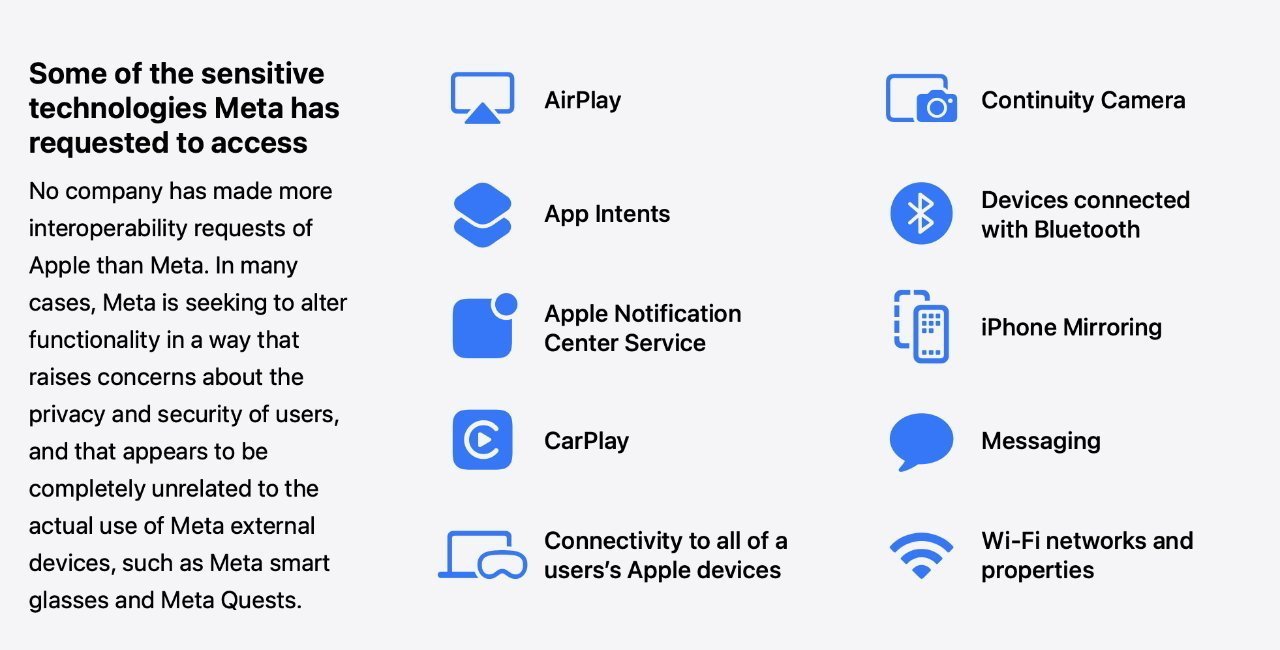
You may be suspicious of why Meta wants all of your private data, but the EU thinks that's fine. — image credit: Apple
Apple alone is being ordered to give its rivals like Meta its customer data, and details on its technology that can be used to circumvent user privacy protections. It's being ordered to do it in ways that irrevocably shatter user privacy and security. Not just in the EU, but for customers, worldwide.
As long as the European Union and European Commission are demanding that user data be handed over to anyone for any purpose in the interest of interoperability, in particular, to other so-called "gatekeeping" companies, Apple is right and the EU is wrong.