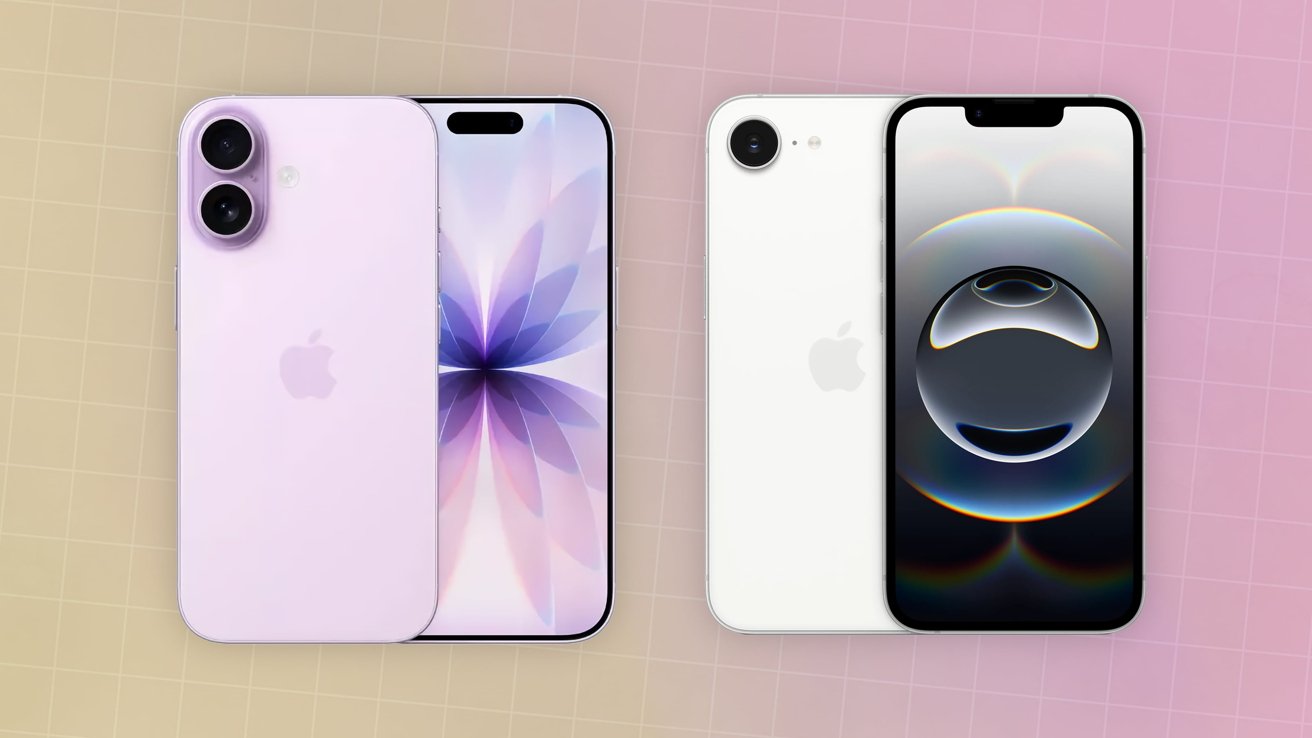
The base model iPhone 17 debuted with improved cameras and Pro-level features like ProMotion. Here's how it compares to Apple's most affordable smartphone, the iPhone 16e.
At its "Awe Dropping" event on September 9, Apple unveiled the new-and-improved iPhone 17. It features a larger 6.3-inch display with ProMotion, a 3nm A19 chip, and a 48MP telephoto camera.
At just $799, the base model iPhone 17 is the lowest-priced device in the iPhone 17 range, but it's not the cheapest iPhone you can get brand new from Apple.
The iPhone 16e remains the most budget-friendly iPhone at the time of writing. Priced at only $599, the 128GB configuration of the iPhone 16e is a whole $200 cheaper than the base spec iPhone 17.
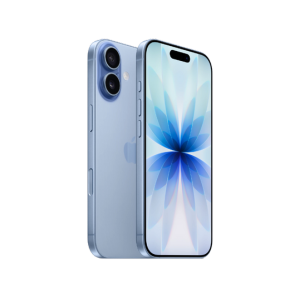
iPhone 17
Apple's marketing would have you believe that the latest and greatest iPhone is practically a necessity, but that's not always the case. Here's how the iPhone 17 and iPhone 16e stack up against each other.
iPhone 17 vs. iPhone 16e: Technical specifications
| Specifications | iPhone 17 | iPhone 16e |
|---|---|---|
| Starting Price (launch) | $799 | $599 |
| Dimensions (inches) | 5.89 x 2.81 x 0.31 | 5.78 x 2.82 x 0.31 |
| Weight (ounces) | 6.24 | 5.88 |
| System-on-chip | A19 5-core GPU |
A18 4-core GPU |
| Display type | 6.3-inch Super Retina XDR, ProMotion, always-on display, 3,000 nits max brightness | 6.1-inch Super Retina XDR, 1,200 nits max brightness |
| Resolution | 2,622 x 1,206 at 460 ppi | 2,532 x 1,170 at 460ppi |
| Biometrics | Face ID | Face ID | Connectivity | 5G (Sub-6GHz and mmWave) Gigabit-class LTE Wi-Fi 7 Bluetooth 6 Ultra Wideband Gen 2 NFC Emergency SOS via Satellite Roadside Assistance via Satellite USB-C |
5G (Sub-6GHz only) Gigabit-class LTE Wi-Fi 6 Bluetooth 5.3 NFC Emergency SOS via Satellite Roadside Assistance via Satellite USB-C (USB 2) |
| Rear Cameras | 48MP Fusion 48MP Ultra Wide Camera Control |
48MP Fusion |
| Video Recording | 4K 60fps 4K 60fps HDR with Dolby Vision 1080p 240fps Slo-Mo Spatial Video Macro Video Sensor-shift optical image stabilization Action Mode Cinematic Mode Dual Capture up to 4K Dolby Vision at 30 fps |
4K 60fps 4K 60fps HDR with Dolby Vision 1080p 240fps Slo-Mo Optical image stabilization |
| Front Camera | 18MP Center Stage with Autofocus | 12MP TrueDepth with Autofocus |
| Battery Life (Video playback time) | Up to 30 hours | Up to 26 hours |
| Wireless charging | MagSafe 25W Qi2 15W Qi 7.5W |
Qi 7.5W |
| Colors | Black White Lavender Mist Blue Sage |
Black White |
iPhone 17 vs. iPhone 16e: Design and dimensions
Relative to the budget-friendly iPhone 16e, Apple's iPhone 17 is easily recognizable as a newer, more expensive model.
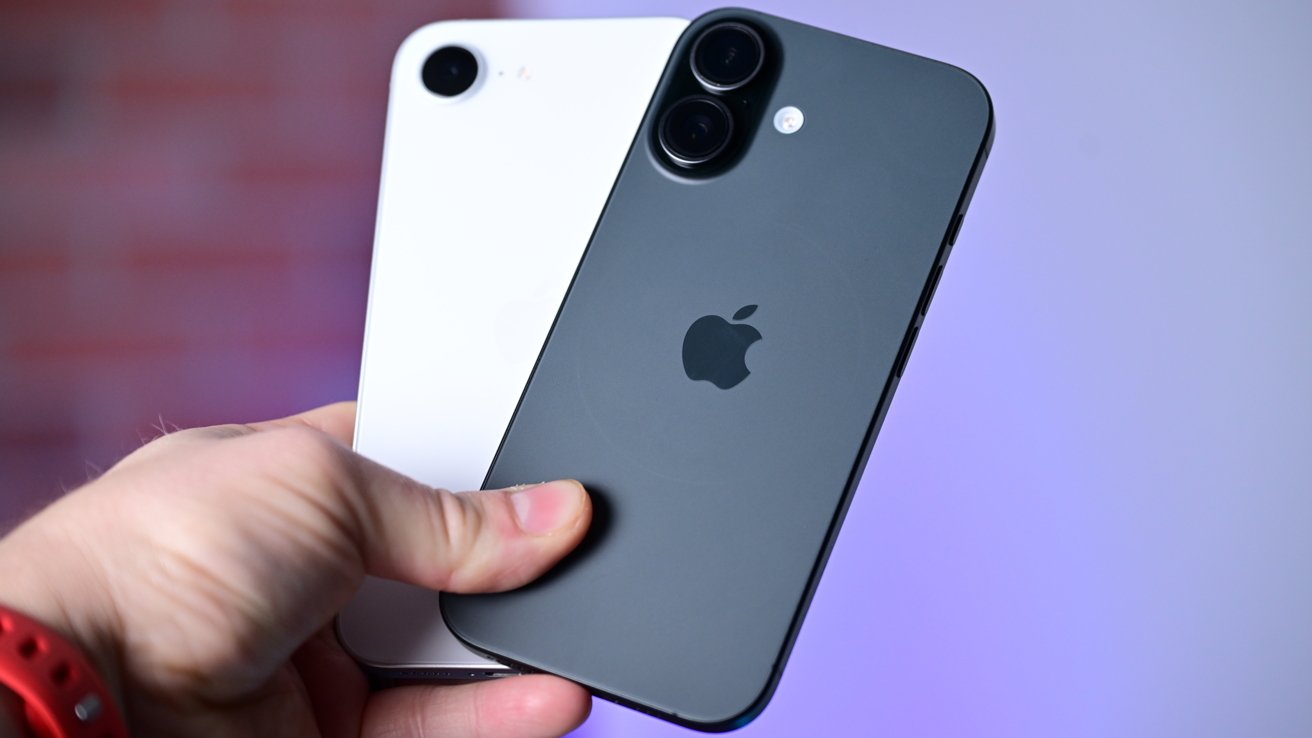
iPhone 17 vs. iPhone 16e: The iPhone 17 is instantly recognizable as a newer model.
The iPhone 17 largely echoes the look of the preceding iPhone 16. Its frame has rounded edges, and the device features two vertically aligned cameras on the rear, enabling Spatial Video.
On the side, the iPhone 17 features an Action button on the left and a Camera Control button on the right.
The more affordable iPhone 16e, meanwhile, is based largely on the standard iPhone 14 with its flat sides. Much like the iPhone 17, the iPhone 16e features an Action button on the left side.
There's no Camera Control, however, and the iPhone 16e only has one rear camera.
The iPhone 17 has a footprint of 5.89 inches by 2.81 inches. The iPhone 16e, meanwhile, measures at 5.78 inches by 2.82 inches.
The iPhone 17 is slightly taller compared to the iPhone 16e. There's no difference in thickness, though, with both models being 0.31 inches thick.
In terms of weight, the iPhone 17 measures 6.24 ounces, while the iPhone 16 is slightly lighter, weighing in at 5.88 ounces.
The construction of the iPhone 17 is based on the standard glass sandwich design with a frame made of aerospace-grade aluminum. The same is true for the iPhone 16e, meaning there's no difference in build quality.
The front of the iPhone 17 and iPhone 16e is where you'll see some major differences between the two. The extra $200s for the iPhone 17 gets you a ProMotion display with Dynamic Island.
iPhone 17 vs. iPhone 16e: Display
The base model iPhone 17 has a 6.3-inch Super Retina XDR display with an OLED panel, which is also an always-on screen with HDR and True Tone support. Compared to the screen of the iPhone 16e, which measures 6.1 inches, the iPhone 17 has a display that's 0.2 inches larger.
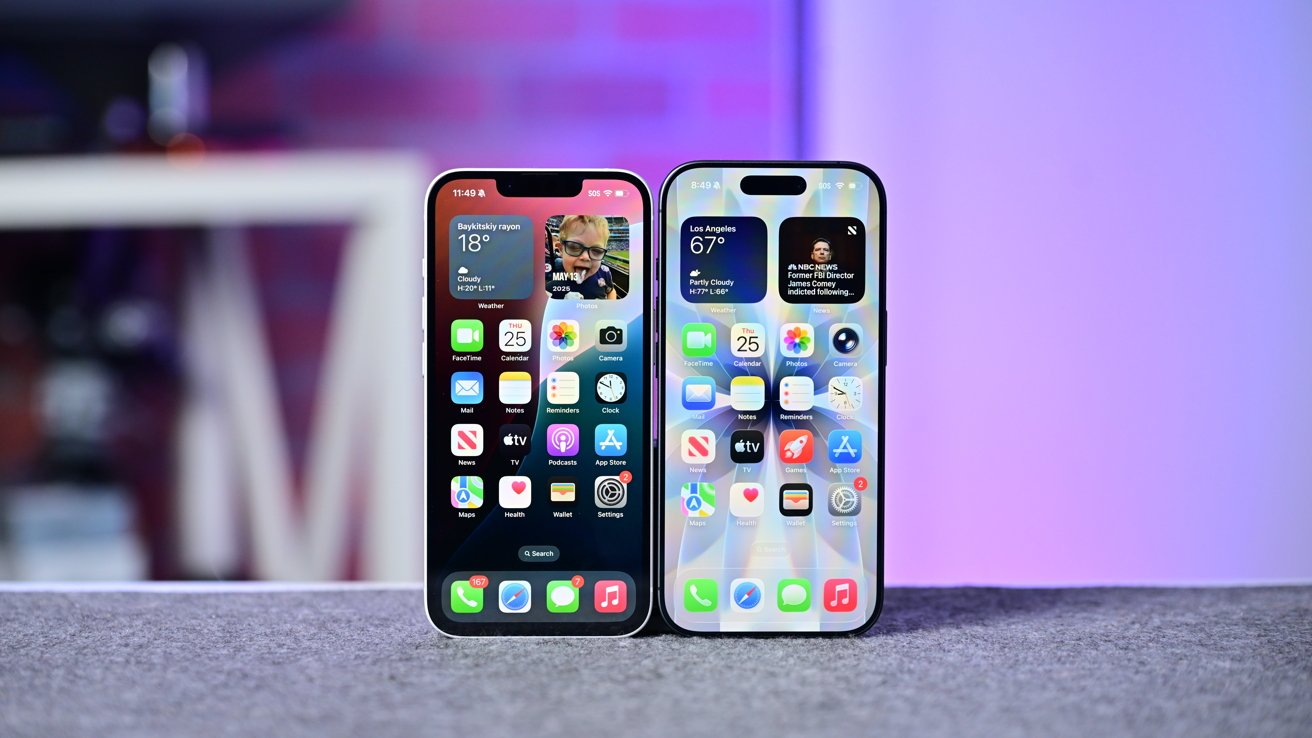
iPhone 17 vs. iPhone 16e: Compared to the iPhone 16e, Apple's iPhone 17 offers a slightly larger 6.3-inch display.
The increased size of the iPhone 17 display is a nice touch, but the presence of Dynamic Island is a more significant difference from the iPhone 16e.
In place of the notch found on the iPhone 16e, the iPhone 17 features a pill-shaped camera cutout. The area around the camera cutout on the iPhone 17 is used to display important information, such as countdown times, media playback, and more.
Another noteworthy feature that made its way to the iPhone 17 is ProMotion. It offers a dynamic refresh rate of up to 120Hz, depending on the content being viewed.
The iPhone 16e display, meanwhile, has a fixed refresh rate of 60Hz.
Also available on the iPhone 17 is always-on mode. It lets you see the date, time, and other relevant information on your device at all times.
On the iPhone 17, the display refresh rate goes down to a mere 1Hz when your iPhone is locked or in StandBy.
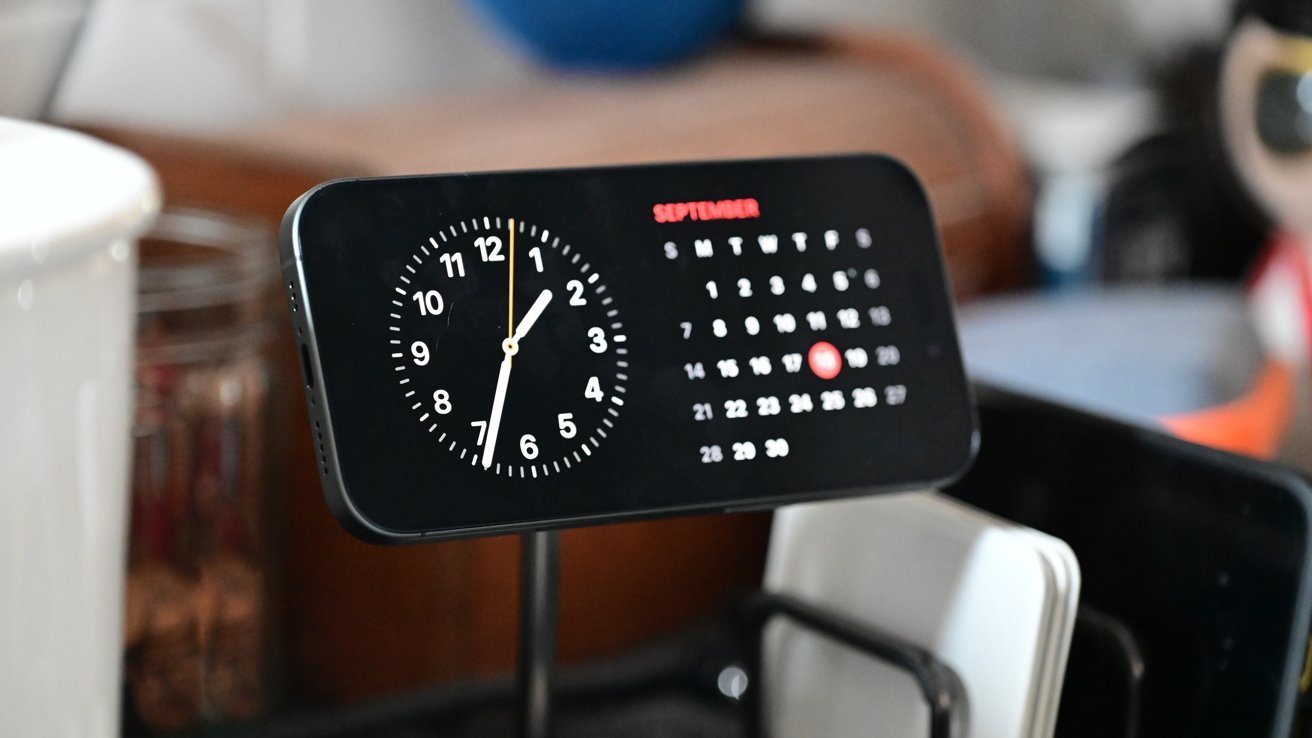
iPhone 17 vs. iPhone 16e: StandBy is much better on the iPhone 17, as its display supports always-on mode.
These are neat changes, but nothing groundbreaking. ProMotion enables smoother scrolling and improved battery life, but not much else.
The iPhone 17 display has a resolution of 2,622 by 1206 pixels. Its predecessor, meanwhile, has a display resolution of 2,532 by 1,170 pixels.
The pixel density, however, remains the same at 460 pixels per inch.
In terms of brightness, Apple says the standard iPhone 17 can manage 1,000 nits for typical content, 1,600 nits of peak brightness for HDR, and 3,000 nits of peak brightness for outdoor usage. Its display has a minimum brightness of 1 nit.
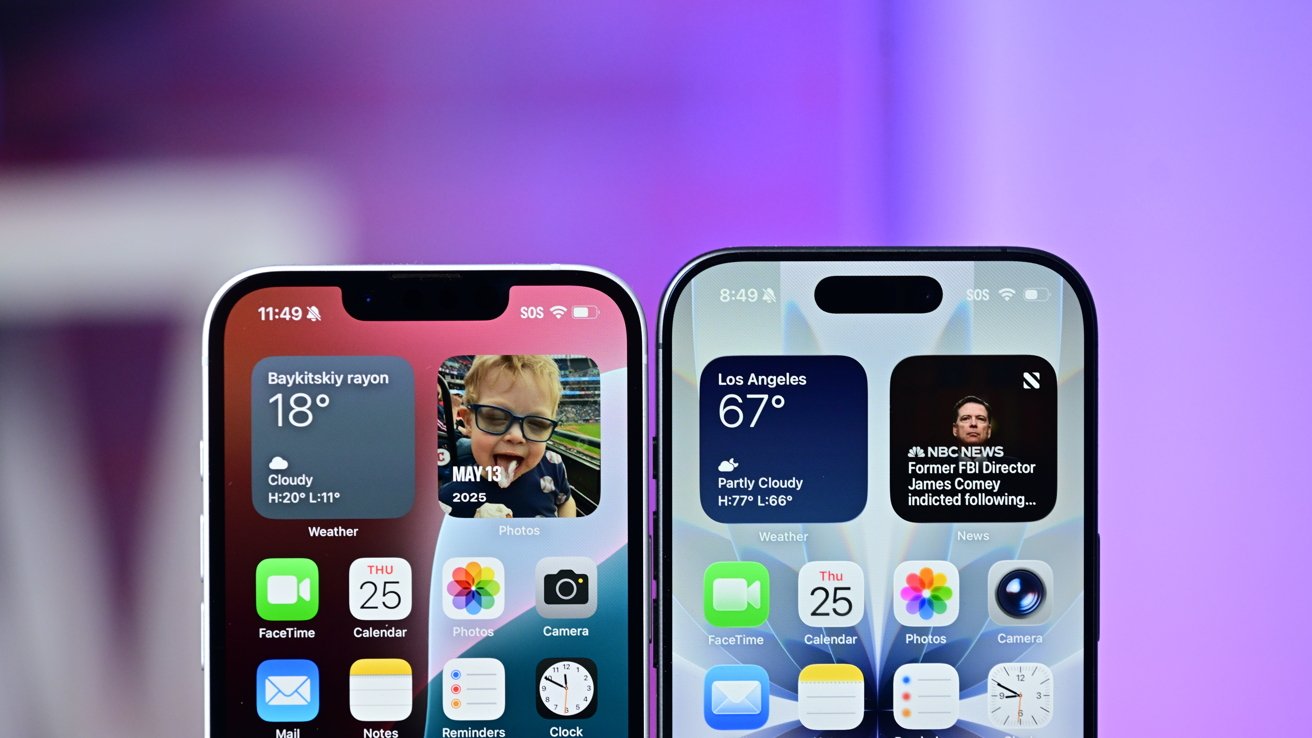
iPhone 17 vs. iPhone 16e: Dynamic Island is available on the iPhone 17, but not on the iPhone 16e.
The iPhone 16e display, meanwhile, has a maximum brightness of 1200 nits, meaning the iPhone 17 display can reach significantly higher brightness levels.
The contrast ratio of 2,000,000:1, however, remains unchanged, relative to the iPhone 16e.
Apple has included True Tone, Wide Color (P3), and Haptic Touch on both models. There's also a fingerprint-resistant oleophobic coating on both the iPhone 17 and iPhone 16e.
The iPhone 17 display is protected by Ceramic Shield 2. Apple says Ceramic Shield 2 has three times better scratch resistance compared to the iPhone 16e's original Ceramic Shield.
Also part of the iPhone 17 display is a seven-layer anti-reflective coating. This makes text more easily readable in bright lighting, both indoors and outdoors, relative to the iPhone 16e display.
Overall, the iPhone 17 is equipped with a ProMotion display that's larger than the one on the iPhone 16e by a fifth of an inch. It's a screen that's also more durable, brighter, and has the more useful Dynamic Island.
iPhone 17 vs. iPhone 16e: Cameras
The back of the iPhone 17 features a 48MP Fusion camera with an f/1.6 aperture, sensor-shift optical image stabilization, and 100% Focus Pixels.
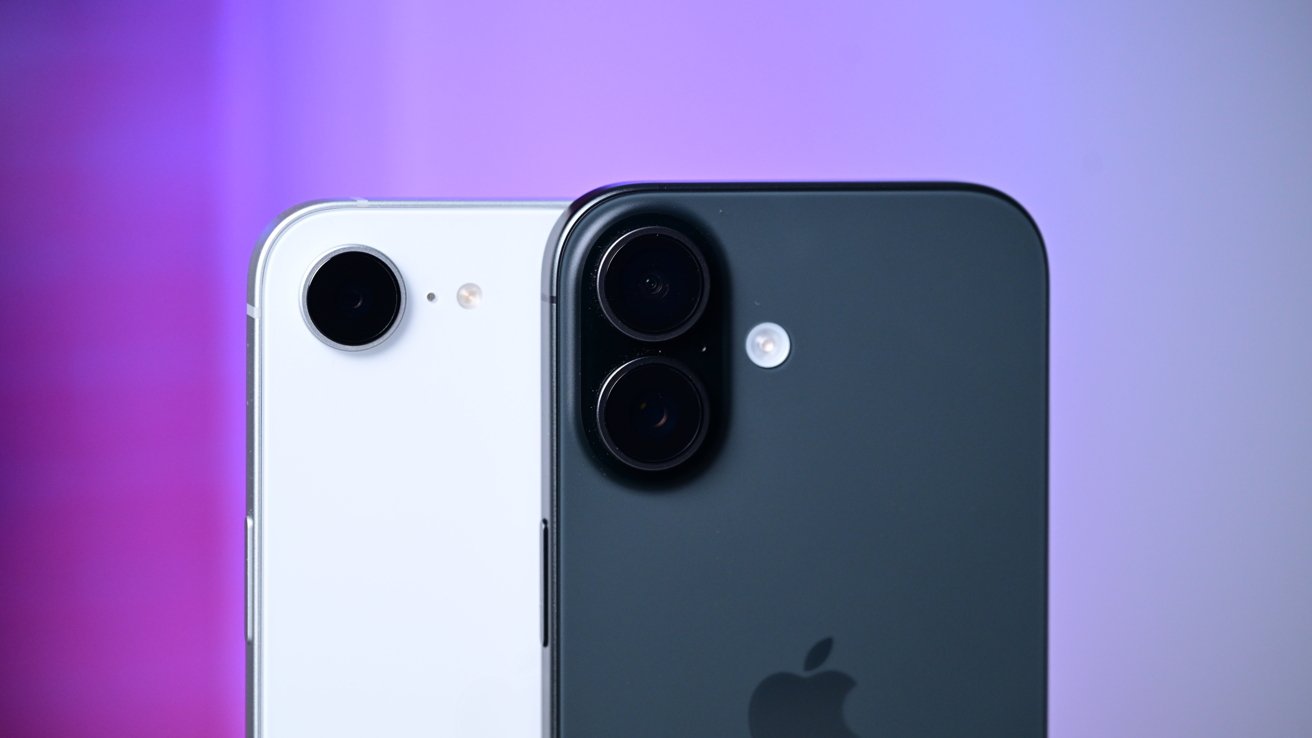
iPhone 17 vs. iPhone 16e: The iPhone 17 is equipped with a 48MP Ultra Wide camera, while the iPhone 16e is not.
Apple calls it a Fusion camera because it can be used as a virtual 2x Telephoto lens. This is pulled off by heavily cropping into the 48MP sensor's image.
The iPhone 16e also has a Fusion camera on the back, with the same f/1.6 aperture. Next to the Fusion camera is a True Tone flash, also available on the iPhone 17.
In terms of features, the iPhone 17 and iPhone 16e both offer Portrait mode with Portrait Lighting, Night Mode, 63MP panoramas, Photographic Styles, and red-eye correction.
However, the iPhone 17 offers several additional camera-related features compared to the iPhone 16e.
While the iPhone 16e boasts only the main Fusion camera on the rear, the iPhone 17 also has a 48MP Fusion Ultra Wide camera with an f/2.2 aperture and a 120-degree field of view.
As a result of the Ultra Wide camera, the iPhone 17 also supports macro photography. This can be used to capture the intricate details of a plant or animal positioned close to the lens, such as a flower.
The two rear cameras on the iPhone 17 are vertically aligned, letting the device record Spatial Video. This ultimately won't matter unless you own an Apple Vision Pro, but it's nice to have the option nonetheless.
The iPhone 17 also has a Camera Control button on the right side of the device, which is missing on the iPhone 16e. It's a capacitive button with force sensor technology, primarily used with the Camera app.
The Camera Control button is capable of recognizing and responding to a multitude of gestures and press types. Pressing the button opens the Camera application, while swiping across the button's surface lets you zoom in and out.
Lightly double-pressing the Camera Control will display more options, including exposure, depth, and tone. You can also use it to switch between cameras or to apply photographic styles, among other things.
Pressing the button again will take a photo. Holding the button down in the Camera app lets you record video without touching the iPhone screen.
On the front, the iPhone 17 has a new 18MP Center Stage camera. It can switch to landscape mode without rotating the iPhone itself, thanks to its new square sensor.
The iPhone 17 is also capable of Dual Capture, letting you record video from both the front and rear cameras simultaneously.
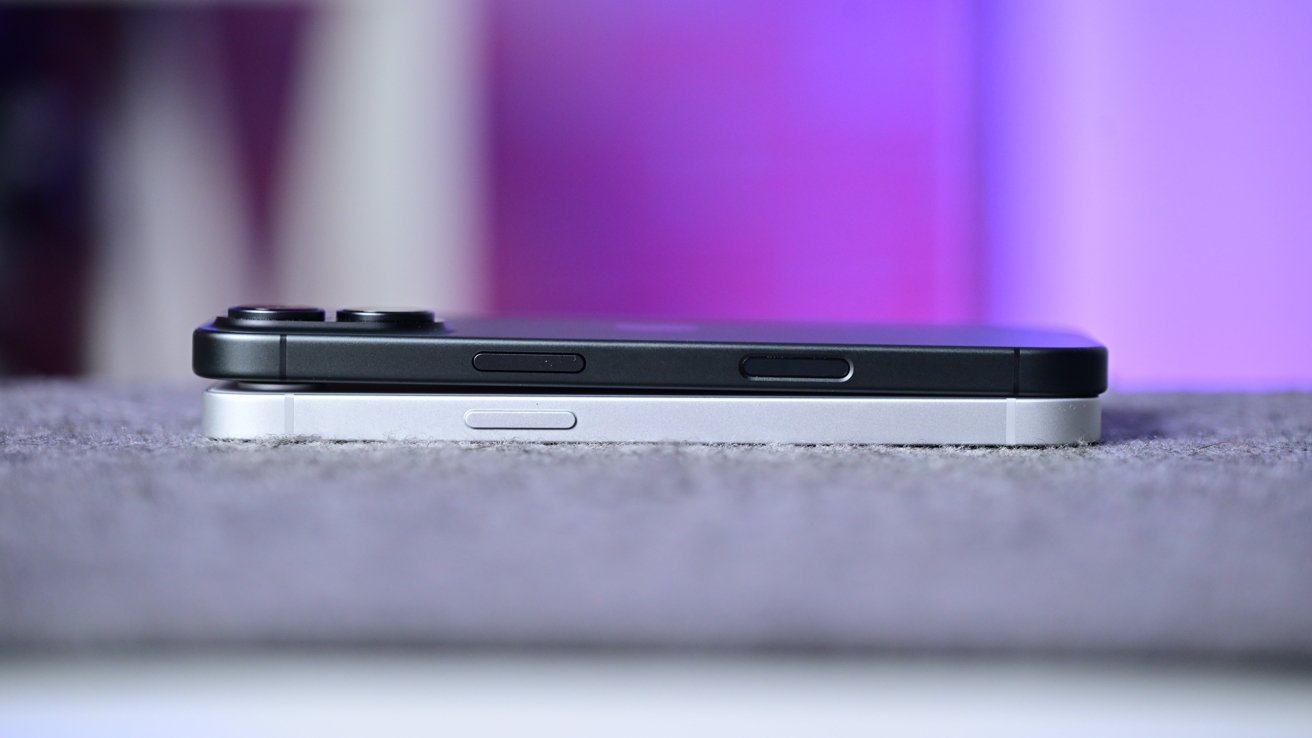
iPhone 17 vs. iPhone 16e: The iPhone 17 features an additional Camera Control button, relative to the iPhone 16e.
The front camera of the iPhone 16e, meanwhile, is Apple's tried-and-tested TrueDepth camera array. Centered around a 12MP sensor, it has an f/1.9 aperture with Focus Pixels, and the same still image benefits as the rear cameras, except for panoramas.
As for video recording, the iPhone 17 can take 4K videos at up to 60 FPS. It can also record 4K 30fps using cinematic video stabilization, 2.8K video at 60fps in Action mode, and 1080p 240fps or 120fps Slo-mo videos.
Dual Capture goes up to 4K at 30fps.
The iPhone 16e, meanwhile, offers largely the same video recording capabilities. However, it lacks Dual Capture and Action mode.
Both models can record Spatial Audio to go with the stereo audio recording, along with a wind noise reduction setting.
Audio Mix is built in as well, so users can easily add their own music choices and mix them into a recording. All without necessarily cutting out the subject's voice.
iPhone 16e
iPhone 17 vs. iPhone 16e: Performance
The iPhone 17 boasts Apple's 3nm A19 chip. The system-on-chip has a six-core CPU and a five-core GPU with Neural Accelerators for improved AI processing.
iPhone 17 vs. iPhone 16e: The A19 chip in the iPhone 17 features the same amount of CPU cores as the A18 in the iPhone 16e.
The A19 CPU consists of two performance cores and four efficiency cores, and Apple says it's 1.5 times faster than the CPU of the A15 Bionic in the iPhone 13.
The A18 chip in the iPhone 16e, meanwhile, consists of six CPU cores and four GPU cores. Apple claims the A18 CPU is 0.5 times faster than the one in the A15 Bionic.
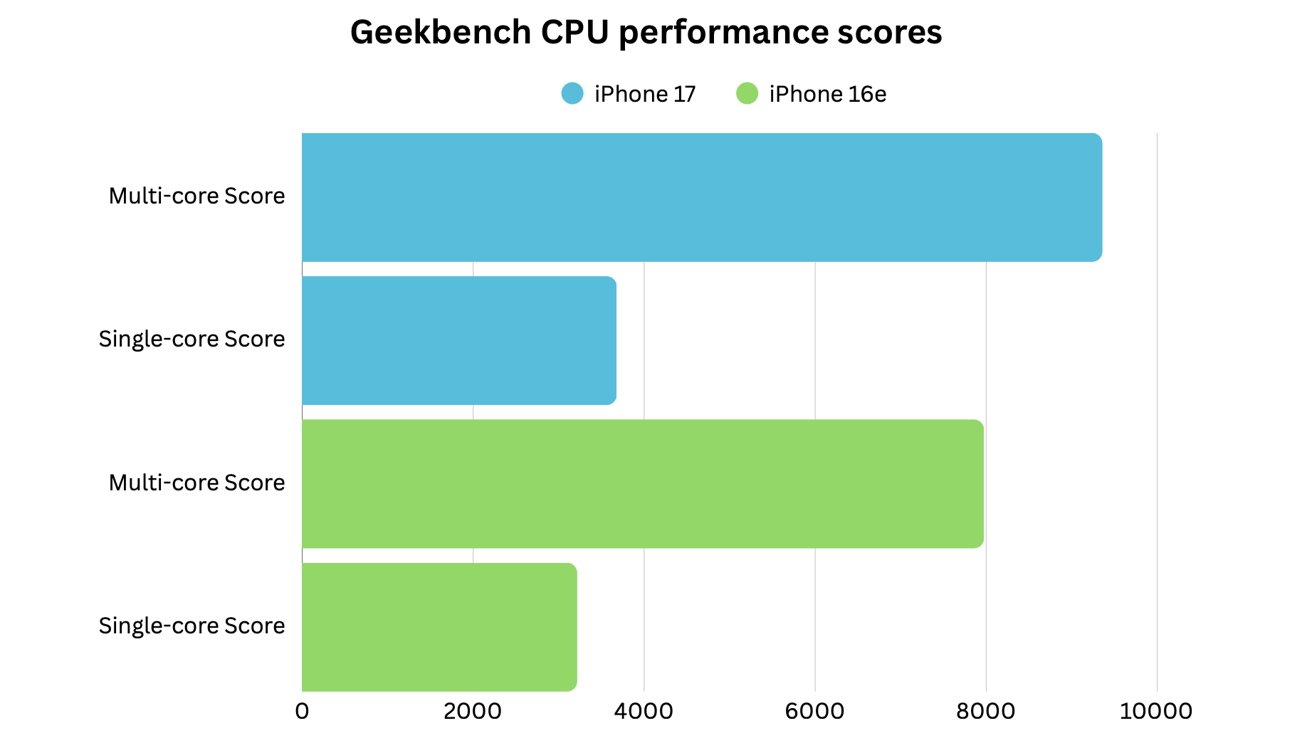
In Geekbench 6 testing, the iPhone 17 received a CPU multi-core performance score of 9,360 points and a single-core performance score of 3680 points.
The iPhone 16e CPU, meanwhile, scored 7,976 points in multi-core CPU tests and 3,217 points in single-core CPU performance.
In terms of graphics processing hardware, the A19 chip in the iPhone 17 features one additional GPU core compared to the A18 in the iPhone 16e.
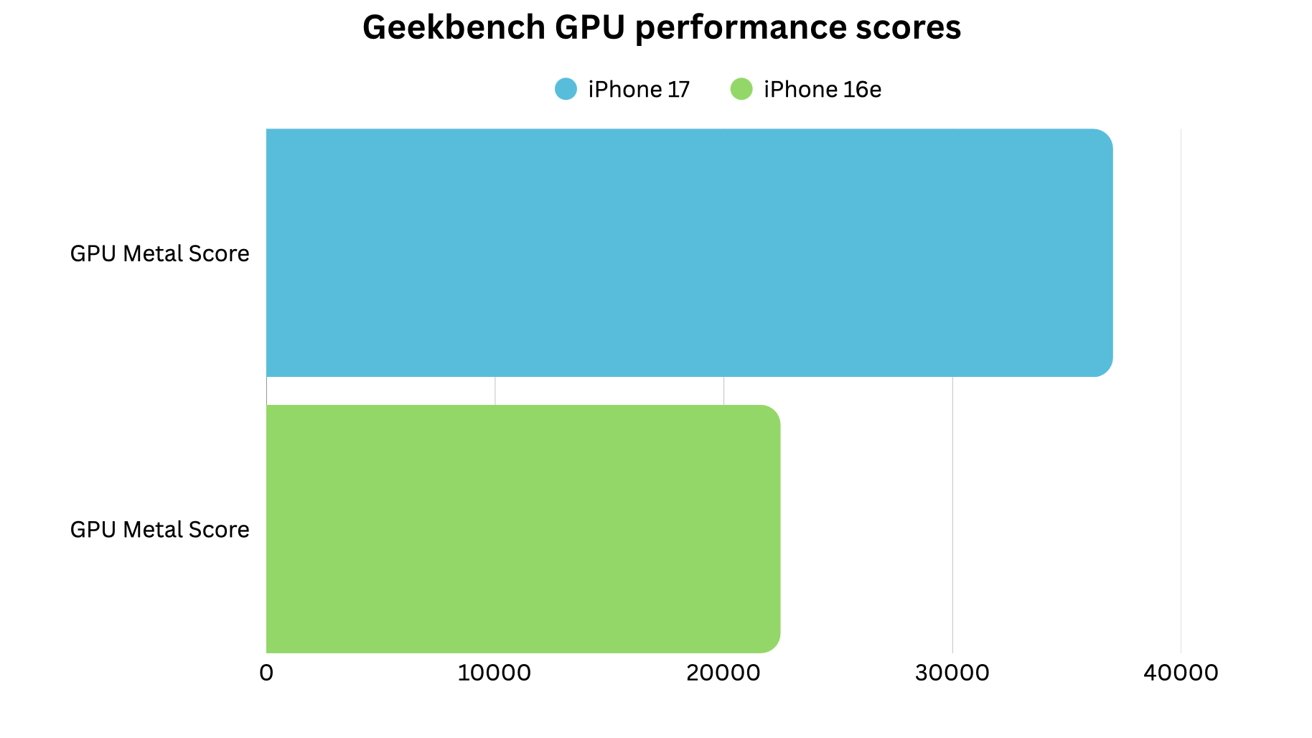
iPhone 17 vs. iPhone 16e: The A19 chip in the iPhone 17 has an extra GPU core compared to the A18 in the iPhone 16e
This won't make much of a difference in day-to-day use, but the extra GPU core in the iPhone 17 provides better performance in graphically intense games.
In Geekbench Metal testing, the iPhone 17 scored 37,014 points. Noticeably higher than the 22,478-point score of the iPhone 16e.
As for RAM, the iPhone 16e has 8GB of LPDDR5 memory, which allows for Apple Intelligence features on the device. The iPhone 17 has improved memory bandwidth, but the A19 chip still has 8GB of RAM, just like the A18 in the iPhone 16e.
The iPhone 17's A19 chip is also equipped with Neural Accelerators, which help run powerful generative AI models on the device. Also important for AI is the Neural Engine.
The A18 chip in the iPhone 16e contains a 16-core Neural Engine that can perform up to 35 trillion operations per second. The iPhone 17 is also equipped with a 16-core Neural Engine, albeit with increased memory bandwidth.
Apple's A19 chip also houses Apple's Display Engine, which helps power ProMotion and the always-on display on the iPhone 17. The A18 chip does not have this, as the iPhone 16e display does not support ProMotion.
All in all, the iPhone 17 offers better CPU and GPU performance, as is to be expected.
iPhone 17 vs. iPhone 16e: Connectivity and battery life
With the iPhone 17 range, Apple has debuted its in-house Wi-Fi chip, dubbed the N1. The Apple-designed chip provides improved AirDrop and Personal Hotspot performance, relative to the hardware in the iPhone 16e.
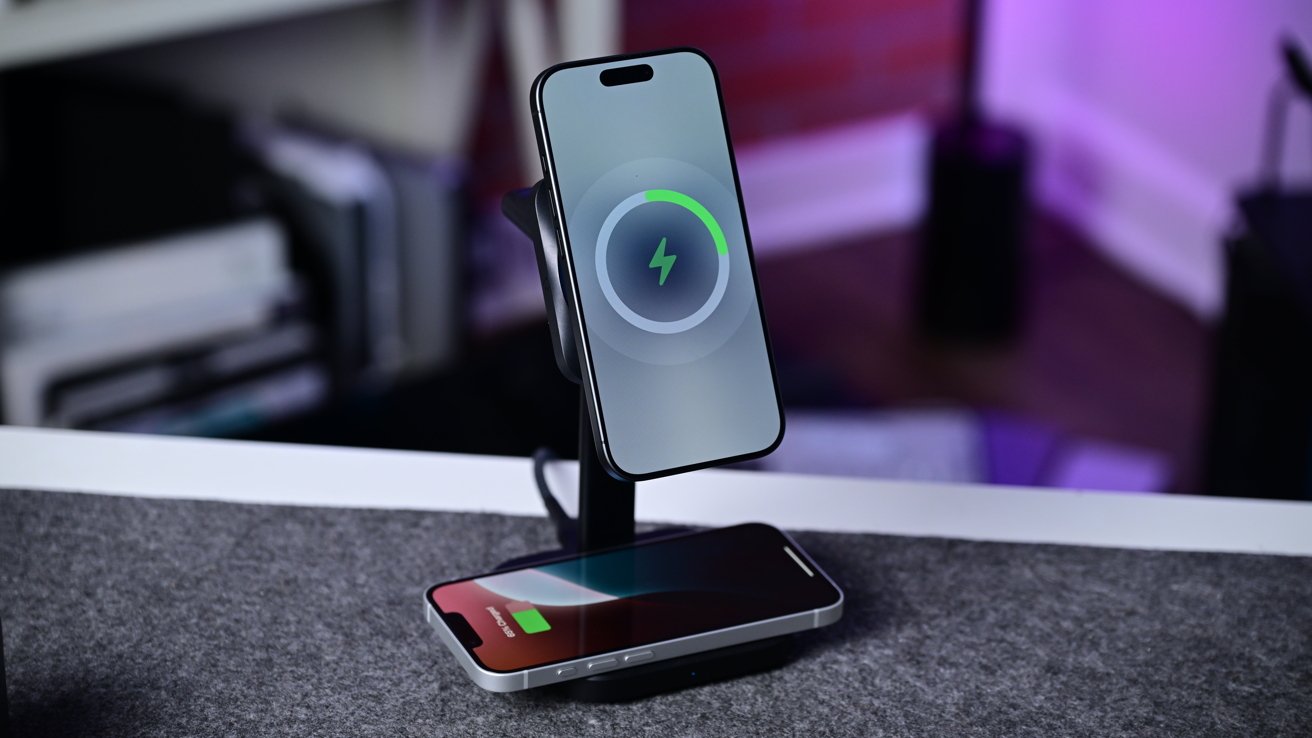
iPhone 17 vs. iPhone 16e: MagSafe is not available on the iPhone 16e.
The N1 chip is also capable of using multiple frequency bands, including 2.4 GHz, 5 GHz, and 6 GHz, simultaneously. The iPhone 16e, meanwhile, only offers Wi-Fi 6 support.
This ultimately won't make much of a difference to most users, as not everyone has a Wi-Fi 7-compatible router yet.
The iPhone 16e also lacks Ultra Wideband and Thread support, though, meaning that Find My and HomeKit usage will not be as good as with the base model iPhone 17.
The N1 chip also brings Bluetooth 6 to the iPhone 17. For reference, the iPhone 16e only supports Bluetooth 5.3.
While Bluetooth 6 is a neat upgrade, it's not something most users will need for the time being. You'll be able to connect keyboard, headphones, and other accessories without issue on both the iPhone 17 and iPhone 16e.
The iPhone 17, which features a Qualcomm modem, supports 5G in both sub-6GHz and mmWave formats, with Gigabit LTE with 4x4 MIMO and carrier aggregation as a backup. The iPhone 16e, meanwhile, boasts Apple's first custom-designed modem, the C1, which does not support mmWave.
On the iPhone 16e, you still get 5G sub-6Ghz connectivity, along with Gigabit LTE, UMTS/HSPA+, and GSM/EDGE. Both the iPhone 17 and iPhone 16e support GPS, GLONASS, Galileo, QZSS, and BeiDou for navigational support.
In terms of battery life, the iPhone 17 offers an additional 4 hours of video playback relative to the iPhone 16e.
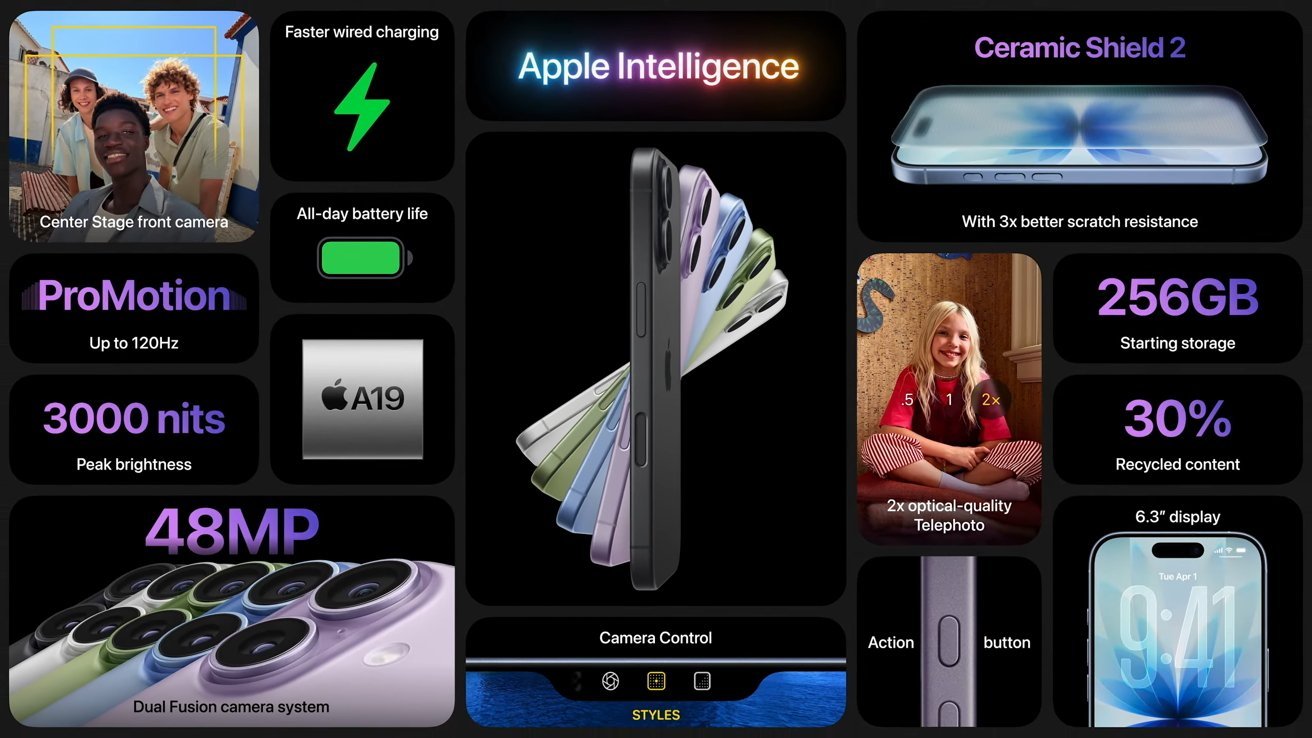
iPhone 17 vs. iPhone 16e: You get better battery life with the iPhone 17 than the iPhone 16e.
According to Apple, the iPhone 17 has a battery capacity allowing up to 30 hours of local video playback and up to 27 hours of streaming video playback. When it comes to the iPhone 16e, local video lasts for 26 hours, and streamed video lasts for 21 hours.
Apple also says the iPhone 17 can charge up to 50% in just 20 minutes, when used with the new 40W Dynamic Power Adapter. The iPhone 16e, meanwhile, takes 30 minutes to charge to 50%.
The iPhone 17 can also charge wirelessly at 25W via MagSafe, up to 7.5W using a Qi charger, and 15W with Qi2.
With the iPhone 16e, Qi wireless support is limited to 7.5W. MagSafe, meanwhile, is entirely absent from the iPhone 16e, though there are third-party cases which enable magnetic attachment while charging.
Overall, the iPhone 16e lacks MagSafe, Ultra Wideband, Thread, and Qi2 support. Battery life is also worse than on the base model iPhone 17, so the iPhone 16e is not a great option in that regard.
iPhone 17 vs. iPhone 16e: Capacity, color options, and pricing
The base model iPhone 17 is available in five different color options, but the same can't be said for the iPhone 16e.
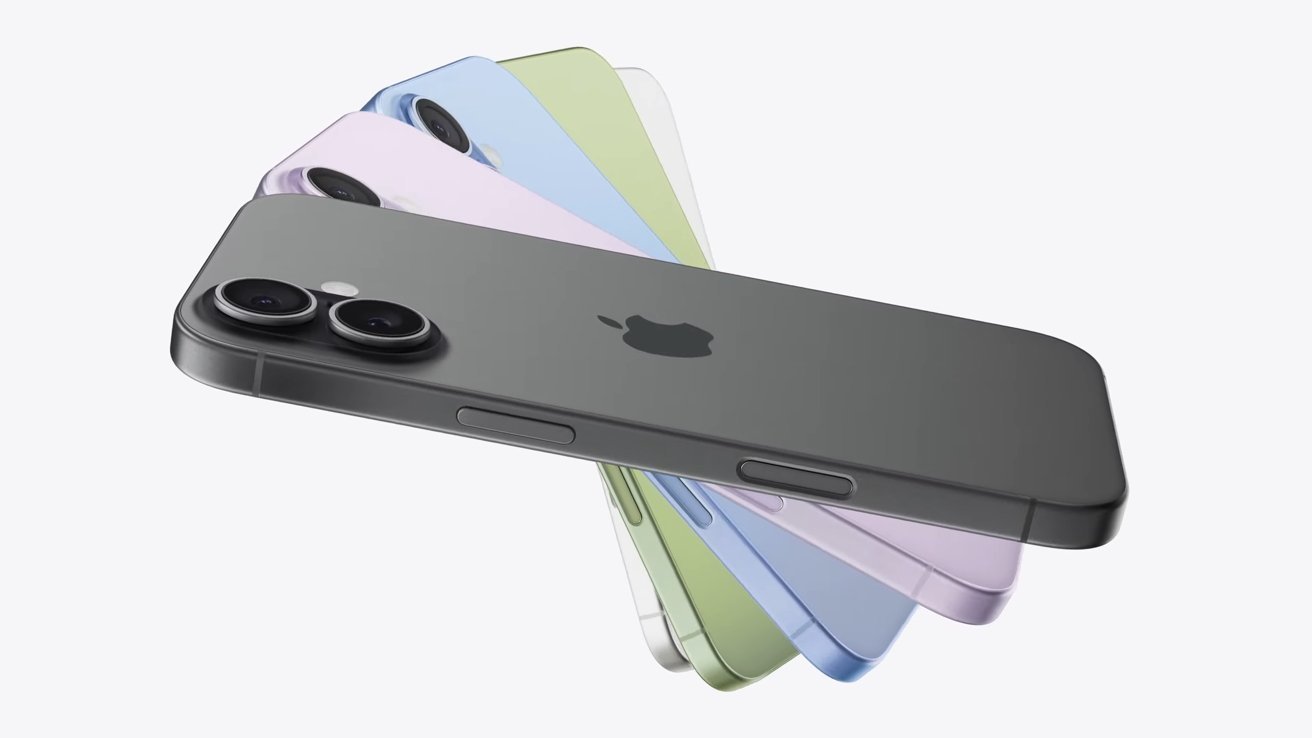
iPhone 17 vs. iPhone 16e: Apple offers the iPhone 17 in five different colors, while the iPhone 16e is only available in black and white.
The iPhone 16e comes in standard black and white colors. Mist Blue, Lavender, and Sage are the color options Apple has for the iPhone 17, along with black and white colorways.
In terms of storage, Apple eliminated the 128GB option with the iPhone 17 range. The 256GB version is priced at $799, and the 512GB variant will cost you $999.
The iPhone 16e is sold in three capacities, at $599 for 128GB, $699 for 256GB, and $899 for 512GB. The higher storage options aren't particularly appealing, given that the base model iPhone 17 is only $100 more.
iPhone 17 vs. iPhone 16e: Should you upgrade?
While the iPhone 17 has all the latest bells and whistles, there's not enough incentive to upgrade from the iPhone 16e.
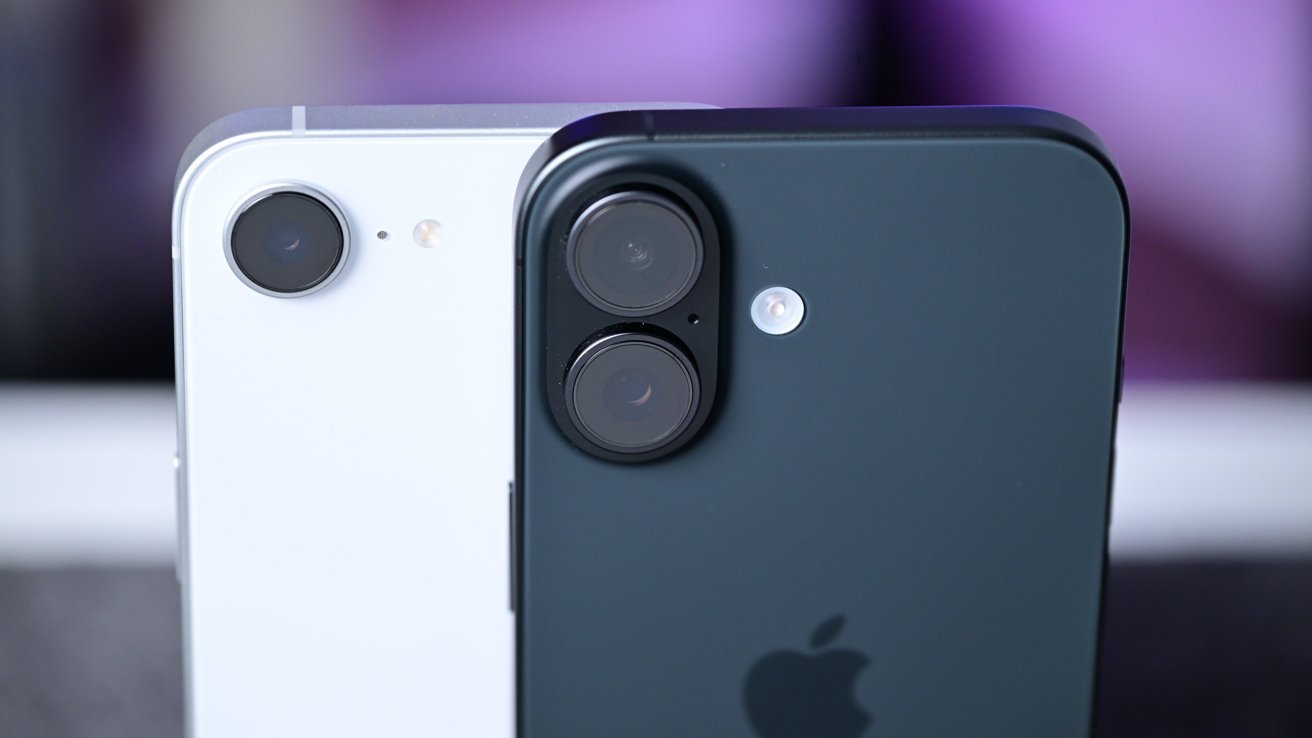
iPhone 17 vs. iPhone 16e: If you have the iPhone 16e already, you can skip the iPhone 17 altogether.
With the iPhone 17, you get a larger 6.3-inch display with ProMotion and Dynamic Island. There's also a 48MP Ultra Wide camera and the Camera Control button.
Visually, you also get more color options, though you're probably going to use a case with it anyway.
In terms of processing power, the A19 is more powerful than the A18 chip. The iPhone 17 offers an extra GPU core that could prove useful for games.
The 18MP Center Stage camera on the iPhone 17 is new as well. No previous iPhone model has had this auto-rotating capability before.
The iPhone 17 also gets you MagSafe, Wi-Fi 7, Bluetooth 6, Ultra Wideband, Thread, and mmWave support. There's also better battery life compared to the iPhone 16e.
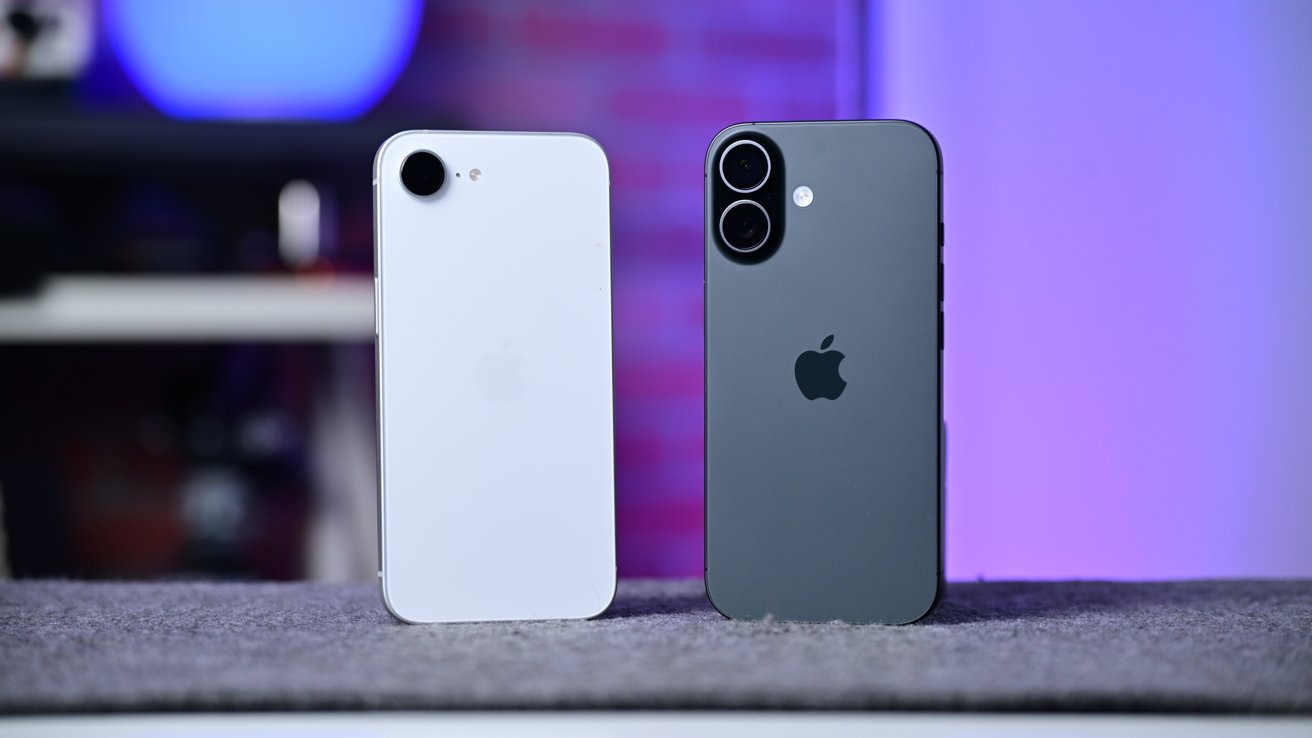
iPhone 17 vs. iPhone 16e: At only $100 more, the iPhone 17 is an option worth considering.
Even so, many of these upgrades are incremental, rather than essential for day-to-day use. If you already own an iPhone 16e, then you might as well wait for Apple to release something more impressive.
If you're looking to buy a new iPhone, however, the iPhone 17 is obviously the better choice. If you disregard the 128GB iPhone 16e, the iPhone 17 is only $100 more expensive than the iPhone 16e.
This makes the iPhone 17 a more reasonable option.
Where to buy Apple's iPhone 17 and iPhone 16e at a discount
Both the iPhone 17 and the iPhone 16e are available to purchase at wireless carriers, with iPhone deals in effect that offer up to $1,100 in bill credits across Apple's smartphone line.
Today's top iPhone offers
- T-Mobile: Get up to $1,100 off a new iPhone with a qualifying trade and plan
- AT&T: Get up to $1,100 off a new iPhone with a qualifying trade and plan
- Verizon: Get up to $830 off a new iPhone with a qualifying trade and plan
You can also trade in your old device at Gazelle to help offset the purchase of a new iPhone. Nab an exclusive 10% bonus on your trade-in for a limited time.