There's a recurring theme from industry watchers, repeated on Friday, that Apple Music is doomed, if Apple doesn't copy Spotify's business model. The core premise is nonsense, and the reasoning for it is ridiculous.
It is true that Apple Music lags far behind Spotify, even if the European Union doesn't seem to think so. It is unquestionably true that Spotify is the largest streaming player in the world, as a new Bloomberg opinion piece by Ashley Carman says.
But saying, as that op-ed does, that Apple must therefore emulate Spotify is the politician's syllogism. We must do something / this is something / therefore we must do this.
The apparent reason for Apple having to do something is that, reportedly, Spotify added 27 million paying subscribers in 2024. In that same year, Apple and Amazon together are said to have only managed 6 million.
And the credit for this growth is specifically given to how Spotify has a free (ad-supported) tier. If you give people music for free, goes the reasoning, they will eventually, ultimately pay for it.
That's not just ironic, though, it's telling. This is Bloomberg actually telling investors that Apple Services will not grow if it doesn't copy Spotify.
Ridiculous.
Hopefully investors do their own due diligence, but it at least used to be that Bloomberg writers get bonuses if they can get the market to move. So if the primary aim here is to affect the stock price, maybe you can excuse the logical fallacies.
Yet taking the piece at face value, you can't ignore them. Starting with this idea that it is a universal truth that free users convert into paid ones.
For instance, it isn't working for Amazon Prime Music. Figures are hard to come by, but all Amazon Prime subscribers do get a version of Amazon's music service for free.
There are 180 million Amazon Prime subscribers in the US. And then Bloomberg itself says fewer than six million upgraded to a paid account in 2024.
Bloomberg can't say free is the only guarantee of growth, and at the same time disparage how little Amazon has converted people to paid. Yet it does say exactly that, repeatedly.
If you keep saying something, maybe people will believe you. And maybe they won't notice that Spotify's brilliant plan to give away free music meant it didn't make any profit at all for nearly 20 years.
Where growth comes from
Bloomberg does make a solid point about how listeners in developing nations are less likely to be able to afford a music subscription. So it does indeed follow that Apple won't reach them.
But it does not follow that therefore they will use Spotify's free tier — and somehow be magically able to move up to its paid one.
There is more reason behind a claim that if Apple limits its services to its own devices, it is deliberately stifling its potential growth. But even there, Bloomberg is forced to refer to Apple Music having a "close association with Apple hardware."
Sure, other than the fact that Apple Music is on Android, smart TVs, and Windows. When Apple expanded its reach by adding Apple Music Classical, it debuted on Android before it went on the Mac.
This opinion piece doesn't mention that Apple Music is on anything but Apple devices. It doesn't mention that Apple TV and Apple Music is on aircraft, for free, for the most part.

Apple is boosting Bad Bunny and Bad Bunny is boosting Apple Music — image credit: Apple
These are all growth areas for Apple Music, growth areas that Bloomberg disregards in favor of pretending Apple Music only reaches Apple users.
That one is especially hard to swallow since Apple Music now sponsors the Super Bowl, very visibly. The 2024 Super Bowl half time show was watched by 129 million people, probably most of them Android and Windows users.
Then after Bad Bunny was announced as the star for the 2026 show, there was a 26% increase in overall demand for streaming his music in the US. For nine days before the announcement, there were 173 million streams, and that rose to 218.5 million over the following eight days.
Bloomberg presumably considers this irrelevant or that all the streaming growth went to Spotify. But Apple is getting attention for Apple Music — and it's paying heavily to get it.
Apple is believed to be spending around $50 million per year on that sponsorship deal. That's the direct spend on the show, too, and excludes the extensive extras across Apple Music and all of Apple's services.
It is true that Apple can afford this. It is true that Apple has enough cash that it doesn't have to chase subscribers the way Spotify must.
Plus it really is true that Apple can afford to give services time to grow. But it's also true that Apple would not have got to this point if it ever just threw away money on a whim.
Whether you like Apple or not, this company consistently follows a long game that works out for it. It just doesn't happen to mean short-term gains for financial journalists.
Offensive nonsense
And then there are two issues in the Bloomberg argument that rankle. Repeatedly, for instance, this opinion piece comments on how Apple Music makes songwriters, artists and the music industry happier than Spotify does.
But it says this as a criticism, and it's vehement about it.
It's also startlingly critical of Apple spending money to make its service better. If you can't quite see how the phrase "hyper-attentiveness to sound quality" can be an insult, you're not a Bloomberg writer.
If you were, though, you would seemingly know that improving your product is a foolish idea. You'd also know that paying artists for what you then sell on to customers is unimaginably poor business.
And yet despite not screwing the music industry out of absolutely every cent it can, Apple still manages to hold on as the world's third most popular streamer. Even Bloomberg does excruciatingly reluctantly admit that.
Apple Music isn't going away, it isn't shrinking. Allegedly, it'll still never grow because Apple will not give away the goods for free.
Apple very rarely gives anything away for free. And somehow it managed to earn around $391 billion in 2024, compared to Spotify's $17 billion. It gets even worse for Spotify when you look at margins.
Naturally, while all of Spotify's revenue comes from music streaming, not all of Apple's does. But that is the point — Apple does not have to grow Apple Music in order to profit.
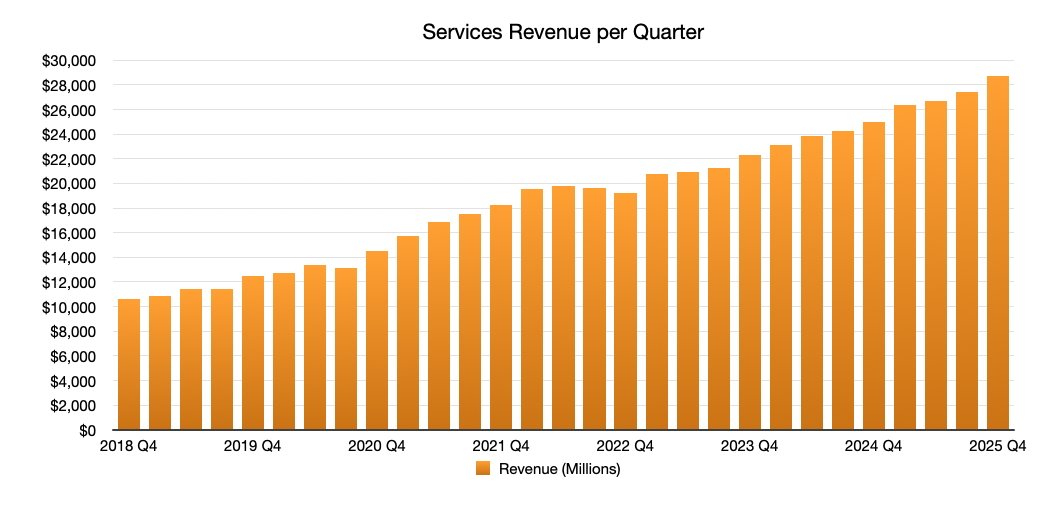
Clearly, Apple Services is going nowhere. Services Revenue chart by Malcolm Owen, AppleInsider
Yet it will grow Apple Music, and it will grow all of its Services — as it keeps on doing.
Every part of Apple's tightly integrated offerings is attracting new users, and every part of it is growing the market for every other part of it.
Apple sells hardware and then its users buy its Services. So iPhones drive Apple Services, but also Services drive iPhones.
And year after year, earnings report after earnings report, Apple gets to champion just how many of its users are new to its platform. They're paying users, too. All of them.
Examining just a single segment of Apple's business and drawing conclusions from it is a fallacy. And, we haven't seen the market move as a response to the piece, so maybe investors see the piece for the nonsense that it is.