Artificial Intelligence is big business, and companies are looking for the next big app to use it. However, Mac app subscription service Setapp has demonstrated that the pursuit of AI comes at the cost of ignoring non-AI apps.
The artificial intelligence gold rush has led to a situation where developers are incentivized to add AI to their apps. Sometimes, it's just for the sake of saying there's AI in it at all.
This isn't a sudden change, as the situation has grown over time in line with AI technology itself.
In December 2024, a survey of Mac app developers revealed that 40% cited AI as having the biggest impact on their apps. This was up from 31% in the 2023 version of the survey.
The same surveys added that 60% of Mac developers were either working on AI features or had already implemented some in their apps by the end of 2024. Again, this was up from almost 50% the previous year.
With the easily-believable perception that AI apps are newer and somehow "better," developers are turning to incorporate it in their releases in some way.
However, not every app needs to use AI. Sometimes, it's not warranted for a particular app at all.
But, as AI has become a must-have element for marketing modern apps, it's easy to forget.
Refused for no AI
AppleInsider was alerted to an odd incident that involved AppHub. It's an app that replicates the Launchpad facility that no longer exists in macOS 26 Tahoe at all, replaced by the Spotlight-style pop-up App search box.
The app itself does a good job of recreating the Launchpad experience, with it spreading apps across the screen in a very similar way to Apple's feature. It's also fully-featured, including options to personalize the way it switches pages, gesture support for trackpads, and full-screen and compact modes.
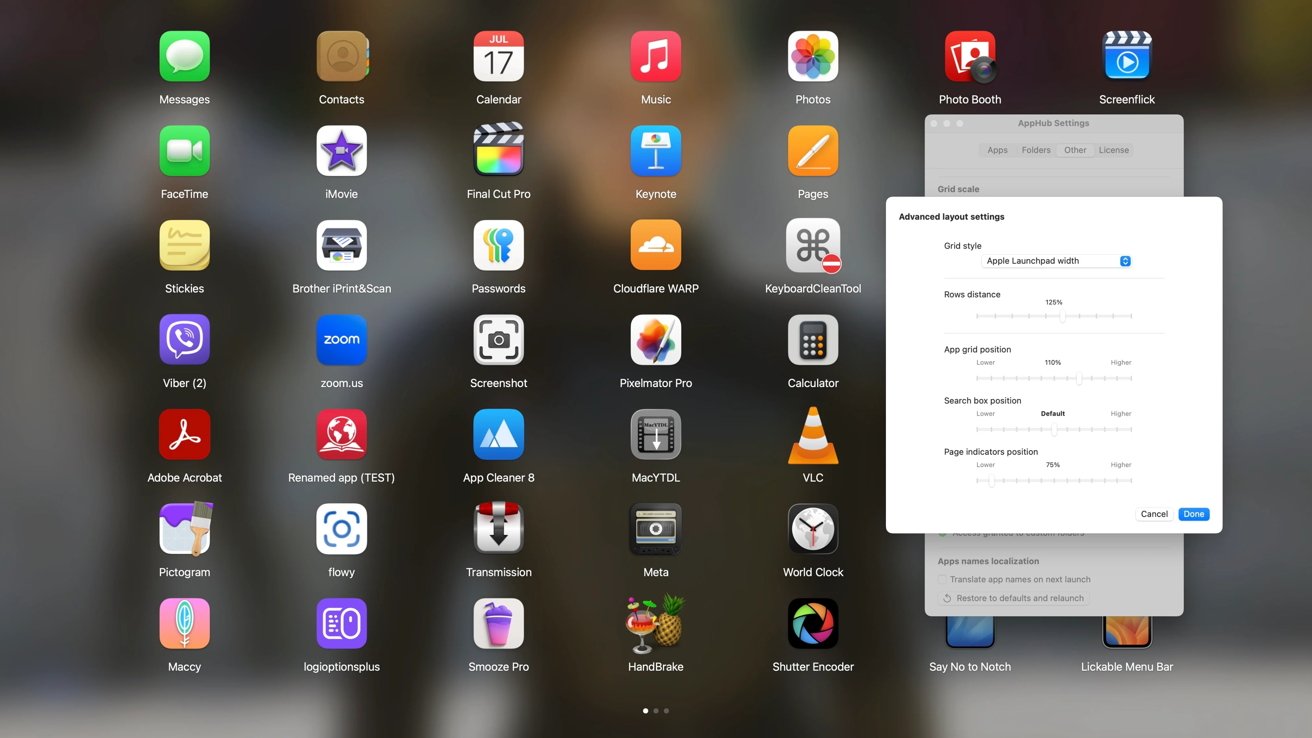
AppHub replaces the now-gone macOS Launchpad - Image Credit: AppHub
His app was rejected by Apple due to a rule forbidding apps from duplicating the look and feel of Apple's software, including Launchpad. This rule is in play even though Launchpad isn't in macOS 26 at all.
Instead, the app is sold through Gumroad for $4.99 as developer Bohdan discovered that selling AppHub through the Mac App Store was not a possibility.
Looking for another way to make money from their app, he asked Setapp. Since Setapp provides a subscription bundle of Mac apps for users to download and use, this makes sense as an alternate distribution route.
A response from Setapp owners MacPaw seen by AppleInsider started off well. AppHub was reviewed by the team, and it was deemed a "great productivity tool."
However, Setapp didn't agree to host the app on AppHub. The reason given was the lack of AI in the app.
"We won't be able to move forward with adding it to Setapp at this time as our current priority is expanding apps for our AI+ collection," the response reads.
It's not a complete "no" from Setapp, as the response says that the firm will be "happy to reconsider" the app in the future. But only if there are any Setapp policy updates in the future that allows it to be looked at a second time.
AI all the things, or not...
AppleInsider is keenly aware of the benefits and the risks of incorporating AI into workflows and into apps. Everything from the accusations of it ripping off human creativity to the very real problem where user data is not secured properly from attackers.
AI is a major part of the tech landscape. We get it. But we also know that it doesn't need to be absolutely everywhere.
Apple's original Launchpad didn't include AI at all. It didn't need it, and its replacement in macOS Tahoe didn't add any to its functionality either.
The original worked perfectly fine for years without AI, and with no room to add AI at all, either. It made sense for AppHub to take the same approach instead of adding AI for AI's sake.
AppHub is a victim of this constant push to adopt AI, even though it works completely well without it in the first place. Also, it does so without leaning on AI for its features.
There is the temptation to add AI just so Setapp would accept the tool for inclusion. But the real issue here is Setapp's focus on AI apps in the first place.
It's not wrong for a company that distributes apps to work on an AI-specific bundle of apps. It is their platform, after all, and their business model.
When Setapp offers apps both with and without AI to consumers, it's a bad move to ignore the non-AI apps completely.
There's room on the market for apps of all shapes and sizes. AI doesn't need to be, and shouldn't be, everywhere.
So long as they do the job they were made to perform, there should be no argument.
Setapp's policy forces developers to strongly consider adding, or shoehorning, AI into their tools, in cases when it's not needed.
AI can be a force for good. But it's not an excuse to get tunnel vision.