
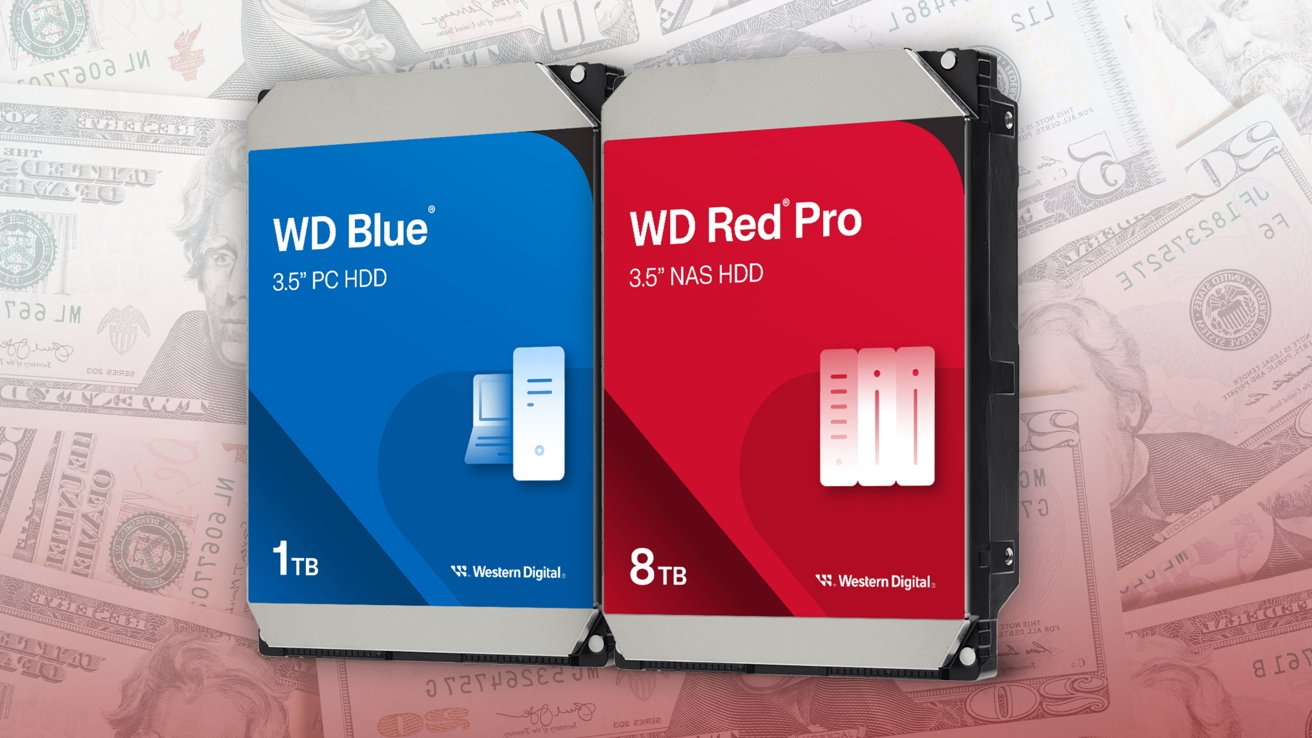
Hard drive prices will continue to be high for quite some time, as the needs of AI data centers continue to consume storage and raise prices for everyone.
One of the major talking points about artificial intelligence has been its impact on memory prices. The demand has caused components to become more expensive to manufacturers like Apple, as well as to consumers, thanks to the build-out of infrastructure needed for AI.
Memory may have made headlines, but it's far from the only component feeling the squeeze. It's also happening to the hard drive market, too.
During the second-quarter earnings call for drive maker Western Digital, CEO Irving Tan confirmed that high demand from its enterprise customers has rocked the boat. TweakTown reports the company has practically run out of manufacturing capacity for drives in 2026, even at this early stage of the year.
WD has orders with its top seven enterprise customers, including long-term agreements for two in 2027. One client even has an agreement for capacity in 2028.
As it stands, Western Digital's capacity is largely made up of enterprise customers, with approximately 89% of its total revenue stemming from cloud-based companies. By contrast, consumer hard drives only make up 5% of its revenue.
Price warning
AI infrastructure's appetite for data storage has expanded its needs to hard disks, which are a relatively low-cost way to store data, albeit without the speed benefits of flash memory used in SSDs. It has resulted in pretty much the same situation for mechanical drives as for memory.
Hard drive prices are already at their highest in the last two years. With WD's CEO warning that its own capacity isn't enough to meet the sheer scale of AI demand, that means the supply for consumer drives will be tighter than usual.
Based on the usual economics of supply and demand, you can expect prices for hard drives to go up, or at least stay elevated for a while longer.
If the fast ramping up of prices for memory are an indicator, hard drives could see similar increases in a short space of time.
Get them while they're hot
For Apple, hard drive prices are not a real problem for its products, since it uses flash memory and SSDs instead of mechanical drives. It also has agreements with suppliers in place that insulate the supply chain from the price increases, at least for a few quarters.
Consumers, meanwhile, do not have that luxury at all. Instead, they are beholden to the whims of retailers and whatever they charge.
With that problem in mind, anyone seeking to add more storage to their computing setup should strongly consider getting a drive sooner rather than later.
AppleInsider has repeatedly advised to use external drive options to augment your Mac's storage capacity, because of Apple's relatively high fees for increasing internal storage at the time of purchase. Indeed, with the number of external drive enclosures and NAS units on the market, adding expansion is now a reasonably easy process.
Some suggested drive options to take advantage now include:
- Western Digital Red Plus 4TB - $114.99 from Amazon and B&H
- Western Digital Red Plus 6TB - $164.99 from Amazon
- Western Digital Red Plus 8TB - $194.99 from Amazon
- Western Digital Blue 6TB - $183.00 from Amazon
- Seagate BarraCuda 4TB - $89.99 from Amazon
- Seagate BarraCuda 8TB - $169.99 from Amazon
- Seagate IronWolf 8TB - $199.99 from Amazon