
The M4 chip used in the new iPad Air does not have the same performance as the iPad Pro version, thanks to core count changes.
The ever-common chip upgrade of Apple's hardware lineup is always an improvement over the previous model. However, while it is often welcomed, not all chips of the same name have the same level of performance.
In the case of the M4 in the new iPad Air, it's not the same chip as you would previously find in the iPad Pro.
A check of the specification sheet for the M4 chip used in the new iPad Air will show it as having two alterations. Both the CPU and GPU core counts are different from the iPad Pro's versions.
Downgraded upgrade
The iPad Air's M4 has an eight-core CPU, with three performance cores and five efficiency cores, as well as a nine-core GPU. The M4 chip in the iPad Pro, meanwhile, shipped in two versions, each with more CPU and GPU cores.
The 256GB and 512GB models of M4 iPad Pro had a nine-core CPU, also with three performance cores, but with six efficiency cores. In effect, Apple removed one efficiency core from the iPad Air's M4 chipset.
It's also fewer cores than found in the M4 in the iPad Pro with 1TB or 2TB of storage capacity. For those variants, there were ten CPU cores in use, with four performance and six efficiency cores.
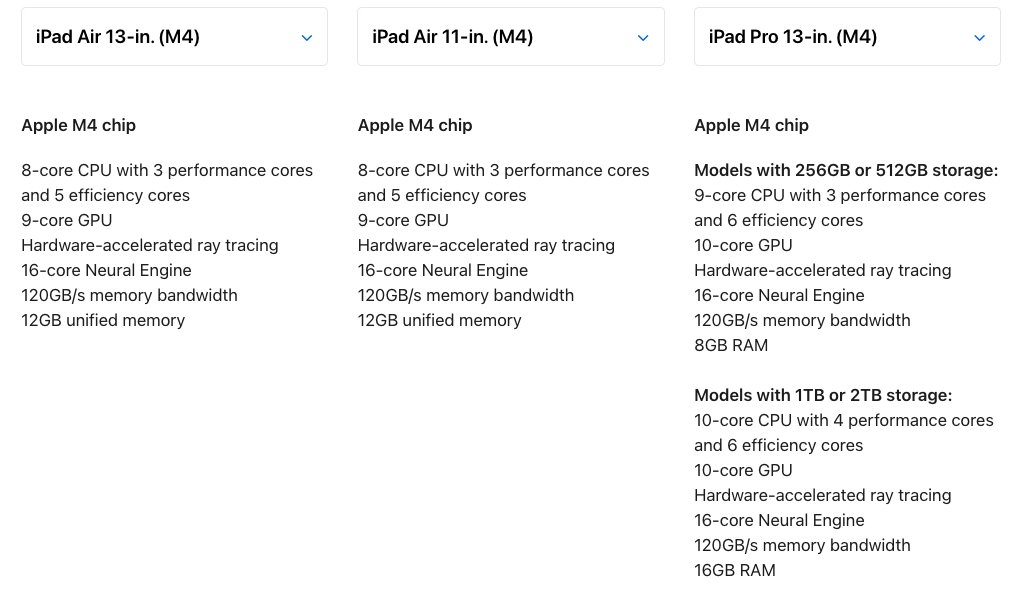
Apple's comparison page details for the M4 chip in the iPad Air and iPad Pro
Apple's current-gen M5 iPad Pro does a similar thing, using a nine-core CPU in the lower two capacity models, and a ten-core CPU for the upper-two capacities.
For the GPU, the M4 in the iPad Air is listed as having nine cores. For the M4 iPad Pro, all versions of the chip used ten GPU cores.
Averaged memory
The chip changes also include a difference in the amount of memory available to users. Though this time, it's not a downgrade.
According to Apple's specifications list, the iPad Air has 12GB of unified memory. This is pretty good, as the lower-tier M4 iPad Pro used 8GB while the upper-tier used 16GB, putting the iPad Air in the middle.
Other chip specifications are the same, including hardware-accelerated ray tracing, a 16-core Neural Engine, 120GB/s of memory bandwidth, and the 8K-capable Media Engine.
Same name, worse performance
Apple's use of a downgraded chip isn't new. Chip binning is an industry practice it has employed in the past to ship models with the same chip architecture, but slightly lower-grade performance.
With the loss of one or two cores for the CPU, as well as one for the GPU, there will simply be fewer cores at work.
It won't really affect single-core benchmark tests, as they always end up using one performance core for those. Fortunately, this covers most user actions on iPad.
For multi-core and Metal-based tasks, the iPad Air will still be good, but not quite to the level of the M4 in the iPad Pro, and certainly not close to M5 iPad Pro speeds.