
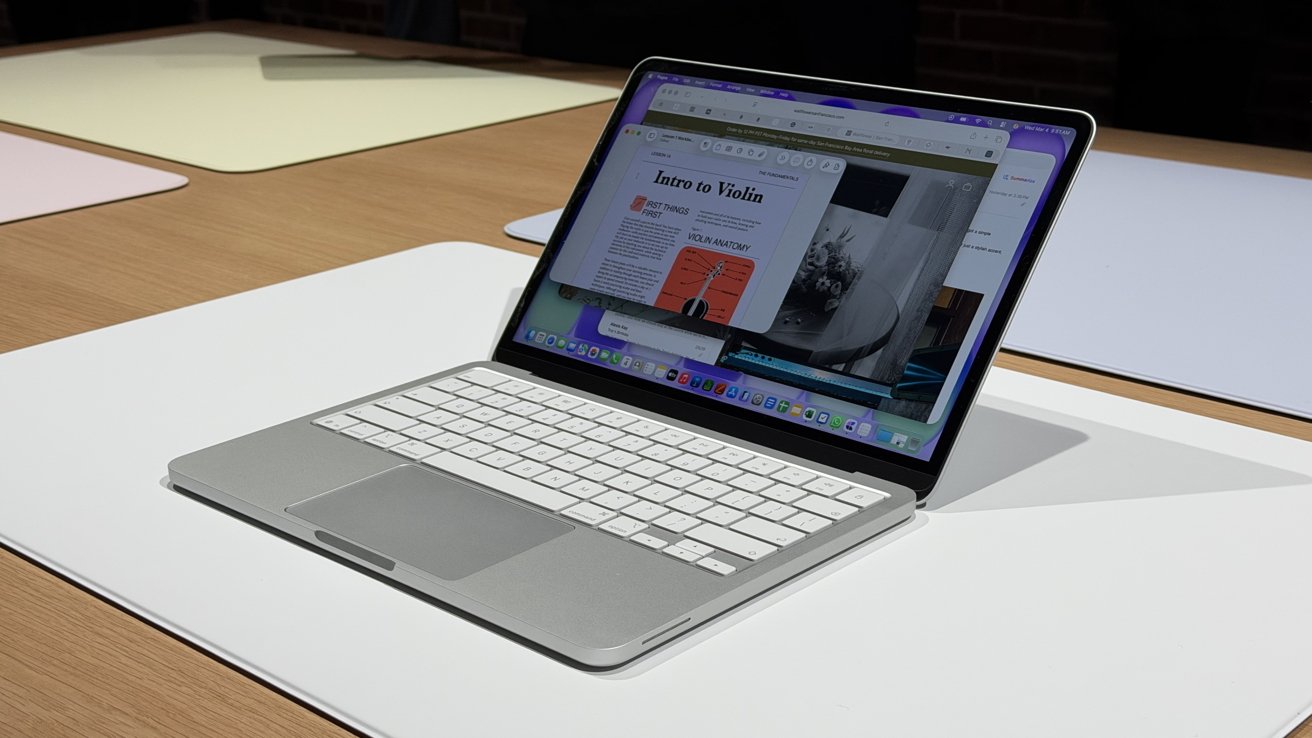
Apple's budget-focused MacBook Neo borrows the A18 Pro chip from an iPhone 16 Pro. Here's how the chip compares against other Apple Silicon Macs, and why it's actually a pretty smart thing for Apple to do.
Apple's launch of the new MacBook Neo is a fresh salvo into the value computer market, normally dominated by Windows notebooks and Chromebooks. The value end of the market meant Apple had to cut production costs.
One of those cuts was the CPU.
There was always the possibility of using an earlier Apple Silicon M-series chip, such as the M1 chip.
Apple went down an entirely different route.
This time, instead of using older M1 chips, Apple reached for the A-series chipsets. It would be an iPhone chip at the heart of its latest notebook.
This makes more sense than it might. Apple Silicon all sprung from Apple's work on iPhone chips. An A18 Pro chip uses the same performance cores, the same efficiency cores, as a M4 chip, just in different numbers.
The new budget MacBook Neo was never going to shatter speed records on launch. It wasn't intended to.
It's not designed to be a powerhouse system, not by any stretch of the imagination.
It just needs enough processing grunt to be able to load webpages, play videos, write documents, and perform other fairly simple tasks.
Even so, observers still want to work out how far behind the rest of the pack the A18-based chip will be against over five years of Apple Silicon releases.
It turns out, it's not that far behind at all.
Out of the box thinking
The first thing that anyone questioning Apple's decision needs to understand is that a chip designed for a mobile device can still be compared with one made for an actual computer.
Getting past that assumption that it's not is easy, if you think about how Apple Silicon came about.
Back in its introduction, Apple touted its design skills creating chips for the iPhone, and that it wanted to put what it learned into making a desktop-class chip instead. Indeed, the M1 is widely considered to be an expansion of the A14X chip, slightly modified for Mac usage.
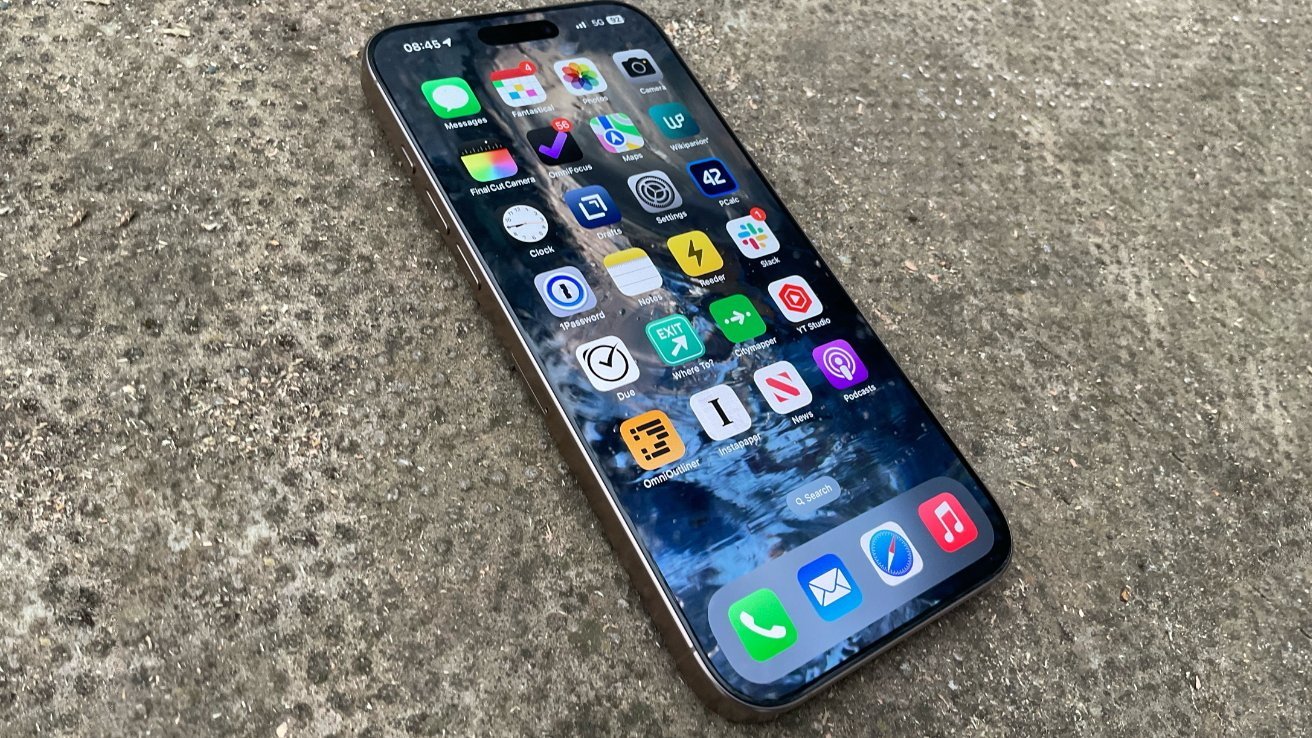
The A18 Pro was introduced in the iPhone 16 Pro range.
It's the same ARM-based architecture, the same usage of an onboard GPU and a Neural Engine, and all of the other benefits that the A-series has. Except Apple could add more cores because it had access to better cooling options.
The result was a chip with high power savings and performance, relative to existing desktop-class chips at the time.
Since then, Apple has been incorporating more updates in its chip lines, with benefits arriving in both lineups at around the same time. The most recent example is the inclusion of neural accelerators in each core of the iPhone 17 Pro GPU, as well as the M5 chip.
For those still unconvinced, the iPhone is still a computer, that lacks a physical keyboard has a touch-first interface.
The MacBook Neo is an iPhone, with a physical keyboard and trackpad, and no touchscreen. It's just running macOS, instead of iOS.
Benchmark Considerations
Apple says the chip inside the new MacBook Neo is 50% faster for everyday tasks like web browsing and up to three times faster when using on-device AI processing than the "bestselling PC with the latest shipping Intel Core Ultra 5."
Sure, okay. This is nice, but we need a more direct benchmark comparison.
For this purpose, we will be looking at Geekbench results for existing Macs with base versions of the M1 and M5 chips. This is to represent current and original Apple Silicon releases.
When it comes to which model's results to use, we will look at the MacBook Air for the M1 model and the 14-inch MacBook Pro for the M5. The use of the Air is appropriate given its reduced thermal management, but the MacBook Pro is the only Mac model with the M5 that's commercially available for the moment.
It's not ideal, but we have to use what's available. When the MacBook Air with M5 ships, that will be a slightly closer comparison point, but there will still be a gulf in performance difference.
On the A-series side, we will use the Pro Max versions of the iPhone 16 and iPhone 17, which have the A18 Pro and A19 Pro, respectively. This is to compare against the current mobile processing capabilities of Apple's top smartphone.
The iPhones aren't known for their cooling, but the MacBook Air also doesn't have an active cooling system. This makes it a good point of comparison for a MacBook Neo that doesn't have cooling fans either.
Single Core
The most-level playing field to look at is single-core performance. This only compares a single fastest core on a chip and ignores any variances like core counts or core types.
The figures we've compiled put the A18 Pro at 3,428 points in Geekbench. This is 46% better than the M1 MacBook Air at 2,347 for the same test.
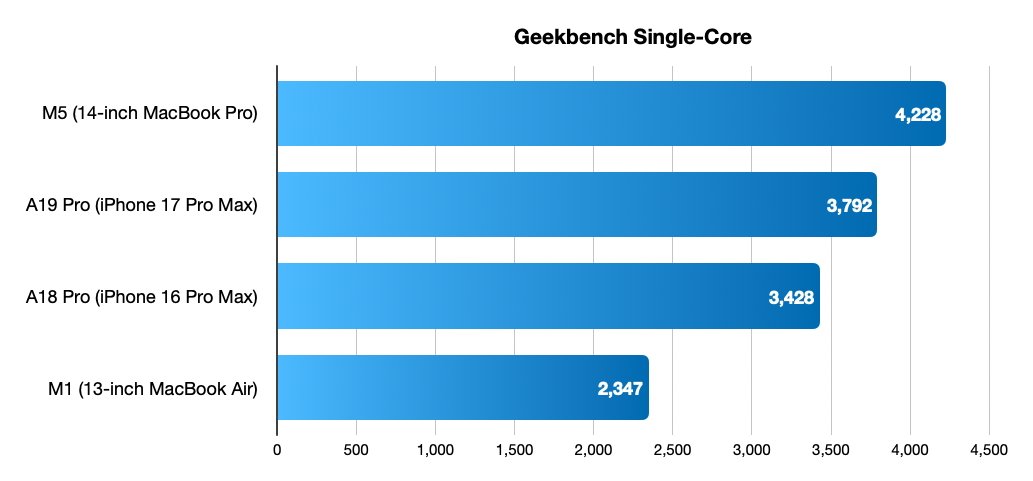
Single-core Geekbench scores: MacBook Neo should be better than M1.
It's also not far off the pace of the A19 Pro, which manages 3,792, a 10% increase in performance.
The difference with M5 is sizable, but again not that big. At 4,228, the M5 is 23% better than the A18 Pro in single-core performance.
Multi-core
Things become less useful when you start bringing multiple cores into the situation. The more cores there are, the bigger the score will generally jump.
That means older chips with slower and fewer cores will struggle here against newer versions.
The A18 Pro and A19 Pro both have the same six-core configuration, with two performance cores and four efficiency cores. There will be a difference because of the clock counts of each core.
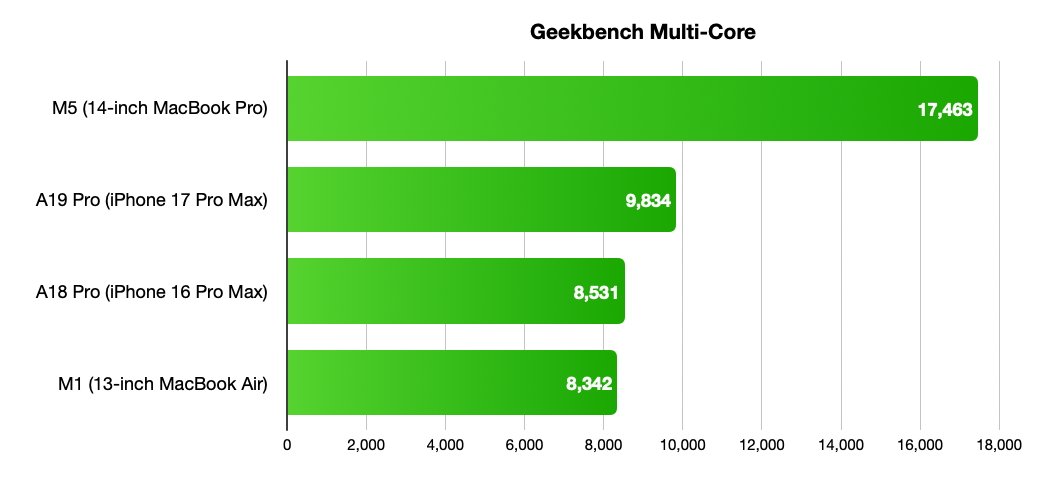
Multi-core Geekbench: MacBook Neo's A18 should hold its own here.
The M1 in the MacBook Air had an 8-core CPU, with four performance cores and four efficiency cores. The M5 has even more with a 10-core CPU using four performance and six efficiency cores.
Looking at the graph, the A18 Pro also fends off the M1, but with a 2.3% margin at 8,531 versus 8,342. Even though there are two more performance cores in the M1.
There's more of a gap between the A18 Pro and A19 Pro, with generational improvements leading to a 15% difference in multi-core performance.
The core counts become insurmountable in the M5, as its score of 17,463 in Geekbench is massive. The improvement is 77% over the A19 Pro, 104% over the A18 Pro, and 109% more over the M1.
Metal
The graphical performance of the A18 Pro relies on an integrated 6-core GPU of Apple's own design. We know it's decent enough for mobile gaming, which bodes well for Mac gaming, too.
However, the A18 Pro in the MacBook Neo isn't quite as powerful, due to Apple's use of a five-core GPU instead. This will mean the benchmark comparison is less useful for graphical comparison as the A18 Pro in the Neo will be worse than the iPhone version.
Further complicating matters is that the A19 Pro in our comparison has not only 6 GPU cores, but Neural Accelerators in each core to help with machine learning tasks, such as Apple Intelligence.
That A18 Pro in the MacBook Neo will still have the Neural Engine available for that, but the Neural Accelerators would've been nice to have.
The M1 in the MacBook Air had a seven-core GPU to play with, sans Neural Accelerators. The M5 MacBook Pro has ten GPU cores, so it has a massive advantage.
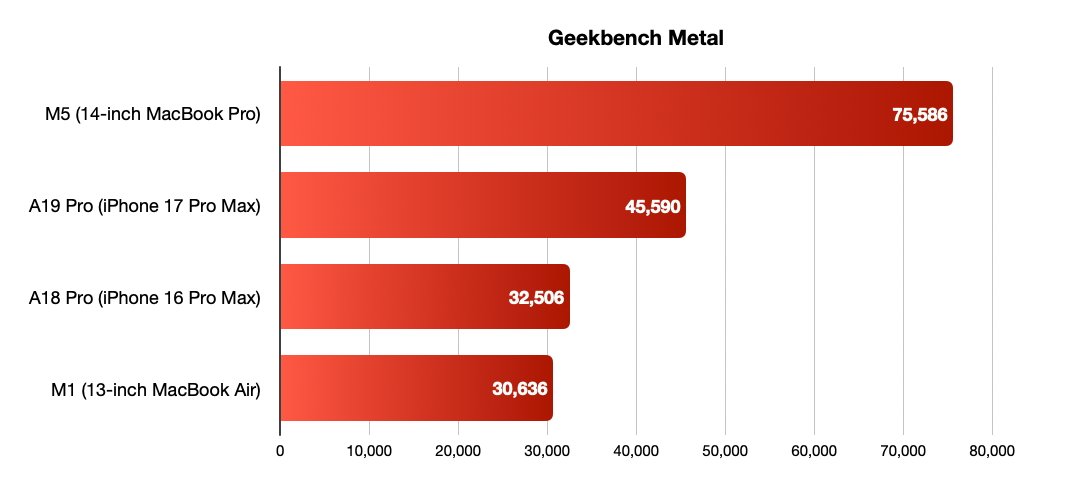
Geekbench Metal: The iPhone's A18 Pro did well, but the MacBook Neo's GPU will have fewer cores.
Checking out the Metal benchmark numbers, and the core counts certainly matter. With over 75,000, the M5 has a big graphical lead, thanks to both core quantity and per-core performance.
In a distant second place is the A19 Pro with 45,000. The A18 Pro manages to edge third place with over 32,000, while the M1 gets just past 30,000.
While this gives the impression the MacBook Neo will have better performance than the M1 MacBook Air, it won't. This figure doesn't take into account the core count reduction.
If benchmarked today, the MacBook Neo's A18 Pro chip will do worse, simply because it has one fewer core to play with.
Not mind blowing, but enough
Looking at the benchmarks for chips used in Apple's past and present tells us a few things about the A18 Pro's usage in the MacBook Neo.
For a start, it's powerful compared to the M1 Mac. Beating a chip that's over five years old isn't impressive, but it does demonstrate that it will hold its own for essential tasks.
There's still a question mark over graphical performance because of that core reduction. It'll still be able to render games well, but I doubt that the average MacBook Neo buyer will care about that too much.
Ultimately, the main takeaway here is that Apple's decision to include an A-series chip in a notebook destined for the value end of the market is justifiable. It doesn't measure up to the newest M5 generation by a long shot, but it holds its own against older Mac releases.
Think of it as a M1 MacBook Air, with better basic use speeds, and without Thunderbolt, and you're in the ballpark.
It's not a flagship release, performance-wise. It'll do very well for watching YouTube in a Starbucks, writing that email on the train, or goofing around with basic use.
If you've got an Intel MacBook of any sort, it's time to upgrade.