Apple may just be one of the few firms actually profiting from AI, as its in-app purchase commission revenues through the App Store are expected to exceed $1 billion in 2026.
It's still a fallacy that Apple is behind on AI, but it is certainly true that its Apple Intelligence-powered Siri has yet to materialize. But while it has no AI chatbot of its own, Apple is profiting handsomely from all of others.
According to the Wall Street Journal, in January 2025, Apple took $35 million in App Store fees from generative AI apps. By August 2025, it was $101 million, for an estimated $900 million over the year.
Based on estimated App Store revenue, it's now predicted that Apple's take from generative AI apps will reach $1 billion for 2026. Although the research also notes that sales of apps like ChatGPT have more recently declined.
According to these figures, for 2025, 75% of the earnings came from ChatGPT. The next closest in App Store fees was Grok, which accounted for 5%.
The Grok and ChatGPT apps are free, but Apple's take comes because of users signing up in the apps to subscribe to the services. This is why Apple's revenue may yet continue to grow even as new app downloads decline
Money in, money out
Right alongside the fact that it is profiting nicely from sales of GenAI apps it does not own, Apple is also spending drastically less on AI than its rivals.
According to this research, Apple's spending has hovered around $2 billion to $4 billion annually since 2020. By comparison, Amazon's AI spending has zoomed up from about $4 billion in 2020 to over $40 billion so far in 2026.
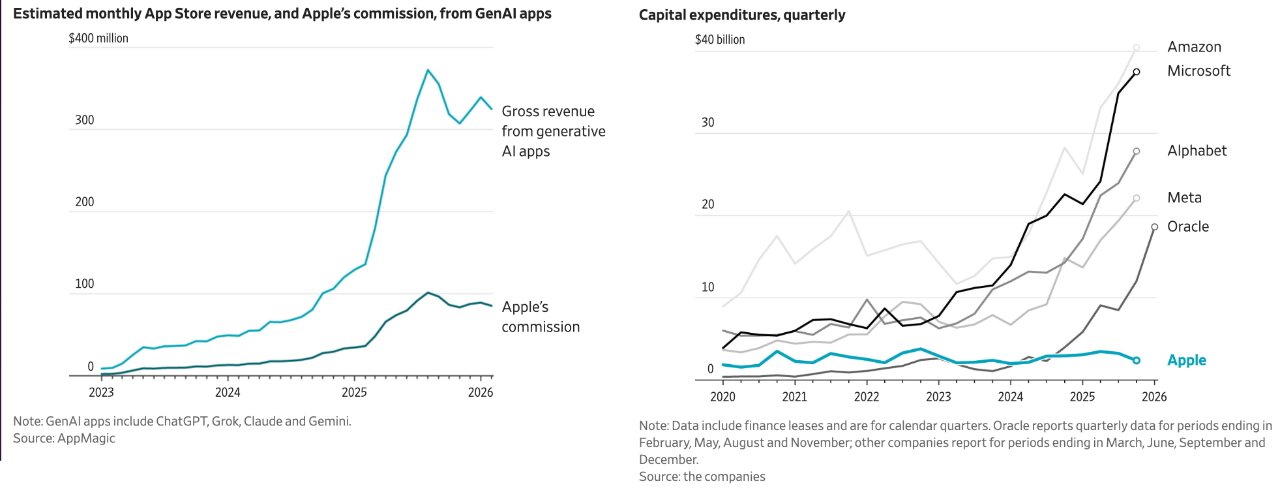
Two charts showing Apple's estimated revenue from App Store sales, and its lack of AI spending compared to its rivals — - image credit: AppMagic via the Wall Street Journal
At the same time, Microsoft is only a little behind on approximately $38 billion. Meta and Google parent company Alphabet have reportedly each spent more than $20 billion on AI research and development.
That spend, though, while it includes research, is chiefly going on infrastructure. These firms are developing processors and data centers, while Apple is not.
Instead, Apple is working to have Apple Intelligence work on iPhones on its own processors, and using the data users store on their own devices. There is Private Cloud Compute and there are the deals with Google Gemini and OpenAI's ChatGPT.
But there isn't the same investment in facilities from Apple as there is from any other large AI firm.
If the new Siri is genuinely improved, then all of this will once again back the notion that Apple knows when to enter a market and when to wait. It feeds into the repeated idea that Apple comes late, but gets it right.
Yet if the new Siri disappoints, or simply doesn't appear, then Apple will truly be behind on AI and an annual $1 billion profit will not make a dent in its income reporting.