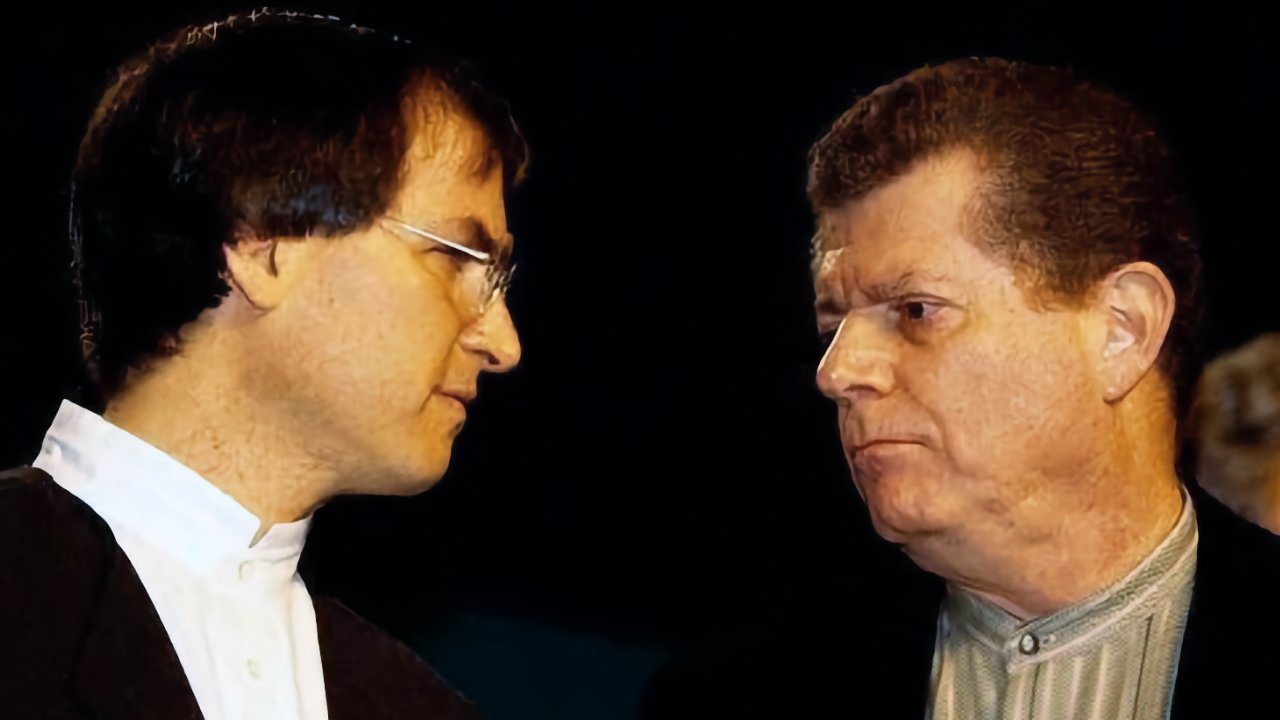
Gil Amelio had the shortest reign of all Apple CEOs, but maybe the greatest impact as, practically despite himself, he set the stage for how the company would survive.
Gil Amelio is yet another Apple CEO who has never had the profile of Tim Cook, Steve Jobs, or John Sculley. If he's remembered for his time running Apple, it is because he had the firm acquire NeXT and so was responsible for Steve Jobs returning to Apple.
Long time AppleInsider readers may also remember that Jobs successfully worked to oust Amelio from the role. But what's not even that well known is that Jobs may even have been taking revenge.
Before Amelio was Apple's CEO
In 1995, Gil Amelio was the CEO of National Semiconductor and during his four years there had basically saved the company. It had been struggling in much the same way Apple was at this time, but Amelio had brought it back into profit.
That may well be why he was invited to join Apple's board by then-CEO Michael Spindler. He officially joined in November 1984, but in his book "On The Firing Line: My 500 Days at Apple," he says he started work on the board in January 1985.
Some time between then and his being made Apple CEO in 1996, he says that Steve Jobs came to see him. Jobs was still running NeXT and Pixar at the time, there was no move by Apple to bring him back, but he came to Amelio to lobby for exactly that.
"Apple is on its way out of business," he reportedly said to Amelio in the offices of National Semiconductor."The only thing that save it is a strong leader, somebody who can rally employees, the press, users, and developers."
"The world has changed," continued Jobs, "the Mac has outlived its usefulness, it's time to go on to something else."
Steve Jobs wanted Amelio's backing and by championing his return to Apple, convince the rest of the board. But Amelio himself wasn't convinced.

Amelio says that he asked Jobs what he would do first as Apple CEO. He specifically asked what would replace the Mac.
While surely Jobs would have said something then about his NeXT computers or the NeXTStep operating system, Amelio reports that he simply had no answers.
Selling Apple
The way Amelio tells it, by the time he was on the board of Apple, just about the only discussions were concerned with selling the company. He thought too much time was being spent on that and not enough on trying to solve the firm's various problems, but says he was just one board member.
Then-CEO Spindler by now was set on selling, and long-term Apple supporter Markkula agreed. They just didn't agree on who to try selling to.
For that reason, and because Apple was a risky buy for any firm, negotiations with various companies took months. Amelio says he argued that Apple should focus on trying to fix its problems, even if only to make it a more attractive acquisition.
Those problems included the now well-known issue that Apple under Spindler was producing too many Mac models with barely any differentiation. What may be less well known is that because of this, the company struggled to meet demand for its popular products.
And that parade of Macs did have popular entries, enough so that for the holiday season 1995, Apple appeared to be on track to do well. It was selling a great many Macs, and Spindler kept reporting to the board just how great that quarter was going to be.
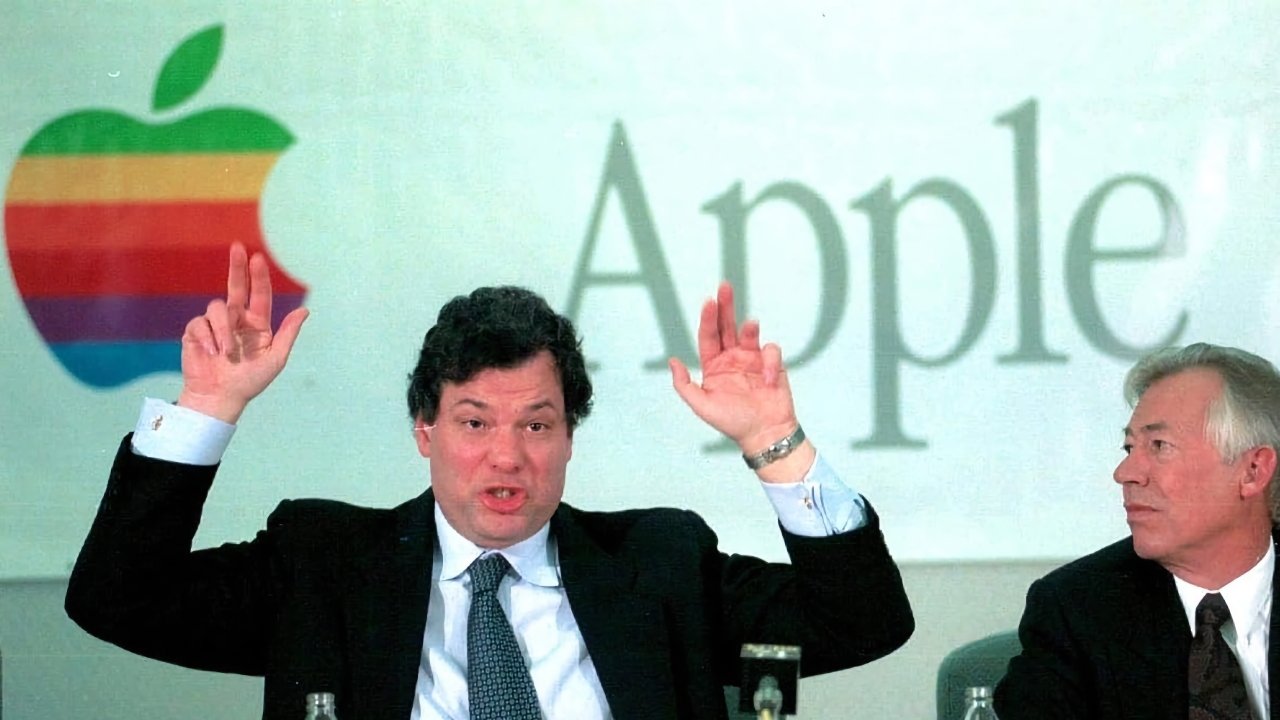
Previous Apple CEO Michael Spindler did not know Macs were being sold at a ruinous discount — image credit: Apple
It wasn't. Unknown to Spindler, the heads of both Apple US and Apple Japan had been selling Macs so well because they were cutting the price. Reportedly some Macs were being sold for 25% below their recommended retail price, and Apple did not have enough margin to absorb that.
Apple ended that quarter with a loss of $69 million. "To say we were stunned would be putting it mildly," wrote Amelio.
There was little chance that Spindler would get to stay as CEO after that. But at the same time as all of this was happening, Sun Microsystems was considering buying Apple.
As Amelio tells it, everyone but him was ecstatic. Since he'd brought National Semiconductor back from the brink, he felt he understood Apple's position, and that things were not as irrevocably bad as they seemed.
Again, though, he was just one member of the board, so he was going along with the decision to sell. Until January 11, 1996, when the board met in New York to discuss both issues, the CEO role, and the sale to Sun.
"If you buy Apple," Amelio says he asked Sun's representatives, "are you going to keep the Apple brand name?" Apparently Sun's people said they hadn't thought about it, and Amelio took that to mean no.
That put him against the deal, but then Sun made a last/best offer that so undervalued Apple that the board wouldn't accept it.
Sun Microsystems was out. And later on at the same meeting, so was Spindler.
But Amelio wasn't offered the CEO role right away. He had expected to be, based on conversations with the rest of the board, but instead he found he was in competition with another board member who asked to be considered.
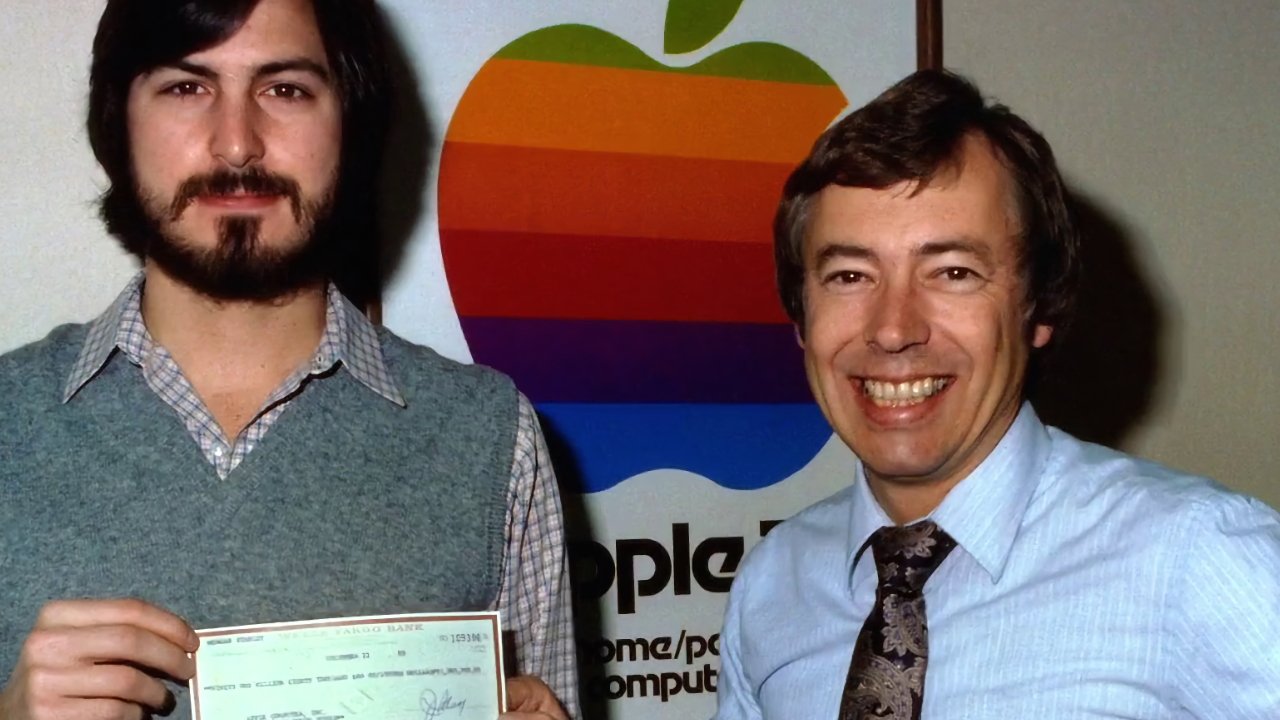
Mike Markkula (right) with Steve Jobs in the 1970s, was again central to the choosing of the company's next CEO — image credit: allaboutstevejobs
If things had gone another way, the next CEO of Apple could have been Jurgen Hintz, formerly of Procter & Gamble. Yet again, though, the choice of CEO came down at least in part to Mike Markkula, who was one of those backing Amelio.
The formal decision still took hours, with contract negotiations going on until nearly midnight. In the end, Gil Amelio became Apple CEO for:
- $990,000 annual salary ($2.1 million in 2026 money)
- $5 million signing bonus ($10.4 million today)
- Potential bonus of up to 300% of salary ($6.3 million today)
- 1 million shares
- 1 million options to buy more stock at a fixed price
That's what he signed on for, but it isn't what he got. After he'd resigned from National Semiconductor and was committed to the new job, Apple lawyers said no. They would not accept the contract he'd been given.
What he got would be broadly in line with what was originally agreed, but with many more conditions and being much more tied to performance. For instance, he would get the $5 million signing bonus, but it would be considered a loan to be paid back if he didn't hit targets each year for five years.
Amelio regarded some of his package as being what's called downside protection. Under the contract he signed, he would have a cushion even if Apple ultimately failed or was bought out.
The new deal had much less of that, but according to Amelio, Mike Markkula made him a separate and private deal. Reportedly, should it come to that, Markkula promised to make up the difference out of his own pocket.
The state of Apple
When Amelio took over as CEO, it was still true that there were too many Mac products. But there were also 23 marketing organizations working on them.
The multiple products and the multiple overlapping work surrounding them all meant there was infighting within the company. There were horrendous quality control issues, which led Amelio to stopping production of certain PowerBooks and recall them.
"Everything at Apple felt like bench-pressing 500 pounds," Amelio later told David Pogue for the book "Apple: The First 50 Years."
Maybe Spindler got out at the right time, too, because in April 1996, Spindler had to tell the board of another loss. Instead of the $96 million loss that cost Spindler his job, Amelio had to report a $740 million one.
Amelio didn't lose his job, but as a result of that loss, around 1,500 Apple employees did. Amelio laid them off, he cut marketing and advertising, and he addressed quality assurance.
Shockingly, Apple at this time did not have a Chief Financial Officer, and it hadn't for many months. Amelio hired one. Fred Anderson joined Apple as CFO on the day of the company's 20th anniversary.
Anderson renegotiated various loans Apple had, he got suppliers to accept payment in 45 days instead of the previous 30. And he did what every corporate employee would recognise: he cut expenses.
According to Pogue, it was Anderson who saw how beneficial Apple's share of the Arm processor company was. Sculley had invested $3 million during his time as CEO, but that was now worth $800 million.
Anderson didn't spend that money, it would be Amelio who later used it.
But it was Anderson's efforts that saw Apple turn a profit in September 1996. Even if that profit was only $25 million.
Apple can't be led
Amelio had that business experience with turning around National Semiconductor, but he also had a technology background. Gil Amelio's name was on 16 patents before he even joined National Semiconductor.
He also had a PhD in solid-state physics from Georgia Tech, although that would prove to be a problem at Apple. Not because of his qualification, he says, but because his assistant would answer his phone by saying "Dr. Amelio's office."
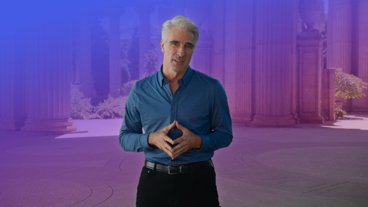
That assistant wasn't the only one, though, and it doesn't seem likely that he or she took it on themselves to announce him that way. There's also an Apple video that credits him on screen as Dr. Gilbert Amelio.
It's a video made to reassure chiefly corporate clients who were concerned about the state of Apple. It was filmed a month after Amelio became CEO and he used it to emphasize that the company was now in a new era.

"I think it's very clear that due to some of the dynamics in the industry as well as, frankly, some of our own mistakes, we've stumbled recently," he said. "We failed to live up to the promise of our technology."
"Our response to this is that we will get up, dust ourselves off, and move forward once again," he continued. "Let me assure you that the troubles that we face are fixable."
Curiously, Amelio specifically speaks in that video about what will happen during the first 100 days of his time leading Apple, but later claimed that was foisted on him. Having casually mentioned at an early meeting that "this is only day ten of my first hundred days," he says others took this to mean "problems solved and solutions in place by the 100-day mark."
"It was symptomatic of how the press can drive your agenda," he wrote in his book, "and would prove a painful headache in the making."
There's a disconnection there between Amelio's video and later recollection, and it's symptomatic of much of his era. That video for corporate clients is a peculiar mix of airing dirty laundry and making unnecessarily defensive statements that should at most have stayed inside Apple.
Then there was also a disconnection between Amelio and Apple's staff. Whether or not it really was all down to that, Apple CEO "Dr. Amelio" was seen as being less involved with the troops than Steve Jobs and others had been.
Perhaps as a result, Amelio tended to simply not be listened to when he did talk to staff. In his book, Amelio recounts having particular conversations about Mac software and then discovering that not a single thing he'd agreed was even discussed further, let alone done.
An unnamed Apple product manager later told David Pogue the other side of this. "[Amelio would] come up with some idea, to be honest, usually not great ideas. So he tells his team, 'this is what we've got to do.'"
"And we're like 'That's a dumb idea. We're not doing that.' So that's why he would say that Apple couldn't be led."
There were also fewer and fewer people to lead, too. Amelio had first laid off 1,500, then Anders let a further 3,000 go. Then in January 1997, Amelio laid off another 2,700.
The search for a new Mac OS
It was chiefly during Amelio's reign that Apple made its big effort to replace the aging Macintosh operating system with an entirely new one. It was needed because the old system wasn't adequate for what were then modern applications.
Plus Windows was technically in much better shape. An app that went wrong on the Mac could freeze up the whole machine, where on Windows only that specific app would freeze.
True, this was Windows so there were still crashes. But even the Mac's predecessor, the Apple Lisa, had an OS that could cope with this kind of problem.
In his book, Amelio describes what the company was working on to fix this. It was the OS code-named Copland, and he was again finding that he was being ignored over it.

Key Copland executives "were responding to action items only a theoretical plane," wrote Amelio. They were "not taking the kind of decisive, hands-on action that was absolutely essential for getting the company back on track."
The way Amelio goes on to describe it, there would forever be one executive who took an order, but then another who would block it.
Even as Copland was struggling forward and Apple was in theory also looking at yet a further OSes code-named Gershwin and Rhapsody, Amelio hired Ellen Hancock. She had worked with him at National Semiconductor, and came to Apple to take over getting Copland out of the door.
It was Hancock who said that none of this was ever going to work. And because of her, Apple pivoted to trying to find an alternative OS to buy.
Today this may seem surprising, but back in the 1990s, Apple actually had some choices. There was BeOS, for one thing, and Amelio came so close to buying it.
BeOS was made by a company that Amelio disparaged, saying, "the joke went around in Silicon Valley that 'Be had never been.'" Founded by Jean-Louis Gassee after he was fired from Apple by John Sculley, Be Inc set out to make the BeBox PC, and produced an operating system for it.
But then Ellen Hancock was pressing for Apple to join with Sun Microsystems and use that firm's Solaris operating system. And throughout this period, Amelio was also seriously discussing Microsoft making a Mac version of Windows NT.

"Bill Gates was on the phone every day trying to sell me on the idea," Amelio wrote. "I concluded that if they created a new Mac operating system based on Windows, Bill Gates would be canonizing us. He'd be saying to computer users worldwide, "It's acceptable to Microsoft if you use the Mac operating system.'"
That would be big of him.
It's not clear now how long the dance with Microsoft went on, but according to Amelio, it was again Ellen Hancock who decided it wasn't going to work. Despite the continued promises from Gates, she concluded that there were insurmountable technical problems.
And then there were two
Today it's also not clear just when Solaris went out of the picture, but it appears to again be an issue of technology problems. Amelio said Apple would have to engineer a whole user interface to go on top of Solaris, and that wasn't so much the case with the remaining options.
BeOS was still one of them, and NeXTStep became the other contender. Amelio went a long way down the road with BeOS, despite later saying that it was "a great concept that was still three years and megabucks away from solving our problem."
Speaking of megabucks, it was really the price of BeOS that ended discussions. Initially Be proposed being bought in exchange for shares in Apple, which Amelio calculated would be worth $500 million, or ten times the value of the Be company.
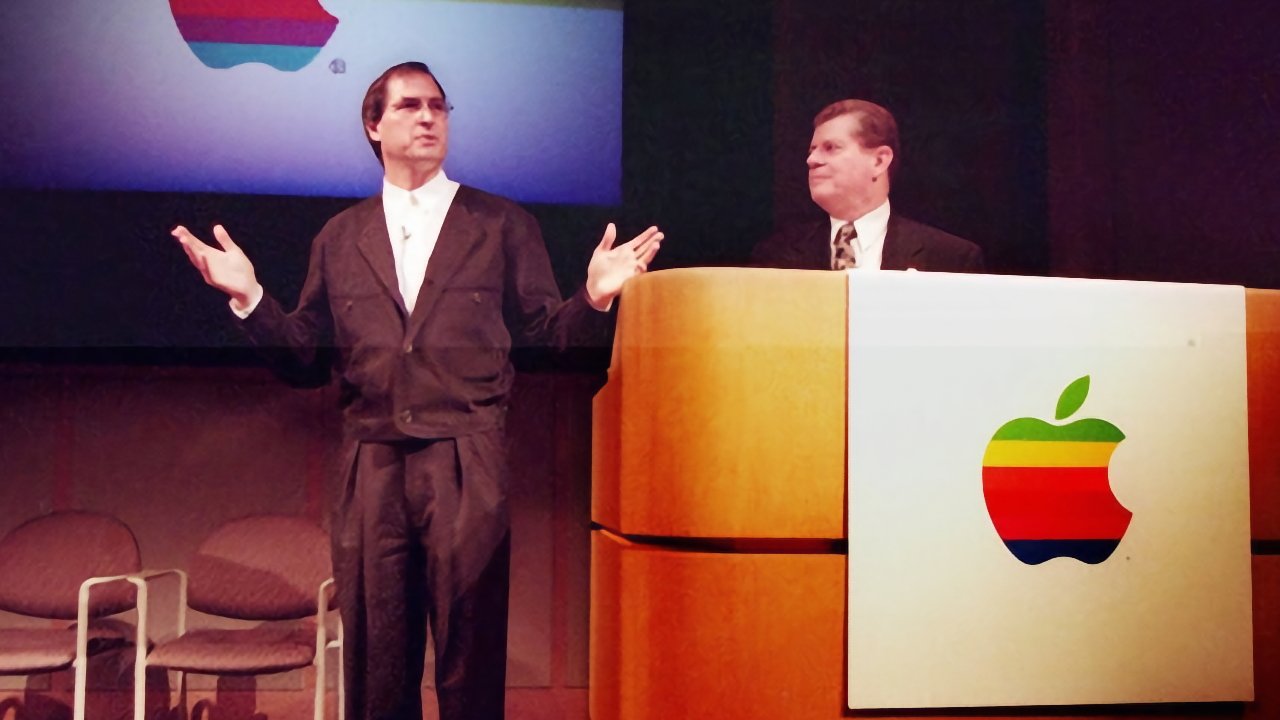
That's Amelio behind the podium (right) and the better public speaker Steve Jobs wowing the crowd - image credit: Apple
That was reduced to $300 million, and Amelio had been prepared to pay up to $125 million. But the two offers could just never met in the middle.
Which should have just left NeXT, but Amelio is a little vague on the sequence of all these negotiations. What he does say is that on December 10, 1996, he invited back to back presentations from NeXT and Be.
Bringing back Steve Jobs
The way he recounts those presentations, Amelio is so dismissive of Jean-Louis Gassee's lack of effort that he sounds as if the Be CEO talked himself out of the contract.
"Everything pointed toward Steve Jobs and NeXT, but Jean-Louis had made it a no-contest," wrote Amelio. "The vote for NeXT was almost a foregone conclusion.
A few days later, Amelio drove his 1973 Mercedes-Benz over to Steve Jobs's house where they negotiated over tea in the kitchen. There was of course back and forth over the details, but there were also two elements that both made it necessary to buy NeXT, and possible.
"I'm not going to stand here and tell you this deal is worth the money we're proposing to pay," Amelio says he told Apple's board later. "But since we've managed to get ourselves into this situation where do not have an operating system strategy, we have very few options."

Apple was in a corner, but then Apple also had one ace. It had the money from selling its Arm shares. Amelio did that deal and because of it, Amelio could buy NeXT.
Death warrant
Much of what happened next belongs in the forthcoming account of Steve Jobs's time as "iCEO" and then CEO. But ostensibly what went on was that Jobs joined Apple as part of the NeXT deal and in theory had no other role than advisor.
In practice, Jobs took over immediately. It took a little while for him to oust Amelio, but in retrospect there was no question that was his aim from the start.
It probably would have been that way regardless of who Apple's CEO was, as Jobs clearly wanted that role. But Jobs also had little to no time for Amelio.

According to Michael Markman, ex Apple marketing professional, Steve Jobs regarded Amelio "as a bozo."
"He thought so little of Gil that it's reported he took to ranking people's stupidity in units of Gils," said Markman in one of his "Mickeleh" YouTube videos. Markman wrote Amelio's scripts, even when Amelio reportedly chose not to follow them.
Note, too, that Amelio's only possible reference to Markman in his book is to describe him as "the writer, a sometime stand-up comic." There's then a difference of opinion over whether this stand-up writer failed to deliver on time, or that the Apple CEO wouldn't answer his emails.
What they were all preparing for, or were supposed to be preparing for, was the January 7, 1997 MacWorld Expo that would reintroduce Steve Jobs.
According to Markman, what happened there was "the Worst. Apple. Keynote. Ever." If you read Amelio, it was a case of "I knew I had not been supported professionally... [although] I didn't know the extent of the disorganization."
What both sides agree on was that the presentation was what Amelio called "one of the most embarrassing and unforgiving experiences of my life."
He says that the slides were in the wrong order, and that the TelePrompTer had an early, outdated version of the script. Amelio recounts that after everything had been overrunning because of the various guests on stage, he "did what the situation demanded" and cut to the chase.
Amelio just took hours to do that. He confirms what Markman also says about overrunning, that the keynote ran for three hours, but also says that "this team didn't measure up."
In Markman's version, "Gil had an obvious win staring him in the face," despite Apple having reported disastrous financial results.
"Against all odds, he could have won that keynote definitively with just three sentences," continued Markman. "'Hello, I'm Gil Amelio. I just bought NeXT. Here's Steve Jobs.'"
Both Amelio and Markman say that the Apple CEO adlibbed the keynote, Amelio because there was nothing else he could do. And Markman because Amelio insisted on it instead of reading the script.
We may now never know what really happened, but there is an extended clip of that MacWorld keynote that shows Amelio is wrong about at least part of it. As Amelio recounts, he was to end the presentation by bringing Steve Wozniak out to join Jobs.
"I introduced Woz, catching the audience by surprise... and he came out to the biggest ovation of the day," wrote Amelio. "Woz back in the spotlight, where he deserves to be... a stunning moment."
"But as soon as Woz appeared onstage, Jobs walked off," continued Amelio. "There was no coaxing him back. His own feelings were more important than good press for Apple; he had decided not to cooperate... and that was that."
It wasn't. In the video, it's true that the audience didn't expect Woz, but it's Amelio who is surprised. He makes a big deal of pointing out Woz in the back row, only to find Wozniak walking on stage from the side. "You were supposed to be at the back," says Amelio.

And Jobs did not walk away. The two Steves talked between themselves a little, perhaps Woz more enthusiastically, but the two men stayed there for photographs and through a presentation.
"I often think how wasteful it is that those with real capabilities should doubt their abilities," Amelio concluded about that failed keynote, "while bunglers seem so damn sure of themselves."
(500) Days of Apple
Throughout every element of Gil Amelio's 500 days as Apple CEO, it seemed as if no one listened to him, and he listened to no one. That would continue right to the end, which he says came with a phone call on the Sunday of Fourth of July weekend, 1997.
Reportedly, Apple's board had been "meeting by phone on and off for the last 36 hours," and they had concluded Amelio had to go. He says he should have been part of the board's discussions, but he wasn't. "It was a done deal."
Apple's fifth CEO was out.
He subsequently partnered in 2005 with Steve Wozniak and Ellen Hancock in Acquicor, a firm that traded on acquiring companies and selling them on for a profit. Since then, he has been a board member and chairman of firms including AT&T Pacific, and a trustee of the American Film Institute.
Apple at 50: How each of its CEOs shaped the company
- Apple at 50: Michael Scott, the company's first CEO, made bold and bad choices
- Apple at 50: Mike Markkula, Apple's second CEO was as important as Steve Jobs
- Apple at 50: John Sculley, Apple's most maligned CEO
- Apple at 50: Michael Spindler, the CEO who brought in the clones
- Apple at 50: Gil Amelio, the CEO who brought back Steve Jobs