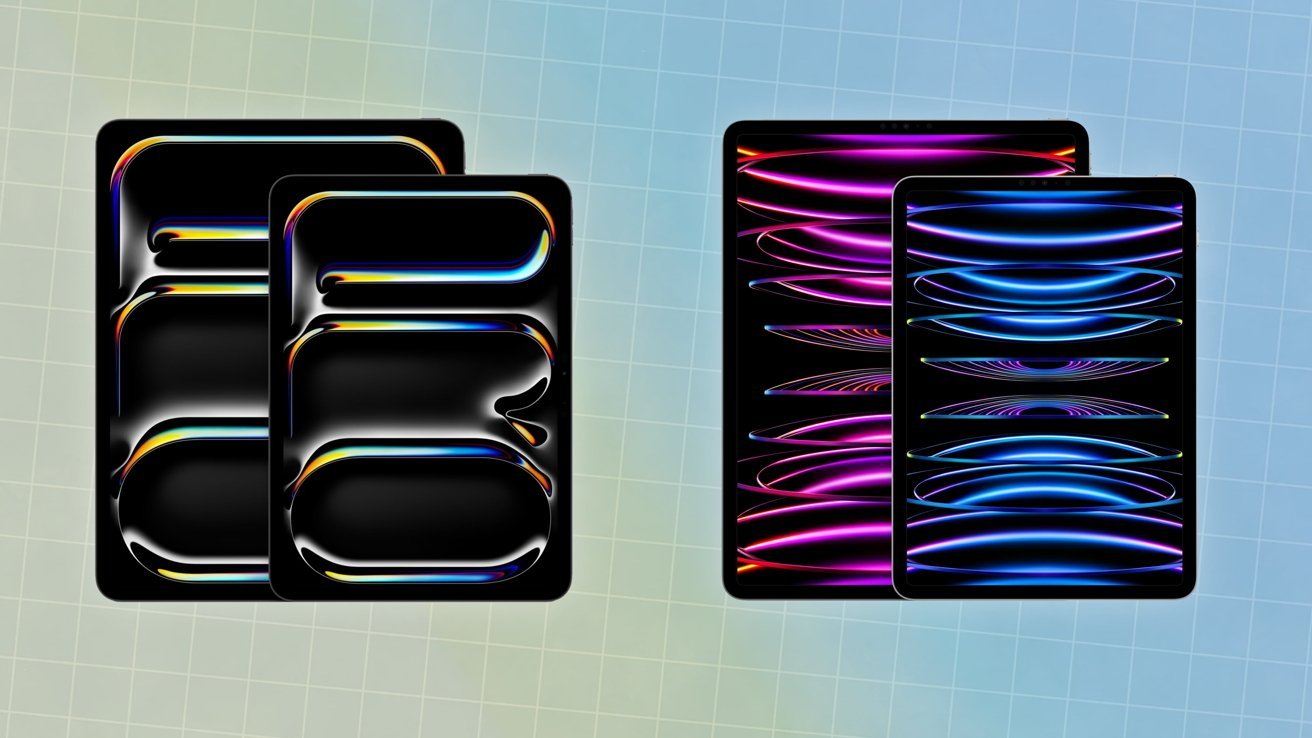
Apple updated the iPad Pro on October 15, increasing the processing power of its 11-inch and 13-inch tablets. Here's how the new M5 models have changed versus the M4 models.
The M5 iPad Pro update has arrived, upgrading Apple's tablet line with a brand new Apple Silicon chip. The periodic update arrives one year after Apple's last refresh of the premium tablet lineup.
However, while the M4 models brought with it OLED as well as a chip change, the M5 is a more muted upgrade and not a complete overhaul.
What follows is a breakdown of the specifications of the M4 and M5 iPad Pro, to show what Apple has changed, and what has stayed the same.
M5 iPad Pro vs M4 iPad Pro - Specifications
| Specifications | M5 iPad Pro | M4 iPad Pro |
|---|---|---|
| Screen size (inches) | 11, 13 | 11, 13 |
| Base price | $999, $1,299 | $999, $1,299 |
| Processor | M5 9-core CPU, M5 10-core CPU | M4 9-core CPU, M4 10-core CPU |
| Resolution | 2,420 x 1,668, 2,752 x 2,064 | 2,420 x 1,668, 2,752 x 2,064 |
| Pixel Density (dpi) | 264, 264 | 264, 264 |
| Brightness (nits) | 1,000 nits (SDR), 1,000 (XDR full-screen), 1,600 (peak brightness HDR) | 1,000 nits (SDR), 1,000 (XDR full-screen), 1,600 (peak brightness HDR) |
| Display type | Ultra Retina XDR, Tandem OLED, ProMotion, True Tone, Wide color (P3), Fully Laminated, Nano-texture display glass option on 1TB, 2TB | Ultra Retina XDR, Tandem OLED, ProMotion, True Tone, Wide color (P3), Fully Laminated, Nano-texture display glass option on 1TB, 2TB |
| Apple Pencil | Apple Pencil Pro, Apple Pencil USB-C | Apple Pencil Pro, Apple Pencil USB-C |
| Smart Connector | Yes | Yes |
| Dimensions (inches) | 9.83 x 6.99 x 0.21, 11.09 x 8.48 x 0.20 | 9.83 x 6.99 x 0.21, 11.09 x 8.48 x 0.20 |
| Weight (lbs) | 0.98, 1.28 | 0.98, 1.28 |
| Capacities | 256GB, 512GB, 1TB, 2TB | 256GB, 512GB, 1TB, 2TB |
| Rear camera (MP) | 12 wide, LiDAR | 12 wide, LiDAR |
| Front camera (MP) | 12MP TrueDepth | 12MP TrueDepth |
| Video recording | 4K at 24/30/60fps (wide) and 60fps (ultra wide), ProRes up to 4K 30fps (1080p30 on 256GB) | 4K at 24/30/60fps (wide) and 60fps (ultra wide), ProRes up to 4K 30fps (1080p30 on 256GB) |
| Biometric | Face ID | Face ID |
| Speakers | 4 | 4 |
| Wireless Connectivity | Wi-Fi 7, Bluetooth 6 | Wi-Fi 6E, Bluetooth 5.3 |
| Port | Thunderbolt / USB 4 | Thunderbolt / USB 4 |
M5 iPad Pro vs M4 iPad Pro - Design and Appearance
The M4 iPad Pro was sold in 11-inch and 13-inch varieties, using a recycled aluminum enclosure with flat sides and an edge-to-edge display. It's Apple's signature rounded-corner rectangle design that is unmistakably an iPad Pro.
The m4 generation saw a little size increase, bringing the 11-inch to 9.83 by 6.99 inches, while the 13-inch model is 11.09 inches by 8.48 inches. The different sizes also have different thicknesses, with the 13-inch model slightly thinner at 0.20 inches to 0.21 for the 11-inch model.
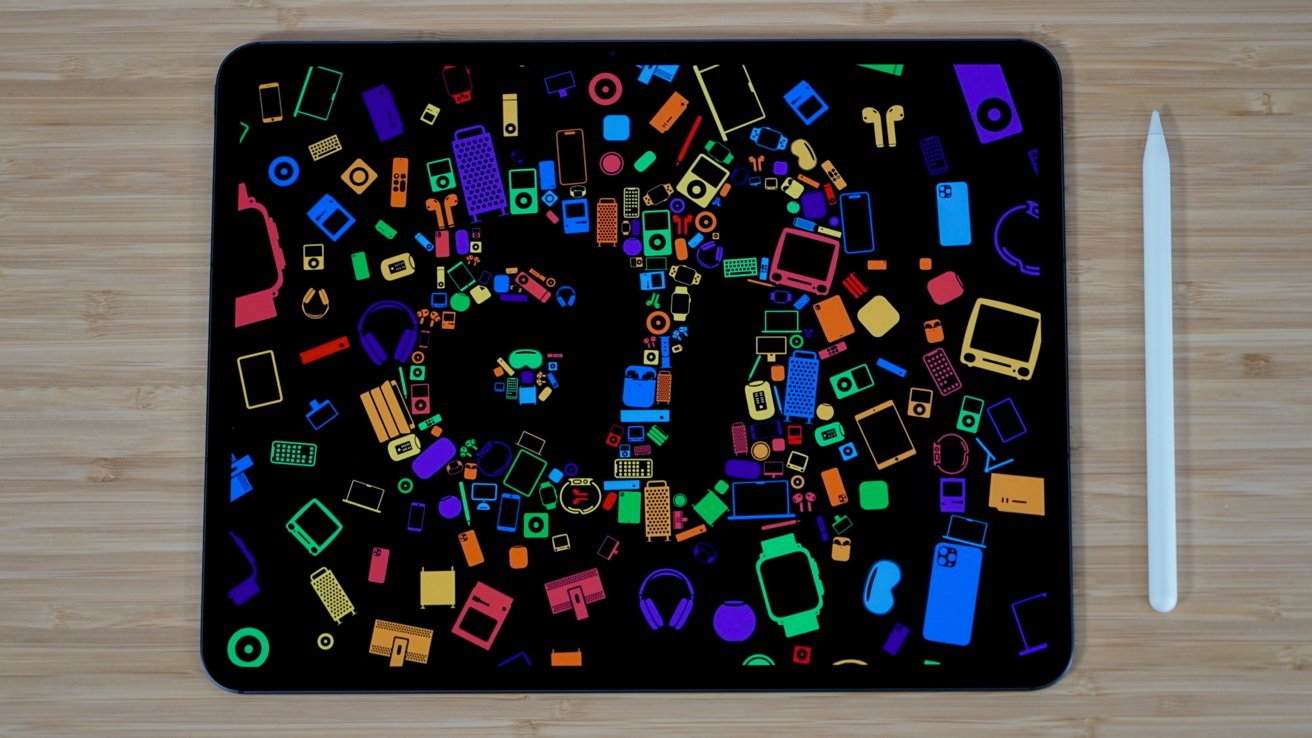
M5 iPad Pro vs M4 iPad Pro: The chassis is the same, as well as a lot of other specs.
As a spec-bump update, Apple's M5 models are identical in terms of appearance and physical dimensions due to using the same chassis. They have the same footprint and thickness across the generations.
When it comes to weight, there's also no change. Both M4 and M5 11-inch iPad Pro tablets weigh 0.98 pounds, while the 13-inch iPad Pro models weigh 1.28 pounds.
Of course, as a spec bump update, you can expect many other elements of the M5 models to be the same as the M4 predecessors.
M5 iPad Pro vs M4 iPad Pro - Displays
Continuing the theme of reusing components, the same thing has happened to the display.
The M4 iPad Pro have 11-inch and 13-inch Ultra Retina XDR displays, and was the first generation to use a Tandem OLED panel. This is a pair of OLED layers instead of just one, allowing for a brighter and more vibrant image to be displayed.
The M5 iPad Pro displays have the same physical specifications.
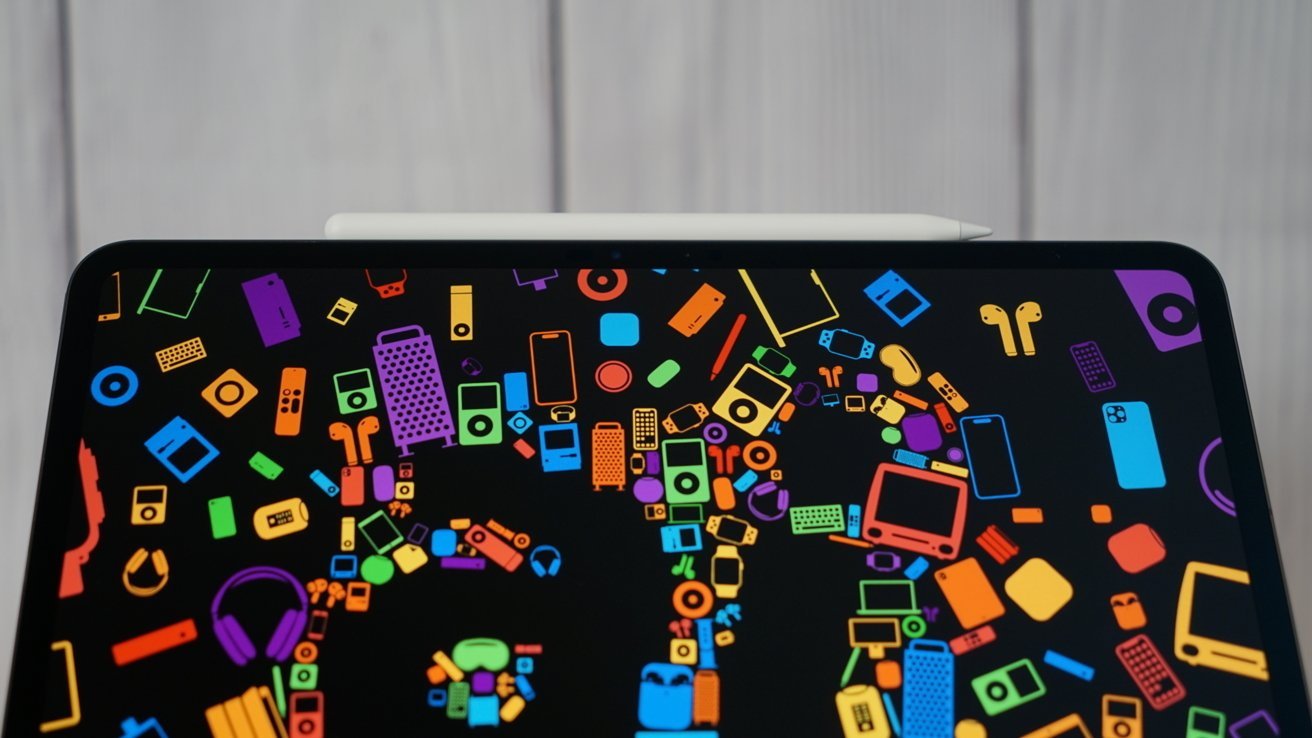
M5 iPad Pro vs M4 iPad Pro: The M4 models were the first with OLED screens.
This also includes the resolutions, at 2,420 by 1,668 and 2,752 by 2,064 for each respective size. This results in a pixel density of 264 pixels per inch, which is fairly standard for Apple.
Both generations also have ProMotion support, an adaptive refresh rate that goes up to 120Hz, depending on what kind of content is being viewed. There's also Wide Color (P3) support and TrueTone across the board.
Brightness is also the same across generations, at 1,000 nits for SDR content, 1,000 nits max for full-screen HDR content, and 1,600 nits at the absolute highest. The 2 million to one contrast ratio is also unchanged, along with an antireflective and oleophobic coating.
External display support continues to consist of up to a 6K-resolution screen between the M4 and M5. However, while the M4 does so at 60Hz, the M5 can go up to 120Hz on a 4K screen with Adaptive Sync support.

M4 iPad Pro
Apple Pencil support includes the USB-C Apple Pencil and Apple Pencil Pro for both M4 and M5 models. That includes support for the Apple Pencil Hover feature.
The M4 introduced the option for users to get a Nano-texture treatment on the glass, minimizing the reflectiveness so users have a clearer image to view. That was available only on the higher 1TB and 2TB models as a paid extra.
Apple's retained the option for the M5 iPad Pro, for the same capacities.
M5 iPad Pro vs M4 iPad Pro - Performance
The main differentiating factor in the iPad Pro generations is the chip, which determines the performance level of each. The M4 range uses the M4, and the M5, unsurprisingly, uses the M5 chip.
The M4 is a second-generation 3-nanometer chip, provided in two forms depending on the storage level. The 256GB and 512GB capacities had a nine-core CPU, which had three performance cores and six efficiency cores.
The 1TB and 2TB versions had a ten-core CPU, with four performance and six efficiency cores. They were accompanied by a ten-core GPU with hardware-accelerated ray tracing, a 16-core Neural Engine.
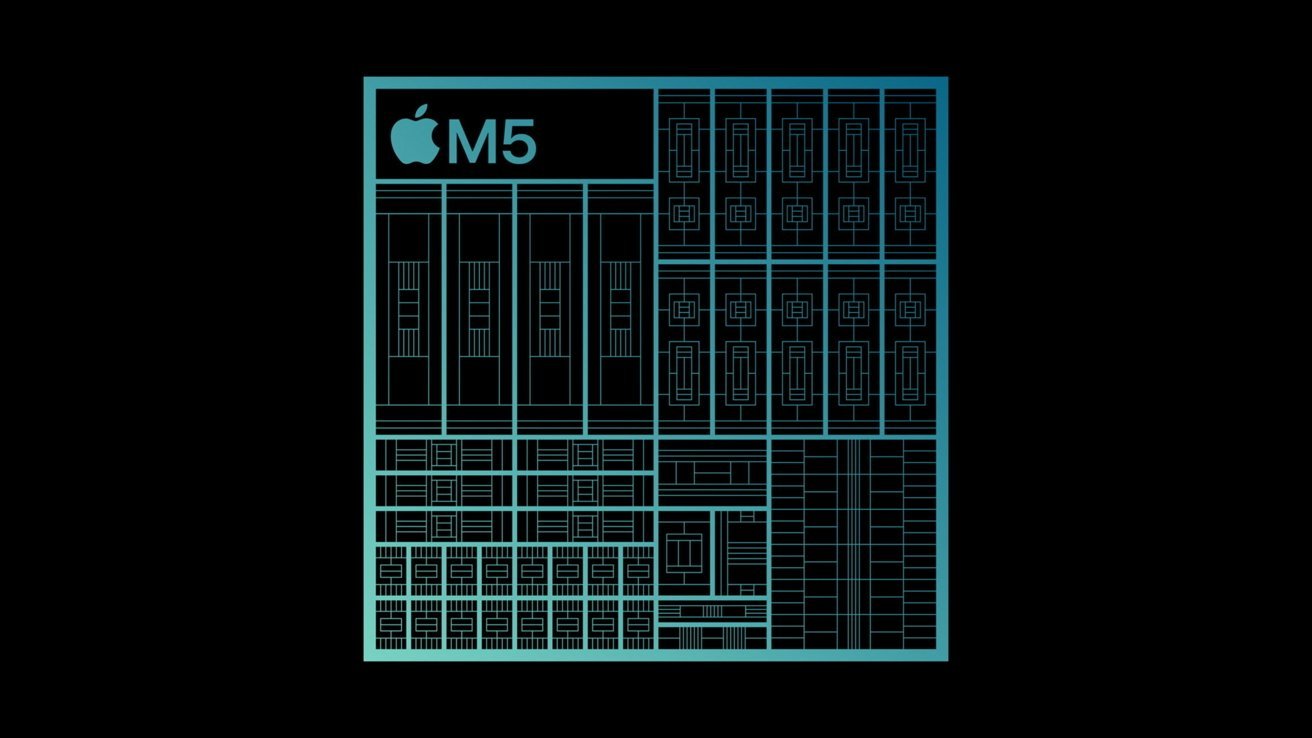
M5 iPad Pro vs M4 iPad Pro: M5 chip layout - Image Credit: Apple
For the M5, Apple's CPU follows the same format. There are nine-core and ten-core versions, depending on the iPad's capacity, with three or four performance cores and six efficiency cores.
Apple obviously claims the M5's CPU cores are the fastest it's created. But the more important change is with the GPU.
The M4 has a ten-core GPU, capable of hardware-accelerated ray tracing for 3D rendering. It also had a 16-core Neural Engine for handling AI workloads.
When it comes to the M5, Apple does include a ten-core GPU with third-gen ray tracing, but each core also has a Neural Accelerator. This allows it to assist with AI-based tasks, besides the faster 16-core Neural Engine.
Apple says that the M5's AI performance is 3.5 times faster than the M4. For its continued push for on-device processing and Apple Intelligence, this is one area of keen interest for the company.
Apple is also continuing to include the Media Engine as part of its Apple Silicon chips. The component includes dedicated video decode and encode engines, including ProRes-specific versions, making it an ideal device for video editing tasks.
For 3D rendering with ray tracing, the M5 runs at 1.5 times the performance of the M4, according to Apple. When it comes to per-application usage, there's 1.2 times increase in performance for video transcoding in Final Cut Pro, double the speed of AI image generation in Draw Things, and 2.3 times faster AI video upscaling in DaVinci Resolve.
Part of the change is also the unified memory, which has some improvements. Across the board, the M4's 120GB/s memory bandwidth is being beaten by the M5's 153GB/s, which helps overall performance.
But then there's capacity. The terabyte-level models in both generations have 16GB of memory, but the 256GB and 512GB models have less. The M4 versions have 8GB, but the M5 starts with more at 12GB.
This will be a benefit certainly felt by owners of the lower-capacity M5 iPad Pro.
When it comes to synthetic benchmarks, the usual story is that we would have to rely on Apple's claims until units are released to reviewers and the public. However, thanks to a late September leak via a YouTuber, we have some credible figures.
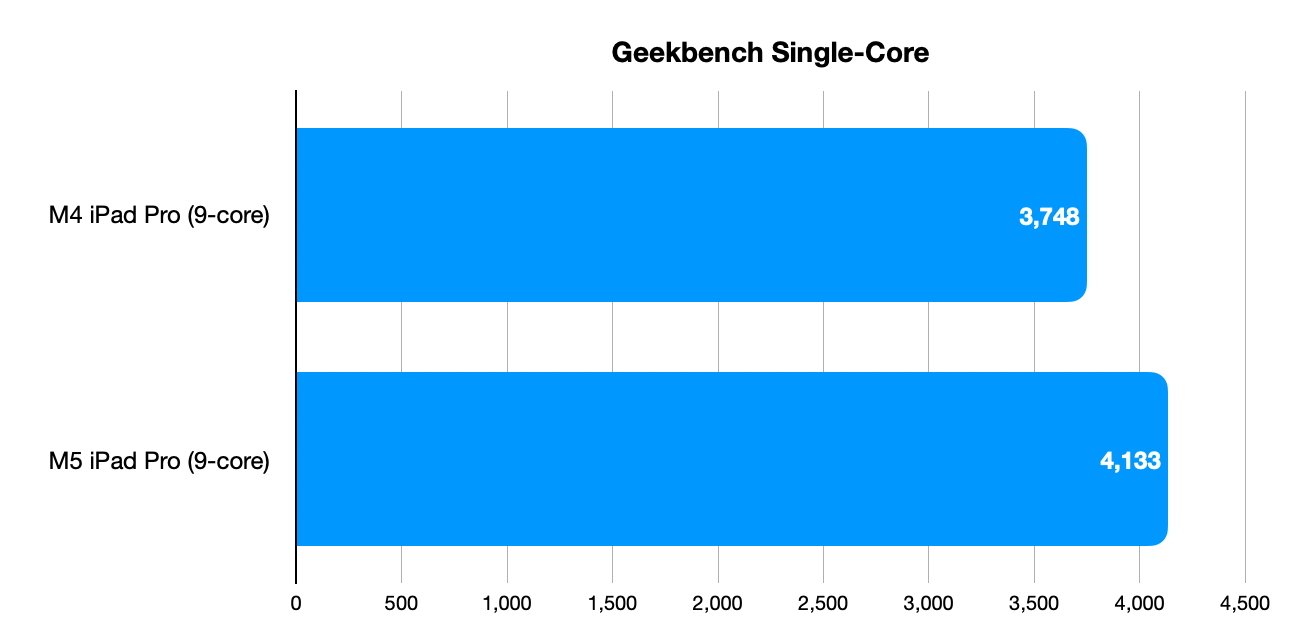
M5 iPad Pro vs M4 iPad Pro: Geekbench single-core scores from a Russian YouTube leak
Under Geekbench 6, using nine-core CPU models of iPad Pro, the single-core test for an M4 reached 3,748, while the M5 hit 4,133.
There was also an improvement seen for multi-core, with the M4 managing 13,324 and the M5 scoring 15,437.
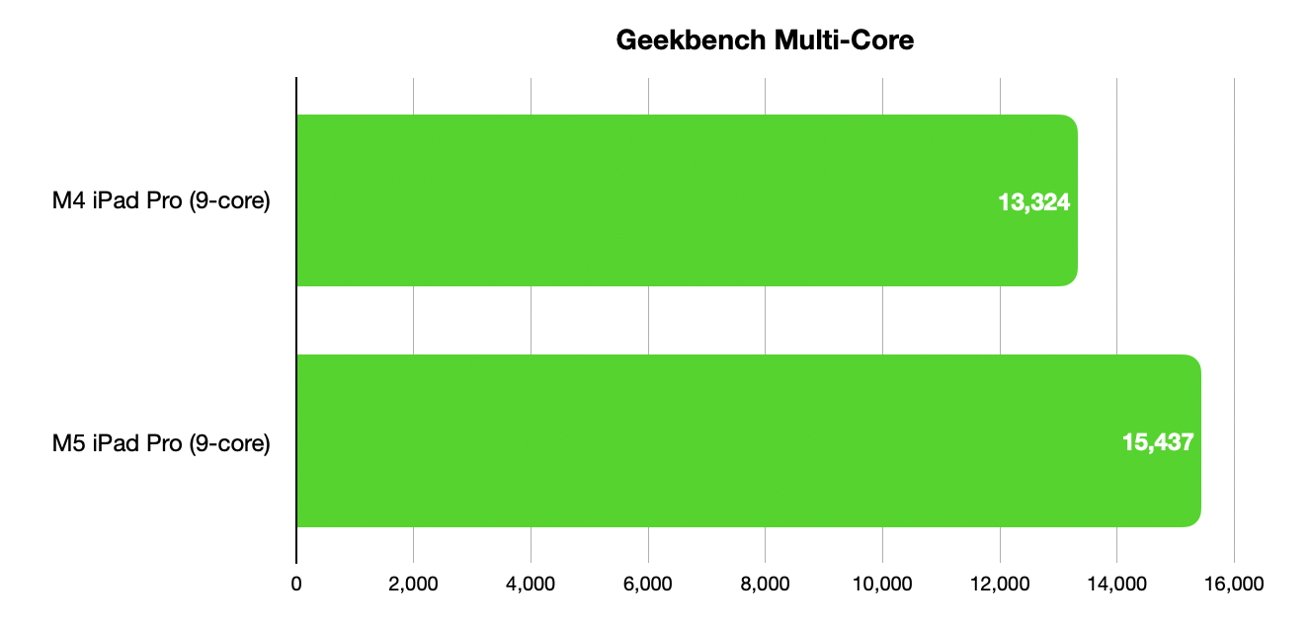
M5 iPad Pro vs M4 iPad Pro: Geekbench multi-core scores from a Russian YouTube leak
The leaker also did the Metal test for graphics. Again, the M5 did really well, managing 74,568 versus 55,702 for the M4.
While we still have a wait for other benchmarks to flood in for the new tablets to corroborate these results, they do at least confirm something we really already know. The M5 was always going to improve on the M4.
M5 iPad Pro vs M4 iPad Pro - Cameras and Audio
When it comes to photography and videography, there is no change at all between the 2024 and 2025 iPad Pro models.
The back still uses a 12MP f/1.8 Wide camera with LiDAR support. Apple's still sticking with one camera on the back of the iPad Pro, after last having two in the 2022 models.
There's 4K video at up to 60fps across both generations. ProRes video support for 4K at 30fps returns for almost all models, but it's capped to 1080p 30fps for the 256GB capacity models across both M4 and M5.
Slo-Mo video continues to be available in both generations at 1080p 240fps, as is time-lapse video, Cinematic mode, and other similar functions.
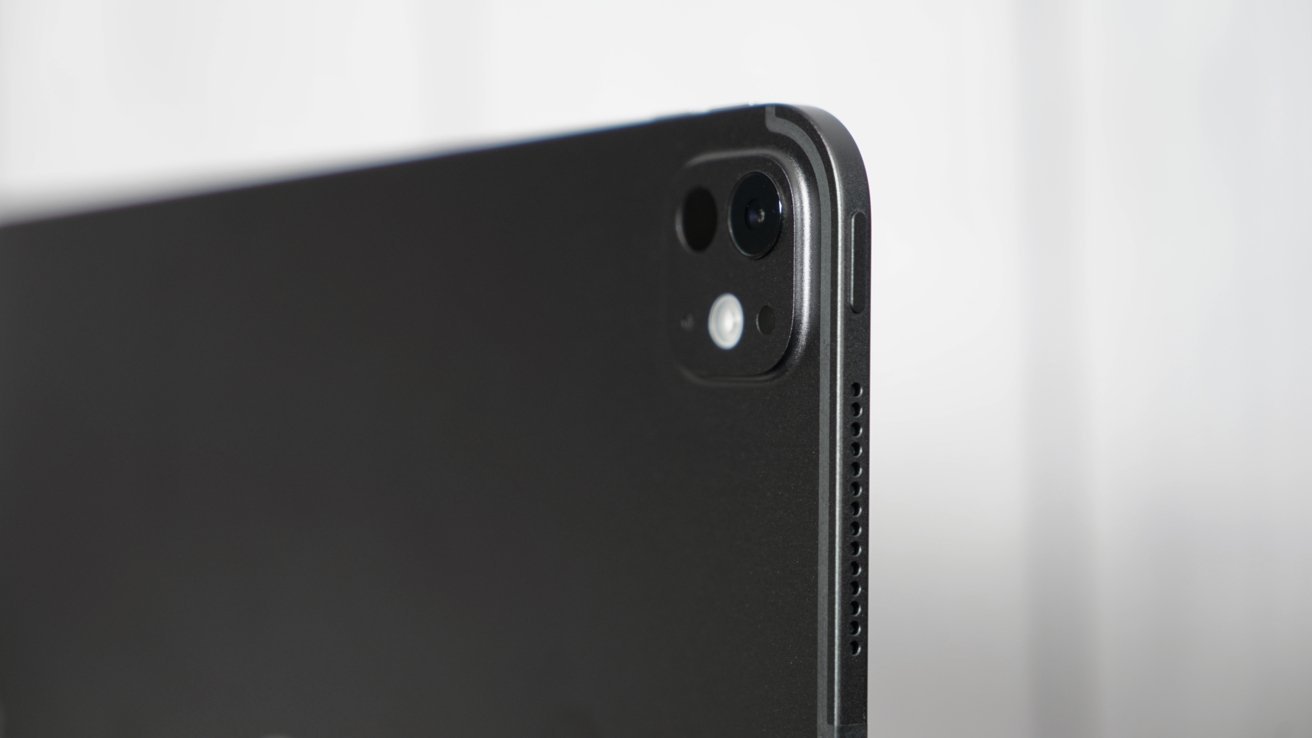
M5 iPad Pro vs M4 iPad Pro: The rear camera hasn't changed this time.
For still images, both M4 and M5 models have a five-element lens, a 5x digital zoom, Smart HDR, Autofocus with Focus Pixels, an Adaptive True-Tone flash, and Burst mode. Red-eye reduction, auto image stabilization, and features like a 63MP panorama also make an appearance in the M5, just like the M4.
The front camera, located on the side so it's centrally located when used in a landscape orientation, was a 12MP Center Stage camera in the M4, and it still is in the M5. Equipped with an f/2.0 aperture, it's still got features like 1080p video at 60fps, Portrait Lighting, Cinematic mode, and automatic image stabilization.
It's still got the TrueDepth camera array functionality, so it can be used for Face ID as well as Animoji and Memoji features. When you're in FaceTime calls, it'll also selectively crop the shot so that you're in the middle of the frame.
On the audio side, there's a quad speaker system at play, allowing for stereo audio to be played regardless of what orientation you hold the iPad Pro.
Once again, the M4 and M5 both use an array of four "Studio-quality" microphones for picking up audio.
Reusing the cameras and audio setup is to be expected for Apple in such a spec-bump update. It didn't really need to make changes here at all.
M5 iPad Pro vs M4 iPad Pro - Connectivity and Battery
Recharging the iPad Pro, as well as connecting it to a Mac or other hardware physically, is handled by the USB Type-C in the base. For both the M4 and M5 generations, it supports both Thunderbolt and USB 4.
Both generations also have a Smart Connector on the back side, which connects the iPad Pro to accessories, such as the Magic Keyboard.
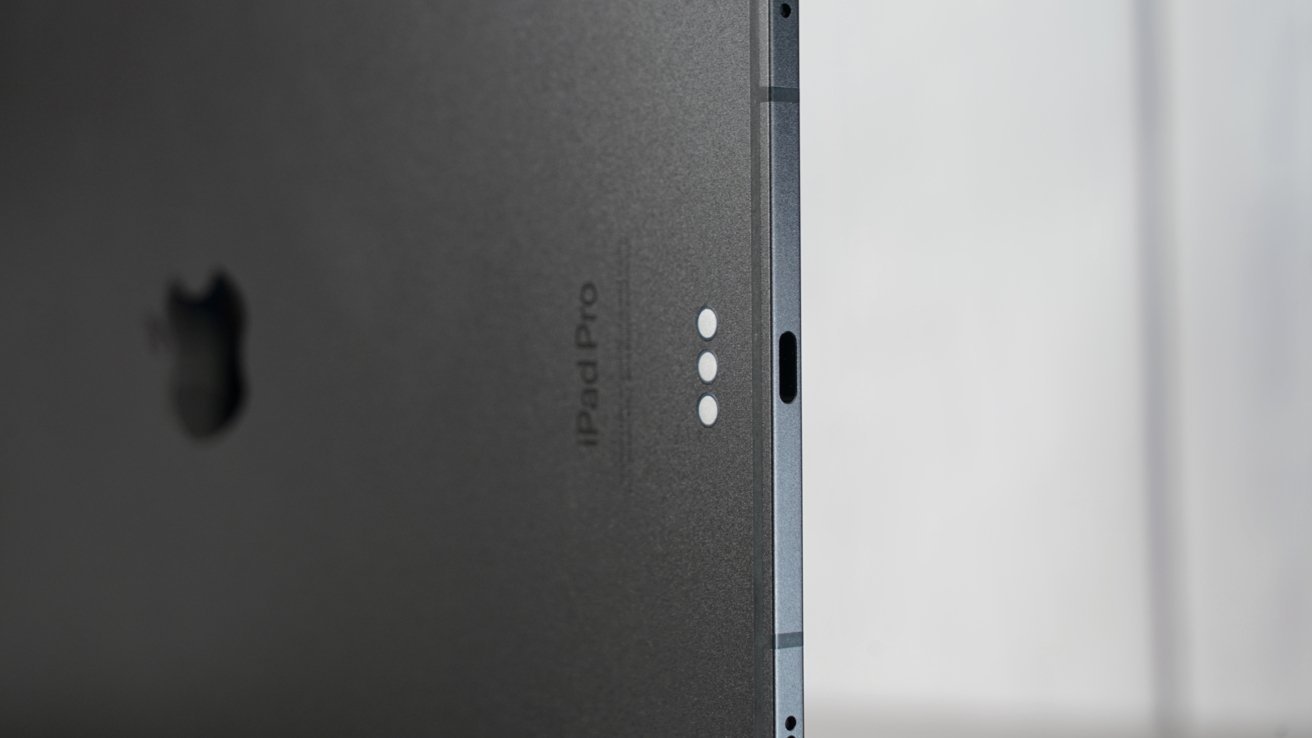
M5 iPad Pro vs M4 iPad Pro: Thunderbolt and the Smart Connector
With very similar hardware setups, you would expect the battery life to be roughly the same between the two variants. You would also be right.
The 11-inch iPad Pro, regardless of whether it uses M4 or M5, is claimed by Apple to last for up to ten hours of web surfing on Wi-Fi or watching video, or up to nine hours of web surfing if on a cellular connection.
The same times were also quoted for the 13-inch iPad Pro, in both its M4 and M5 forms.
For wireless connectivity, there is a subtle change between the generations. This is because Apple is now using its own chips for this part.
The M4 iPad Pro models had Wi-Fi 6E support as well as Bluetooth 5.3. However, by using Apple's new N1 wireless networking chip, the M5 iPad Pro gets Wi-Fi 7 and Bluetooth 6.
On the cellular side, Apple has started to use the C1X modem in the iPad Pro, which could lead to big changes in how it connects with mobile networks in the future.
However, in its current guise, the M5 iPad Pro still connects to the mobile network just like the M4 iPad Pro. Namely, 5G support with sub-6GHz bands, as well as up to 31 bands of Gigabit LTE.
Apple also says that its C1X modem can provide up to 50 percent faster cellular data performance with more efficiency. But ultimately, it's practically the same cellular connectivity, just supplied by a different modem.
M5 iPad Pro vs M4 iPad Pro - Capacity and Pricing
Apple sold the 11-inch iPad Pro with M4 starting from $999 with 256GB of storage, rising to $1,199 for 512GB, $1,599 for 1TB, and $1,999 for 2TB. The 13-inch models were $200 more expensive than the 11-inch versions.
Cellular cost an extra $200, pushing the base M4 11-inch iPad Pro to start from $1,199, while the 13-inch rose to $1,499. Nano-texture glass was an option for the terabyte-level models, which cost $100 regardless of capacity.
Much like the construction of the new models, the M5 iPad Pro generation has exactly the same pricing levels as the M4.
M5 iPad Pro vs M4 iPad Pro - Should you upgrade?
When it comes to spec-bump updates, it is always hard to justify for owners of the previous generation to upgrade to the newer version. Without any real standout features other than a fairly gradual performance improvement, there's no tangible reason to do so.
That is precisely the case for owners of the M4 iPad Pro. Unless they're upgrading for more storage, there's little else other than a performance jump in the M5 iPad Pro models.
There is more of a justification for owners of the M2 iPad Pro, the two-generations-ago version. Aside from a three-chip-generation jump in performance, there's also the switch over to an OLED screen as an added attractive feature.
As it stands, the M5 iPad Pro continues to be the de facto top-of-the-range iPad in Apple's catalog. There's still a lot to like about the premium tablet line in its new state.
It's just not that far off from the previous one.
Where to buy Apple's M5 iPad Pro vs M4 iPad Pro
Apple's 2025 iPad Pro is available for preorder now at Amazon, but shoppers on the hunt for a closeout deal can find markdowns on the last-gen M4 models.
Amazon at press time has the standard M4 11-inch spec on sale for $906, a discount of $94 off MSRP.
You can compare prices and availability across popular retailers in our M4 11-inch iPad Pro Price Guide and M4 13-inch iPad Pro Price Guide, as well as follow the latest sales all season long in our best iPad deals roundup.