Apple has announced a series of clean energy projects with both European countries and China to expand wind and solar energy production, and says that it covers iPhone and Mac power usage in the region. It doesn't come close to addressing the company's total energy use footprint.
Environmental projects at Apple have recently been accused of greenwashing — which Tim Cook called "reprehensible" — and its carbon neutral products have been called into question. But overall, its long-stated goal of becoming entirely carbon neutral by 2030 continues.
The company has now announced new projects in Greece, Italy, Latvia, Poland, and Romania. And, it has an interesting take on the matter.
"By 2030, we want our users to know that all the energy it takes to charge their iPhone or power their Mac is matched with clean electricity," said Lisa Jackson, Apple's vice president of Environment, Policy, and Social Initiatives. "Our new projects in Europe will help us achieve our ambitious Apple 2030 goal, while contributing to healthy communities, thriving economies, and secure energy sources across the continent."
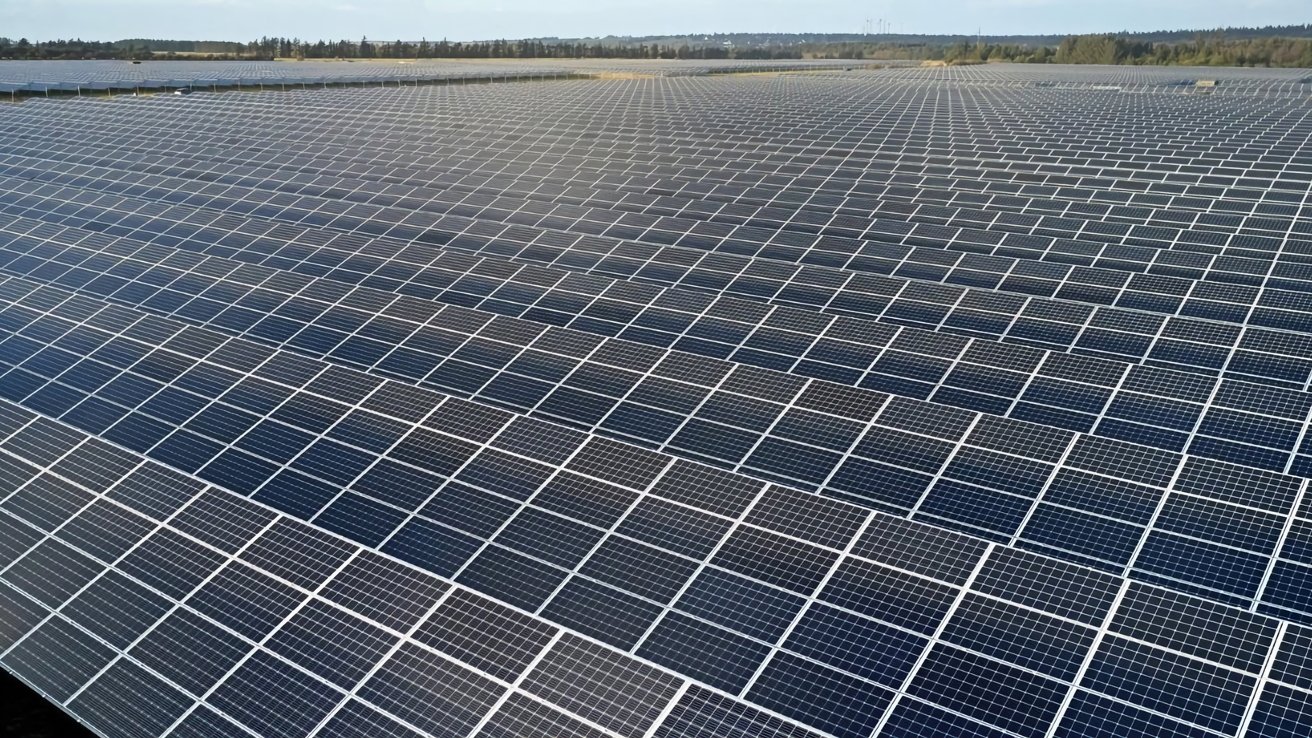
Alongside an existing solar project in Spain, Apple says that its new deals will add 650 megawatts of renewable energy capacity to European electrical grids over the next few years. The new clean energy projects and the local firms partnering with Apple are:
- Greece: 110MW solar power with HELLENiQ ENERGY
- Italy: 129MW mix of solar and wind projects
- Poland: 40MW solar array with Econergy
- Romania: Plans for 99MW wind farm with Nala Renewables
- Latvia: 110MW solar power with European Energy
In each case, Apple says it will procure power from its partner companies. It also says that its solar farm project in Spain is now operational.
"Apple's commitment enabled ib vogt to bring 131 MW of clean solar capacity online in Segovia [in Spain] this year," said Andreas Schell, CEO of the country's ib vogt company. "This creates the long-term certainty needed to develop utility-scale projects that deliver meaningful carbon reductions across European markets."
In April 2025, Apple claimed that it had cut over 60% of its global greenhouse gas emissions. Now in this latest announcement, it says that the new projects are focusing on how 29% of its global greenhouse gas use comes from charging iPhones and powering Macs.
With the exception of the Spanish project, which is already operational, these new projects are said to be starting later in 2025.
Choose your statistics
Apple's latest announcements focus on this persuasive metric of matching users' energy usage with their iPhones and Macs by 2030. But right now and increasingly over the next five years, there is growing energy demand from AI data centers.
Unlike its rivals, Apple does emphasize the use of Apple Intelligence on-device, rather than in data centers. That does mean lower power consumption because of reduced reliance on the data centers.
But it doesn't remove data centers. And on-device Apple Intelligence means users will have to recharge their iPhones more often.
Apple reached out to AppleInsider to stress that all of its data centers have been using 100% renewable energy since 2014, and presented figures to back that up. Using renewable energy, however, is not the same as generating it, and doesn't address the issue of more recharging of devices.
Separately, Apple has announced an investment fund in China, through which its suppliers and others aim to add 1 million megawatt hours of clean energy to the country's grid by 2030. This, too, is about creating the infrastructure for clean energy.
Energy usage in Big Tech
It's not possible to predict how Apple Intelligence will drive the company to producing more data centers. But the International Energy Agency (IEA) has said in that in 2021 Apple used around six times less energy than Google — and 11 times less than Amazon.
Specifically, the IEA reports that in 2021, the following Big Tech firms either generated or purchased enough renewable energy to match their operational consumption:
Apple: 2.8 TWh
Meta: 9.4 TWh
Microsoft: 13 TWh
Google: 18.3 TWh
Amazon did not match its usage, achieving 85% of its 30.9 TWh with renewable energy. IEA says that Amazon aimed to achieved 100% renewable energy by 2025.
The figures for 2021 are the latest published by the IEA. So they pre-date most of the recent expansion of AI, and Apple's energy use has only increased.
The claim of carbon neutrality
Apple has already claimed that it is carbon neutral as a global corporation. But its says that its aim is to also become carbon neutral across its entire business — and the entire life cycle of its products.
To that end, in 2023, Apple said that its then-new Apple Watch Series 9 was the the company's first-ever carbon neutral product. Then in 2024, it said that the M4 Mac mini was its first-ever carbon neutral Mac.
-xl.jpg)
Apple no longer markets the M4 Mac mini as a carbon neutral product.
But in October 2025, Apple removed claims of carbon neutrality from its website for both products, and also the Apple Watch Ultra 3.
This did follow a court ruling in Germany that said the claims were unfounded, as well as being in violation of competition law.
However, there is also the forthcoming European Directive 2024/825. This forbids "claims based on the offsetting of greenhouse gas emissions to assert that a product has a neutral, reduced, or positive impact on the environment."
It remains true that, for example, the Apple Watch Series 9 is made from 30% recycled or renewable materials, with 100% of the electricity used coming from renewable sources. But there were CO2 emissions, and Apple was offsetting those through a Paraguay project that saw it planting eucalyptus trees.
Apple denies climatewashing
Criticisms of Apple's environmental projects have centered on this business of carbon neutrality — of offsetting carbon use rather than reducing it — and it's been called climatewashing.
But Tim Cook has previously said that the company is both offsetting its carbon use, and genuinely reducing it, too.
"I'd invite anybody to look at how we're defining it on our website because what we're doing is doing the hard work to lower our footprint dramatically," he has said. "And then whatever is left over after doing all of these actions we offset with with high-quality offsets like managed forests and managed grasslands that pull carbon from the atmosphere."
So even if the new announcements are cherry-picking statistics in the interest of marketing, Apple is genuinely pursuing its 2030 goal.