
The iPhone Fold is likely to be Apple's first large-scale use of Liquidmetal. Here's what you need to know about the mysterious material and Apple's probable plans for it.
The iPhone Fold is the subject of frequent speculation, with claims about its design evolving over time. However, some of the more recent rumors about the hardware include a reference to a material known as Liquidmetal.
While everyone is familiar with mercury being a metal that is a liquid at room temperature, the Liquidmetal material is something completely different.
It's also something that Apple has been linked to for over a decade.
What is Liquidmetal?
The material is often referred to as Liquid Metal — but its real trade name is Liquidmetal. Regardless of what you call it, the material is an amorphous metal alloy. It was created by a research team at the California Institute of Technology, and almost a decade after its invention, it's being marketed by Liquidmetal Technologies starting in 2023.
Liquidmetal is an alloy that has many desirable properties from a construction material, which normal metals and alloys may not necessarily provide.
It is classed as an amorphous solid or non-crystalline solid.
A crystalline structure, such as aluminum or cast iron, has atoms that settle into repeating patterns, like in a grid. An amorphous solid doesn't structure the atoms with a repeating pattern, giving Liquidmetal unique properties.
It can be produced with a high tensile strength, namely, that it can be pulled and stretched a lot without breaking. It also has a good coefficient of restitution or elasticity, which means it can bounce back and return to its original shape.
There's also resistance to corrosion, so it won't be affected by coming into contact with corrosive substances or atmospheric elements as much as others. You're not going to find Liquidmetal items tarnishing or rusting as quickly compared to other metals.
As a material, it's also capable of being heat-formed, that is, warming the metal and moulding it before cooling it down. This echoes techniques used to make products and components using thermoplastics.
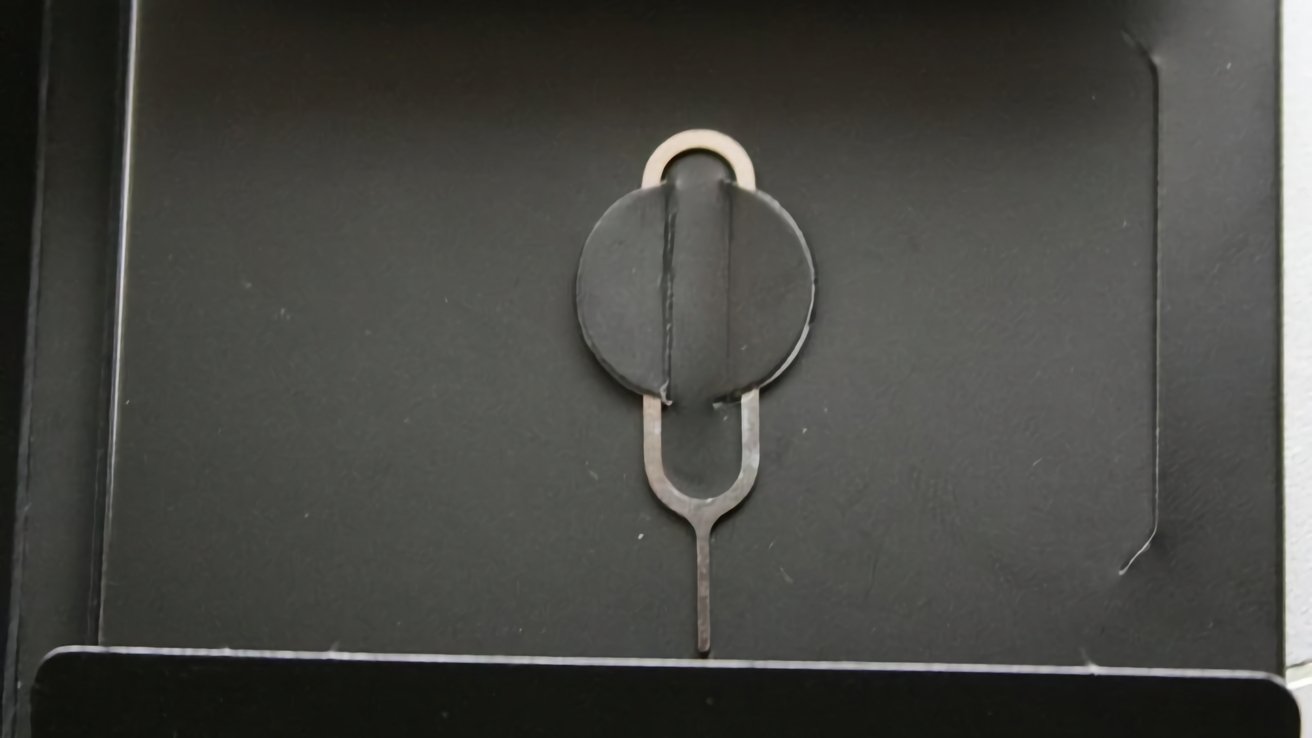
Apple used Liquidmetal to make the SIM ejection tool for iPhones.
It is malleable at temperatures approaching 760F, which is fairly low. It acts like glass at low temperatures, in that the atoms move around like a fluid, but without going to a crystalline formation when cooling.
At higher temperatures, it is more like plastic, in that it can be very easily shaped and molded without actually melting. As it cools down, it does so quickly enough that the atoms and molecules don't have time to get into a crystalline structure.
Liquidmetal is made in various alloys, including Zirconium and titanium-based versions, which can make them extremely strong and hard. This despite having an amorphous, non-crystalline structure.
The result is a moldable material that happens to be light like titanium. But at the same time, properly cast, goods made from it are 1.5 times harder than stainless steel and 2.5 times stronger than the titanium alloys used in consumer goods.
This quickly led to it being used in a variety of ways since its introduction, including medical equipment, technology for the U.S. Department of Defense, and to make golf club heads more bouncy.
As you would expect for a material that could lead to lighter and more durable products, Apple had to get involved.
Poking SIMs and Apple licenses
Apple isn't afraid to take advantage of new materials if it helps to make its designs as close to its view of perfection as possible. If it also makes its products even more exclusive, that's a bonus.
Back in 2010, AppleInsider revealed that Apple had entered an exclusive license agreement with Liquidmetal Technologies. One to explore the use of the alloys in its technologies, as well as eventually commercialize them in electronics.
The licensing agreement has periodically surfaced, with Appel renewing exclusivity for its use. While those renewals haven't made headlines since 2015, Apple is still very keen to keep exploring the use of the technology.
There are patents that exist, showing how Liquidmetal could be used to create devices on a layer-by-layer basis, similar to 3D printing. One such Apple patent dates back to 2015 on the topic, with it also assigned to Liquidmetal subsidiary Crucible Intellectual Property.
In 2014, Apple and Crucible applied for "Counter-gravity casting of hollow shapes," describing how to pull molten material into a mold using a vacuum instead of pouring it.

An image from a patent filing for "Bulk Amorphous Alloy Sheet Forming Processes"
In 2013, Crucible Intellectual Property filed for a method to mass-produce items using the material. It was described as using a "float glass process," similar to how window glass is manufactured.
Apple has also explored the possibility of using Liquidmetal for Velcro-like fastenings to prevent devcie tampering. It's even thought about how to create touch-sensing surfaces using the alloy.
The problem is, Apple hasn't really used the technology despite spending heavily on the license and patents.
So far, the only recorded "hardware" that Apple has made using Liquidmetal is a SIM card ejection tool. The creation, which shipped with the iPhone and 3G iPad in 2010, was an unusual inclusion for something that could've easily been a bit of stamped metal sheeting.
The oddity may have had a purpose, as it could've served as a test for working with the material.
Even so, it's not really become a prominent material for Apple at all. The rumor mill still believes it's got a chance years later.
Behold the Fold
In March 2025, the rumors of Apple potentially using Liquidmetal in a meaningful way reappeared, thanks to a report from Ming-Chi Kuo.
Rumors and reports about the iPhone Fold at the time discussed the foldable displays. The hinge mechanism was thought to be key to minimize creasing on the display itself.
Kuo claimed that Apple would use "liquid metal materials for key component bearings (hinge)," via a die casting process. It would be made with components from Dongguan Yian Technology, a supplier said to have an exclusive contract with Apple to make Liquidmetal components.
Not long after Kuo's claims in that same month, Weibo leaker Setsuna Digital doubled down, describing the hinge as using an "amorphous alloy" or "metallic glass." This is a direct reference to using a titanium-alloy version of Liquidmetal.
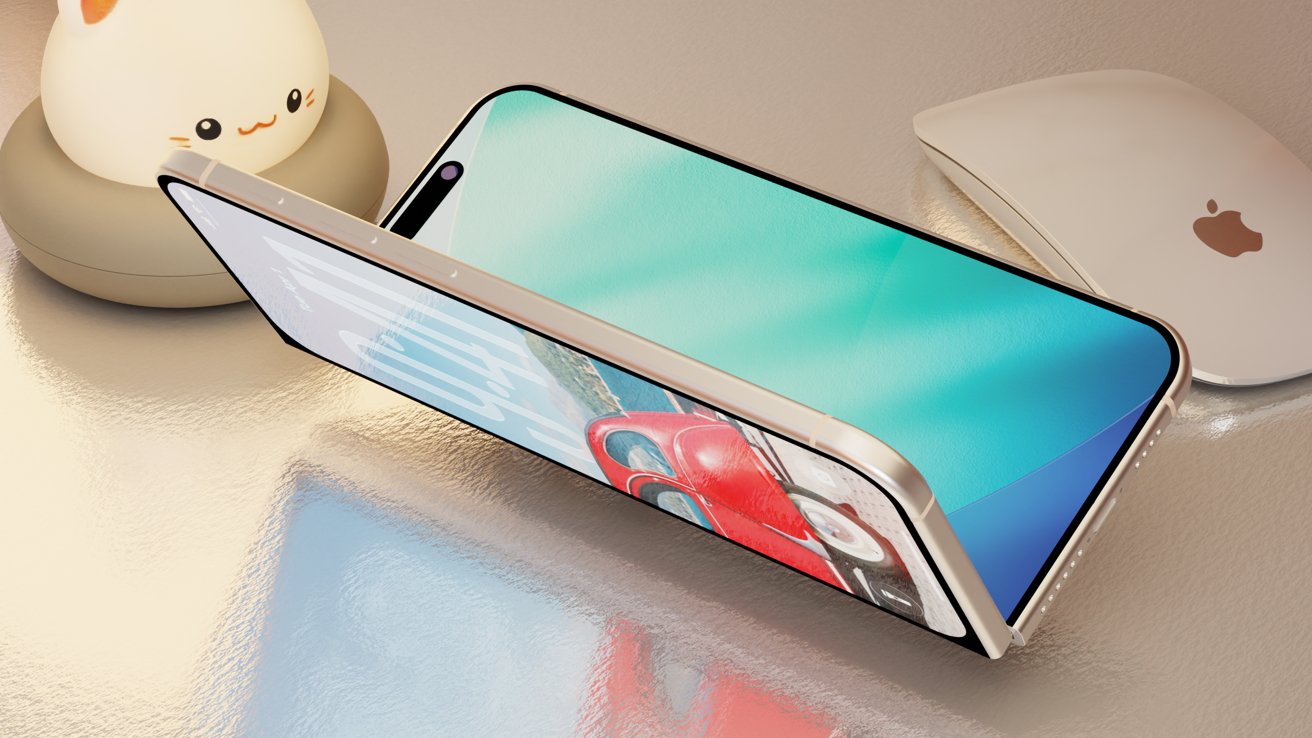
The iPhone Fold could be the first serious use of Liquidmetal by Apple - Image Credit: AppleInsider
The leaker added that the amorphous particle structure and better resistance to bending and deformation will make Liquidmetal a good material for this component. As for what consumers could expect to see, the leaker added that they should expect it to appear "close to your favorite kind of high-grade stainless steel."
A later note in October from analyst Jeff Pu added that the iPhone Fold will have a hybrid aluminum and titanium frame. While Liquidmetal wasn't mentioned, the use of titanium could be the same alloy brought up in earlier rumors.
While rumors are always to be taken with care without compelling evidence, the use of a Liquidmetal alloy for the hinge mechanism of the iPhone Fold does make some sense.
The hinge is a vital component, since parts that move and flex are typically the weakpoints of a product's design. Since the last thing Apple needs is a hinge that breaks easily, it would need that hinge to be as tough as possible.
But, since using materials like stainless steel would result in a very heavy hinge, Apple has to look elsewhere for potential alternatives. Liquidmetal is much lighter in comparison while still remaining strong, making it a good candidate for the task.
The way Liquidmetal works also mandates that it must be made thin and not thick, which works in its favor here. This is in part due to a thin casting letting its strength and elasticity properties to come through, unlike a more brittle thicker casting.
It is worth remembering that these rumors discuss the hinge mechanism of a foldable smartphone, not its entire construction.
Given Apple's previous minimal use of Liquidmetal to make an almost throwaway accessory, it seems unlikely for it to suddenly make the entire iPhone Fold's chassis from Liquidmetal.
There's no reason why Apple can't use Liquidmetal for parts of the hinge mechanism. The real thing to wonder about is if Apple really is going to use a material that it had a deep interest in a decade ago, but hasn't really worked with since.
At this point, it's a nice fantasy to have, but hard to take too seriously at this time.