Apple CEO Tim Cook is stepping down from his position after 15 years, leaving a 28-year legacy at the company. Here's how Cook started at Apple, and how it's winding down.
The departure of Cook to the board brings to an end a long tenure at Apple, one which saw him assist with growing the company into one of the world's tech giants. He arrived at Apple in the wake of Steve Jobs' return, and was instrumental in the turnaround of the company, to the economic behemoth it has become since.
Here's how Cook got started with Apple, and significant mile-markers along the way.
Jobs convinced him to switch
Cook joined Apple after being recruited by Jobs in 1998, two years after Jobs himself rejoined Apple to turn the company around.
Previous to Apple, Cook had been at Compaq as the vice president for corporate materials for less than a year. Prior to that, he had worked at IBM for over a decade, including time as its director of North American fulfillment.
The Duke University alum was convinced to join Jobs in transforming the company within a few minutes of being interviewed. This in spite of an intense rivalry between Apple and IBM, as well as PC clone vendors such as Compaq.
At that early stage, Apple was still in need of major restructuring and reform, one that Cook himself said that "any purely rational consideration" meant he should avoid Apple and stay with Compaq.
In a 2017 commencement speech, Cook said the consideration of cost and benefits "lined up in Compaq's favor." People who knew him best also advised him to stay with his then-current employer, as it was the better decision on the surface.
However, Cook decided to take the leap and go with Apple.
"I was never going to find my purpose working some place without a clear sense of purpose of its own," he continued in his speech. "I tried meditation, I sought guidance and religion. I read great philosophers and authors. In a moment of youthful indiscretion, I might even have experimented with a Windows PC. And obviously, that didn't work."
Cook jumped aboard Apple, as the senior vice president of Operations.
Pre-CEO work
In his new role, as well as later promotions to executive vice president of Worldwide Sales and Operations in 2002 and leading the Macintosh division in 2004 , Cook was given the chance to refine Apple's working processes in a way that would allow the company to thrive.
He became the architect of Apple's shift away from owning its own factories, in favor of contract manufacturing and a greater reliance on Chinese assembly partners.
The closure of factories and warehouses, and abandoning ownership of the means of production to rely on others provided Apple with a flexibility that it previously didn't have.
By outsourcing production to assembly partners, this meant Apple held on to stock for shorter periods of time, and so more chance to adapt and use new hardware and technologies in its products at a faster rate.
The move also involved Apple performing intense negotiations with its suppliers and assembly partners, bringing the cost of manufacturing as low as feasibly possible for Apple. At the same time, Cook also helped drive Apple's strategy of a high level of supply chain control, enabling it to further drive down costs while building the products it wants to make.
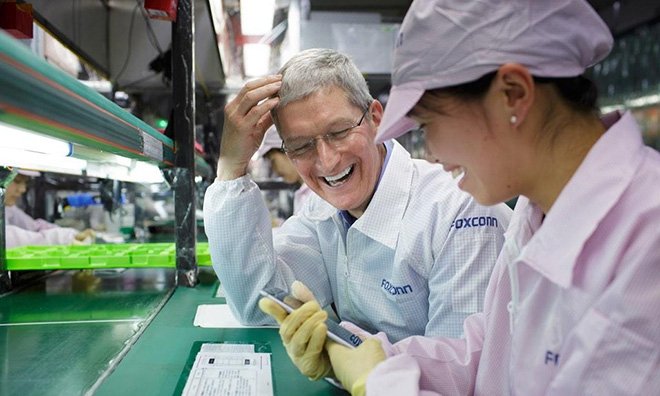
Tim Cook visiting a Foxconn factory in 2014.
Cook did so while knowing full well his strengths were different to Jobs, in that he wasn't a "product person." While Jobs would check in with famed designer Jony Ive regularly as another design and product-led individual, Jobs didn't feel the same way about Cook.
According to Jobs biographer Walter Isaacson in 2019, Jobs told him that Cook "can do everything" at the company. However, Jobs added "But Tim is not a product person."
Cook's drive to improve the manufacturing and supply chain processes led to other changes, including an increased need to predict the future needs of the company, as well as potential product sales.
These predictions also bore fruit, enabling Apple to place long-term bets in ground-breaking technologies. One such investment was in flash memory, which not only led to Apple securing supplies of components it could use in industry-shaking products like the iPhone, but also gave it an early advantage over rivals in being able to use the technology to its fullest potential.
By 2005, Cook was named as chief operating officer at Apple, reporting directly to Jobs.
Taking over from Jobs
Cook's move into the role of CEO was gradual, and one that was prompted by Jobs' declining health.
In his role as COO, Cook took over for Jobs and handled day-to-day operations a number of times, while Jobs recovered from medical treatments. For example, in January 2009 Cook stepped in as acting CEO while Jobs took a leave of absence until June the same year.
During that time, Jobs underwent a liver transplant. Cook reportedly offered to donate part of his liver to the CEO but that offer was declined.
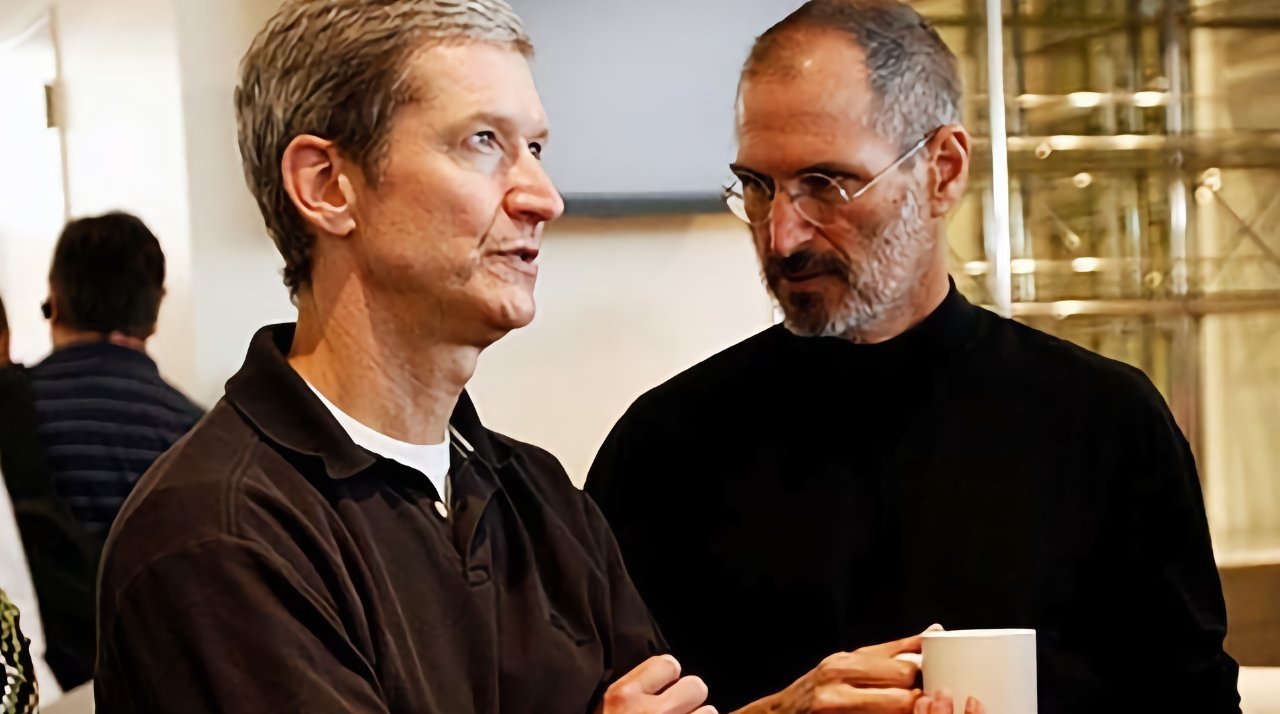
![Tim Cook [left] with Steve Jobs [right]](https://photos5.appleinsider.com/gallery/58801-119847-26929-98158-000-lead-Tim-Cook-and-Steve-Jobs-xl-xl.jpg)
Tim Cook [left] with Steve Jobs [right]
In January 2011, Jobs announced he would take another period of medical leave for an unknown amount of time, but would remain CEO while Cook ran the company.
On August 24, 2011, Jobs released a letter that he could "no longer meet my duties and expectations as Apple's CEO." Jobs went on to "strongly recommend" that the board implement a succession plan, with Cook becoming the CEO.
"The board has complete confidence that Tim is the right person to be our next CEO," said Genetech chairman Art Levinson on behalf of the board. "Tim's 13 years of service to Apple has been marked by outstanding performance, and he has demonstrated remarkable talent and sound judgment in everything he does."
Growth acceleration
In his tenure at the top of the company, Cook has helped grow Apple into formidable organization.
When he fully became the CEO of Apple in August 2011, Apple had a market capitalization of around $348 billion. While that is high by most standards, that number grew multiple times under Cook's management.
Apple became the first trillion-dollar U.S. company in history in August 2018, before dropping down below the milestone a few months later. In September 2019, its market capitalization reached the same level again, and kept going up.
By June 2020, Apple became the first publicly-traded U.S. company to hit a market cap of $1.5 trillion, and then swiftly reached $2 trillion in August the same year, then $3 trillion in January 2022.
It remains in a dance with Microsoft and Nvidia as market cap leader in the US.
The size of the company also brings in major revenue, and it has repeatedly broken records in its quarterly earnings.
Milestones weren't just hit on the balance sheet, as Apple's growth enabled other areas to reach similar stratospheric heights. One example is with its key product line, the iPhone.
The smartphone remains its major source of revenue, with a constantly growing user base. In January 2021, Apple revealed it had crossed over 1 billion iPhones in active use by customers.
Acquisitions and In-house shifts
With the scale of the company and Cook's continued strategy to optimize design and production, there grew a need to take even more control over proceedings. As well as its expansion of its research and development teams to create new technologies for its products, Apple moved to internalize some of its development instead of relying on third-party designs.
Big examples of this include its October 2018 $600M deal to license patents, purchase assets, and acquire employees from chipmaker Dialog Semiconductor, bringing some of the power management work in-house. Its $360M acquisition of PrimeSense in 2013 did the same thing, and resulted in the creation of Face ID.
Following the settlement of a potentially expensive Qualcomm modem lawsuit, Apple made a similar forward-thinking move in 2019, buying Intel's modem business. Reports at the time speculated Apple would use the engineers and technologies to engineer its own modems, so it didn't have to rely on Qualcomm for the component in the future.
Apple paid a billion dollars for Intel's modem business.
The in-house design movement became extremely prominent in 2020, when Cook used WWDC to announce Apple was shifting away from Intel processors for its Mac lineup in favor of its own Apple Silicon chips. A move seemingly triggered by Intel's repeated production delays and a slower pace of development, Apple Silicon leaned on R&D used to create its A-series chips, but instead aimed at desktop computing usage.
The famous $3 billion acquisition of Beats Music and Beats Electronics in 2014 handed Apple elements that it would put towards creating the Apple Music streaming service. The purchase also gave it control of the Beats headphone business, which Apple continued to operate as a separate brand, one that continued to be popular many years after the change in ownership.
Cook's spending wasn't just limited to acquisitions, as Apple also made a few investments that could benefit it in the future. Arguably the most important was the 2016 investment in Chinese ride-sharing platform Didi Chuxing for $1 billion, which Cook characterized was for "a number of strategic reasons," as well as for a "strong return" of capital over time.
While Apple was more free in its acquisition and investment activities under Cook, it seems that what the money was spent on ended up having an important end goal for the company.
Shift into Services
While the bulk of Apple's revenue stems from the iPhone, a big change that Cook's Apple made was a greater focus on non-hardware elements. Generally referred to as "Services," the business segment would cover the App Store and other digital storefronts, and other online services.
Under Cook, Apple has taken steps to increase its Services offering, making the Services arm a highly reliable source of revenue for the company. This includes repeated annual growth and revenue in the billions of dollars, enough that it has previously offset off-years for iPhone sales.
Apple TV+ is Apple's growing streaming service
These offerings include the aforementioned Apple Music, as well as moves into gaming with Apple Arcade, workouts in Apple Fitness+, and even taking on Netflix with Apple TV+.
Apple even expanded from handling Apple Pay transactions into providing financial services, partnering with Goldman Sachs on the Apple Card.
While it does offer a physical card component, the service was groundbreaking in allowing users to use their credit within hours of acceptance via Apple Pay, as well as offering enhanced features to users.
World-changing ambition
Apple was known for having some environmental responsibility before Cook took the reins, but has since amped up its attempts to be more world-minded. In 2014, Cook launched a campaign to promote initiatives that Apple was undertaking to make the world a better place.
These changes ranged from making its product production more environmentally-minded, assorted power-saving initiatives, and attempts to refine supply chain environmental efforts.
Apple has even committed to reaching total carbon neutrality across its entire business by 2030, expanding on its existing achievement of carbon neutrality for its global corporate operations to cover its entire business. This includes everything from device production to sales, and even throughout the product's life cycle.
Speaking to the United Nations Climate Ambition Summit in December 2020, Cook warned everyone "has a particular burden to act" on the environment. "The choice between the bottom line and the future of our planet is a false one, and each new green innovation offers the proof," he said, adding "There is no time for changes of the margins."
Cook's nudges to change the world for the better also occurred in other areas, including introducing Apple Initiatives to combat race problems. Launched in June 2020, Apple's Racial Equality and Justice Initiative had Apple putting up $100 million to invest in projects surrounding "education, economic equality, and criminal reform," said Cook at the time, with the initiative expanded over time.
In a connected statement from June 2020 titled "Speaking Up on Racism," Cook called for society to do more to "stand up for one another, and recognize the fear, hurt, and outrage" provoked by events such as the killing of George Floyd.
Cook's efforts on equality became publicly personal for the CEO in October 2014, when he became the first head of a Fortune 500 company to come out publicly, doing so via an open letter. While previously reports had brought up his sexuality, Cook chose not to publicly disclose his sexual orientation before that letter.
Five years later, Cook revealed in an interview that he regularly received letters from people grappling with personal dilemmas related to being gay, which made him decide to come out. The letter was a message shared with kids struggling to come out, and to those who didn't understand how to treat gay people.
Cook has also been very outspoken about privacy, and a need for governments, security agencies, and companies to focus on privacy as an ongoing concern. In January 2021, Cook called privacy "one of the top issues of the century," one that was assailed by attempts by law enforcement agencies and governments to weaken end-to-end encryption.
The CEO has previously likened privacy to a "basic human right," one that shouldn't be given up "to scaremongering or to people who fundamentally don't understand the details."
Cook's belief on the matter was highlighted in April 2019, when he admitted he wished an attempt by the U.S. Department of Justice to force Apple to unlock the San Bernardino shooter's iPhone had gone to court.
Politics
For a company of its size, it became a necessity for Apple to take a greater interest in politics, something Cook adopted a few years into his role. Seemingly more open to dealing with the political side of the role than Jobs, Cook worked to both affect Washington, as well as to try and prevent Washington from affecting Apple.
As part of Apple's fight for equality, Cook and SVP for Retail and People Deirdre O'Brien filed briefs with the Supreme Court in 2019 to support the preservation of the Deferred Action for Childhood Arrivals program (DACA). The scheme, which was wound down in 2017, protected the children of illegal immigrants from being deported while they were in the United States.
Continuing attempts to protect those who were covered by DACA, the joint amicus brief on behalf of the company argued for protection of DACA participants, as well as urging for action to implement immigration safeguards for those people, which included over 400 Apple employees.
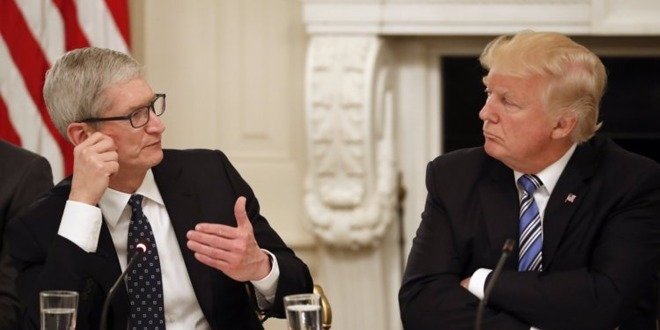
Tim Cook and former U.S. President Donald Trump
In July 2020, as part of a U.S. House Antitrust Subcommittee investigation, Cook testified for Apple under questioning about its App Store, and the overall power of the company over markets. Under questioning, Cook defended the iPhone maker over the App Store rule complaints, Apple Books allegations, parental controls, forced labor of Uighur Muslims in China, and many competition-relayed queries.
Cook also managed togenerate a rapport with President Donald Trump during his first term, nudging the administration into altering policies that could've hurt Apple if left unchanged. The rapport, which included frequent conversations and meetings, enabled Cook to simultaneously support and challenge Trump on subjects, though without any real serious pushback or criticism.
For example, while Trump campaigned on trying to make Apple produce the iPhone in the United States, Apple wasn't penalized for its seeming inaction on the subject. During the U.S.-China trade war in 2019, the rapport even allowed Apple to delay some of the import tariffs on its products, which could have increased the cost to US consumers.
This rapport was fairly unique, as relatively few CEOs had succeeded in producing a working relationship with Trump over the four-year period. One former administration official explained Cook's ability as "In being measured and thoughtful, he doesn't create crisis when there doesn't need to be one, or antagonism when there doesn't need to be any."
And that "rapport" continued, a bit more controversially than before, into Trump's second term. After the "reciprocal" tariffs were announced in April 2025, Cook navigated Trump's tariffs and a "made in America" manufacturing push by highlighting US manufacturing initiatives that have been in place for years.
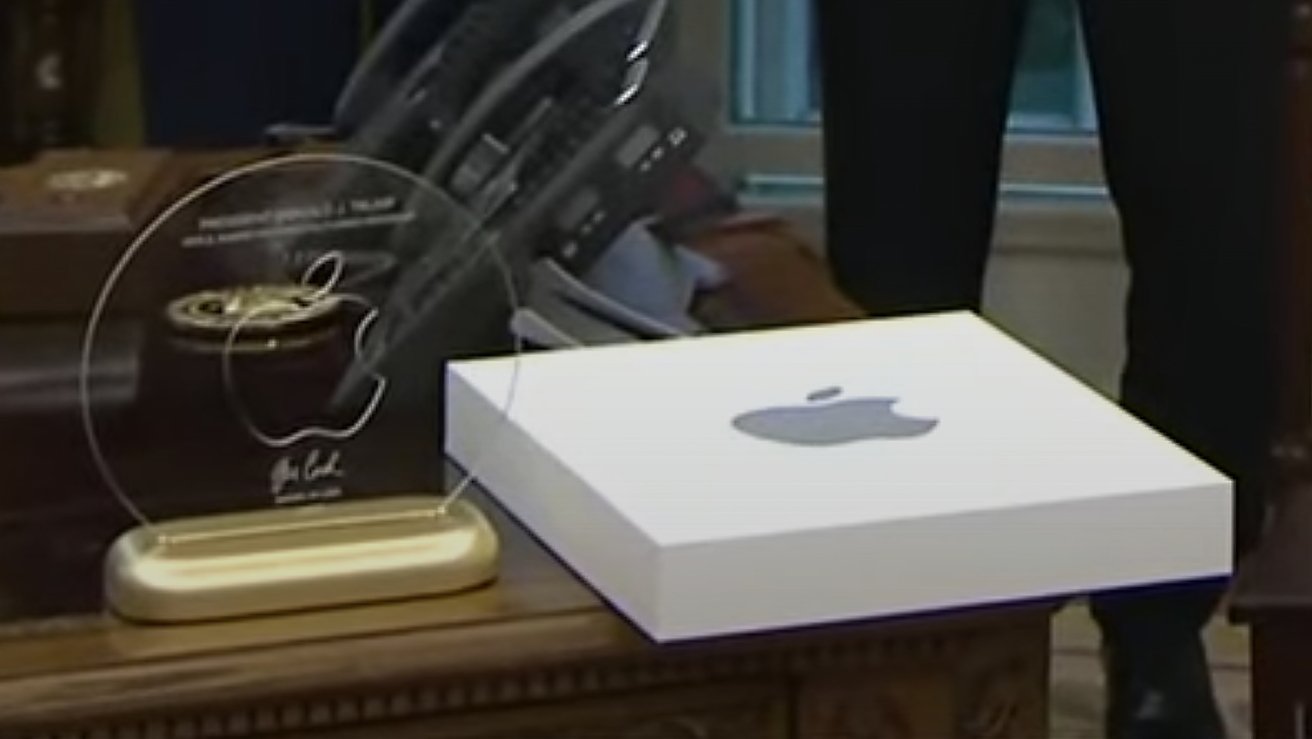
A Corning Gorilla Glass ornament set in gold sourced from Utah
And then there was the gold plaque for President Trump. That was met with derision and mockery publicly, but the president seemed pretty happy about it.
Following that event, rumors started spreading about Cook's retirement. There were some obvious choices, like Johnny Srouji, Sabih Khan, Craig Federighi, and John Ternus for the position.
On April 20, Ternus was named to the CEO position. The reins of the company surrendered by Cook on September 1, 2026.
Cook's legacy
Any long-time CEO of a company will leave the company different from where they started. This is especially true for Tim Cook and Apple.
Under Cook's watch, Apple has grown considerably, refined its design and production processes, and is structured to continue growing for some time to come. Apple has also become more ecological, more world-minded, and more proactive on issues like equality and privacy.
And, it has become more publicly political.
When Jobs was in charge, it was a golden age for Apple's product creations. Cook's Apple took those same creations, enhanced them, and released them into a world hungry for Apple technology.
And the finances are there to prove it.
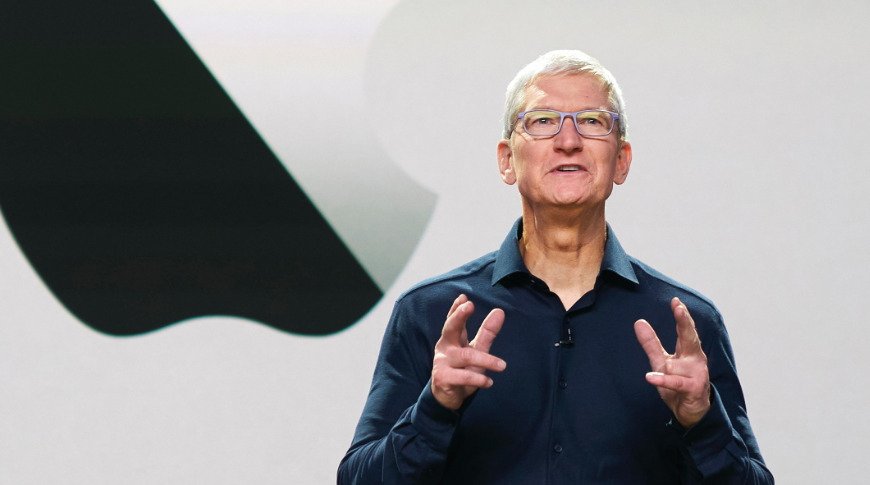
Tim Cook speaking during an Apple event.
Cook's legacy is one where the company took what it knew and refined its processes. To not be afraid to acquire and invest in the future of the company's growth. To be more outspoken about things that affect the world.
Though Jobs's legacy will be what people will look towards when considering Apple as a company, Cook will still serve as an example of how a CEO can inherit a great company and act as a force multiplier, both in terms of finances and in its impact on the planet.
John Ternus has big shoes to fill. And Tim Cook will still be on the board of directors to lend a guiding hand when needed.